What Is a Komainu? Japan's Shrine Guardian Pair
Komainu are the paired guardian statues that stand at the entrance to Japanese Shinto shrines, and often at Buddhist temples too. English guides call them lion-dogs. One figure has its mouth open, the other closed. Together they are meant to drive off evil and mark where sacred ground begins.
What it is
A komainu pair flanks a gate, an approach path, or the inner precinct. Strictly speaking the two animals are not the same. The open-mouthed figure is a lion, called shishi or karashishi (Chinese lion). The closed-mouthed figure is the lion-dog proper, komainu, which in older examples carries a single horn. In everyday use both are simply called komainu.
The open and closed mouths form a pair called a-un (阿吽), the first and last sounds of the Sanskrit alphabet. The open mouth voices "a", the closed mouth "un", and together they stand for beginning and end, much like alpha and omega. The same device appears on the Niō, the muscular guardian kings at Buddhist temple gates, and komainu almost certainly borrowed it from them.
Origins and history
The guardian lion is not native to Japan. The lion as a symbol of power travelled from India, where it tops a column of King Ashoka in the 3rd century BCE, along the Silk Road into China, where it became the stylised "Chinese lion". From China the type passed through Korea and reached Japan with Buddhism in the 6th century, arriving as the pair of lions set before an altar. The name komainu means "Goguryeo dog", from Koma (高麗), the Japanese term for a Korean kingdom, a memory of that route.
During the Nara period (710–794) the pair was still two lions, made of wood and kept indoors. The split came in the Heian period (794–1185), when one figure kept its open lion mouth and the other closed its mouth, grew a horn, and became the dog-like komainu. The Kyoto National Museum dates this pairing of one lion and one lion-dog to the Heian period and notes that the figures stayed indoors, under the roofs of gates and halls, through the Heian and Kamakura eras.
Stone pairs in the open air, the kind most visitors picture, came later. As guardians moved outside to face the weather they began to be carved in stone rather than wood, a shift that spread from around the 14th century onward. Many of the stone pairs along a shrine approach today are far younger than the custom itself.
Role at shrines
Komainu are apotropaic: their job is to repel harm. They face outward, toward the profane world, not inward toward the kami. The bared teeth and heavy muscle are meant to frighten off hostile spirits before they reach the main sanctuary.
At Inari shrines the guardians are kitsune foxes instead, a separate cult with its own meaning. For most other shrines, the komainu pair remains the default.
The lion that lost its horn
The single horn is the clearest sign of how the type drifted over time. Early lion-dogs wore it; by the Kamakura period the horned beast was already giving way to a hornless version, and in art from the Edo period onward the horn rarely appears. Pairs made from the Shōwa era on usually have no horn at all, which by the strict definition makes them two lions rather than a lion and a lion-dog.
Even the placement is not fixed. Most museum pairs put the open-mouthed lion on the right as you face them and the closed-mouthed komainu on the left, but the convention is not universal and some sources and shrines reverse it. It is safer to read the pair by its mouths than by its sides.
A pair you can still see
The Metropolitan Museum holds a wooden pair that shows the indoor guardian at its peak. Carved in the mid-13th century, during the Kamakura period, the two lion-dogs are made of Japanese cypress with lacquer, gold leaf, and colour, and stand about 43 and 46 cm tall. They were never meant for a windswept approach. Figures like these sat inside, under a gate roof or before an altar, which is why they survive in painted wood rather than weathered stone.
Older wooden examples are documented too, such as the painted pair at Yakushi-ji in Nara and the lacquered figures at Itsukushima in Hiroshima, while the JAANUS art-history dictionary records stone guardians by a 12th-century Chinese sculptor inside the south gate of Tōdaiji.
In your scene
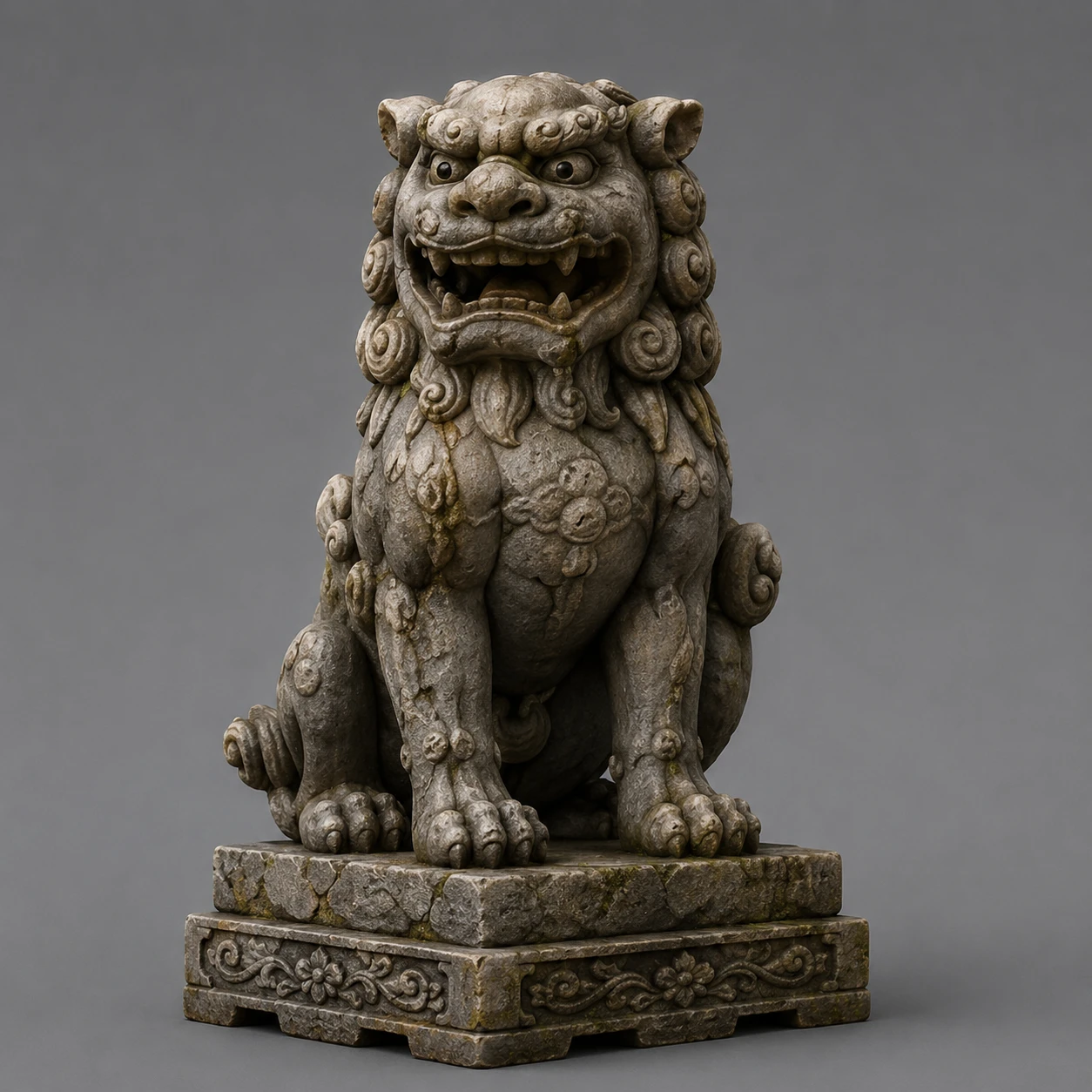
Place the pair symmetrically beside a torii or a stone stair, open mouth on one side and closed on the other, scaled to about human height. Our Shinto Shrine Relics pack includes komainu models sized for a shrine approach.