What Is a Kitsune? Japan's Fox of Shrine and Story
Kitsune is the Japanese word for fox, but in religion and folklore it means more than the animal. At Inari shrines across Japan, seated fox statues stand where other shrines place komainu lion-dogs. In older stories the same creature shape-shifts, tricks humans, or grows nine tails as it ages.
What it is
In everyday speech kitsune simply names the red or grey fox native to Japan. In Shinto practice at Inari shrines, the fox is Inari's messenger and guardian. Stone or ceramic statues show it seated upright, often wearing a red bib called a yodarekake and holding a key, a jewel, or a rice sheaf in the mouth or paws. The key usually stands for access to the granary.
Folklore adds a second kitsune apart from the shrine guardian. These are yōkai, supernatural foxes with magic that strengthens as they age. Stories divide them roughly into zenko, benevolent foxes linked to Inari, and nogitsune, wild tricksters who deceive or possess humans. The borders blur in practice, but the seated shrine statue belongs to the Inari side of the tradition, not to the fox-wedding tales of the countryside.
Origins and history
Foxes and humans overlapped in rural Japan for centuries, which gave the animal a double reputation. Foxes hunted rats that damaged rice, yet they also raided hen houses. Britannica traces godlike foxes with magical powers in written sources to the 8th century CE, including the Nihon shoki chronicle. By the Edo period (1603–1868) trickster kitsune crowded popular literature, while Inari's fox messengers grew in prestige as the rice god's cult spread.
Inari worship itself is ancient. Legend places the first rites on Mount Inari in the 8th century, and the Fushimi Inari Taisha near Kyoto, the head shrine of the cult, was founded in 711 CE. When the shrine moved down the mountain to its present site in the 9th century, the fox had already become the god's emblem. Buddhist syncretism later linked Inari with Dakini riding a fox, a motif visible in medieval painting, but the outdoor stone fox at a village Inari shrine remained a Shinto fixture.
Role at Inari shrines
Inari is the kami of rice, harvest, and prosperity. World History Encyclopedia counts thousands of Inari shrines across Japan, from the great precinct at Fushimi to small roadside shelters. Where a general shrine might flank its entrance with komainu, an Inari shrine typically pairs stone foxes instead.
The statues are not Inari itself. They are messengers who carry prayers to the god and blessings back. Worshippers leave offerings such as inari-zushi, sweet rice wrapped in fried tofu, a food named for the shrines. Some sites cut a small hole in the precinct wall so a fox spirit can enter and leave easily. Red bibs tied on weathered stone foxes are renewed by visitors seeking luck.
From trickster tales to fixed guardians
Edo urban culture loved fox stories: weddings held in rain, foxfires on New Year's Eve, possessed women in kabuki and kyōgen plays. Those narratives fed the nogitsune image. Shrine sculpture moved the other way, freezing the fox into a readable type. Sit upright, face the visitor, emphasize ears and tail, add a bib for protection, put a key in the mouth to show guardianship of the harvest storehouse.
Materials vary by region and budget: granite, volcanic stone, ceramic, occasionally wood inside halls. Pairs are common, one fox with a key and one with a jewel, though local custom differs. Modern cast copies sit outside restaurants and businesses that invoke Inari's commerce aspect, so a fox on a city corner may be decades old or brand new while copying an older form.
A kitsune you can still see
Outdoor shrine foxes rarely enter museums because they stay in place for generations. A painted record of the living cult survives in the Metropolitan Museum. Utagawa Hiroshige's woodblock print New Year's Eve Foxfires at the Changing Tree, Ōji, dated around 1857, shows foxes gathering at an old hackberry tree before paying homage at Ōji Inari, the eastern headquarters of the cult. The museum's label notes kitsunebi, foxfires, that farmers counted as omens for the coming rice harvest. The sheet measures about 32.5 by 21.9 cm.
The print is not a statue. It documents the same belief system the stone guardians serve: foxes as Inari's agents moving between forest and shrine at ritual seasons. Hiroshige's foxes are wild messengers on the road. Your seated kitsune model condenses that role into a single watchful figure at the gate.
What archaeology and records show
No one date marks the first stone fox. Shrine inventories and local gazetteers mention fox sculptures from the medieval period onward, while folklore texts preserve older stories of possession and shape-shifting that may never have been carved in stone. Archaeology tells less than parish custom does here, because the objects stayed in use and were replaced when cracked or defaced.
What survives in quantity is variety: keyed foxes, jeweled foxes, foxes with sheaves, worn bibs in fading red, and paired guardians flanking a small honden on a mountainside. The type is recognizable across Japan even when surface detail differs.
In your scene
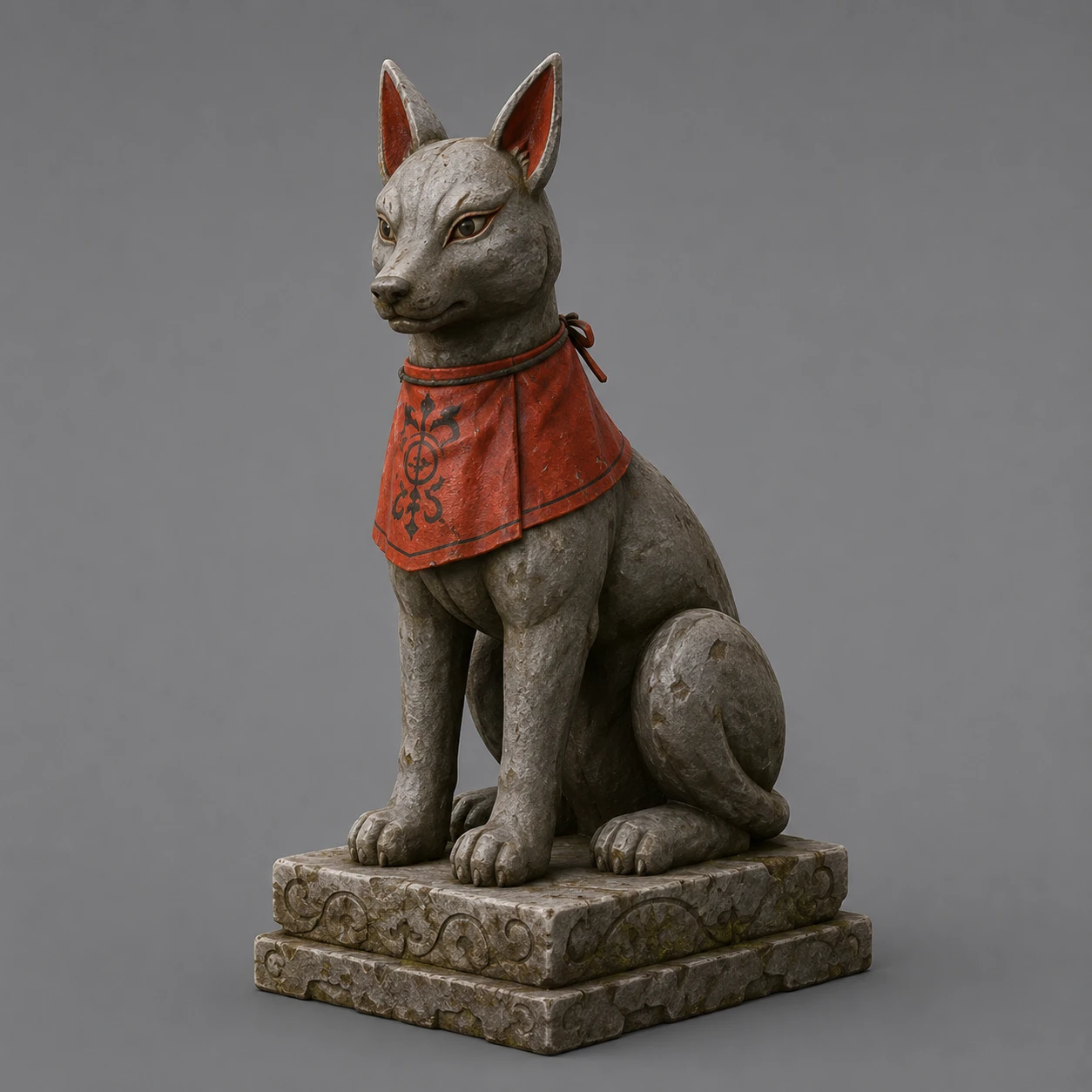
At an Inari-style entrance, pair seated foxes facing outward and swap komainu for them. A red bib and a granary key read instantly to players even at game scale. Our Shinto Shrine Relics pack includes a kitsune statue model sized for a shrine approach beside stone lanterns and bells.