Shrine Path Lights: Stone Lanterns from Heian to Tea Gardens
A Japanese stone lantern is a carved pedestal lamp called tōrō, or ishi-dōrō when the material is stone. You see them along shrine sandō paths, beside temple gates, and in tea gardens. The form is old, practical, and layered with Buddhist and Shinto meaning: light offered to a deity, light that guides a visitor through sacred ground after dark.
Tōrō, ishi-dōrō, and the seven stacked parts
Tōrō (灯籠) is the general word for a standing or hanging lantern. Ishi-dōrō (石灯籠) specifies stone. Most shrine and garden examples you picture are dai-dōrō, platform lanterns set on a base rather than hung from eaves. Tsuri-dōrō are the hanging bronze or wood types under corridor roofs.
A full standing stone lantern is built in stacked parts. The finial on top is the hōju, often shaped like a lotus bud. Below it sits the kasa, a curved roof or canopy that sheds rain from the fire box. The hibukuro is the hollow light chamber, pierced with windows called higuchi that may be round, square, or cut as sun and moon motifs. A shaft called sao rises from a lotus-like base stone, the kiso, sometimes set on an extra foundation block, the kidan. Styles vary, but the logic is the same: protect a small flame and let it breathe through fixed openings.
Granite is the usual stone for outdoor work because it weathers slowly. Bronze lanterns served the same job at richer temples. Paper and oil lamps inside were replaced over time, yet the stone shell outlasted centuries of donors and repairs.
From Buddhist temple paths to Shinto sandō
Stone lanterns entered Japan with Buddhism from China, likely by way of Korea, during the Asuka period (538 to 710 CE) or shortly after. At first they belonged to temple precincts, where they lined paths and counted as offerings of light to the Buddha. Britannica notes that some stone lanterns used at shrines are works of art in their own right, with a dedicator's name and year cut into the stone to carry faith forward.
Use at Shinto shrines and in private homes spread during the Heian period (794–1185), when Buddhist and kami worship overlapped more openly than they would later. Secular garden fashion came much later. Tea masters began placing temple-style lanterns in chanoyu gardens during the Momoyama period (1568 to 1603), and stonemasons in the Edo period (1603 to 1868) made smaller replicas for town houses. That late spread is why many people today meet stone lanterns in gardens before they notice them at shrines, even though the shrine path came first at major sites like Kasuga Taisha in Nara.
Offerings of light along the approach
Along a sandō, the main approach, lanterns mark sacred space the way komainu pairs mark the gate. They were lit so priests and pilgrims could walk safely at night, and the flame itself was an offering. Donors paid to install a lantern and often had their name, date, or prayer carved on the shaft or base, which turned a utilitarian lamp into a permanent record of devotion.
At Kasuga Taisha, stone lanterns also greet ancestral spirits. World History Encyclopedia describes the roughly 2,000 stone lanterns along the path as a traditional way to welcome the dead, donated by worshippers across centuries. Many carry deer motifs tied to the shrine's sacred messengers. The kasuga-dōrō style, with a tall round shaft, hexagonal fire box, and roof with upturned warabite corners, takes its name from this shrine even when copies appear elsewhere.
Shrine lanterns today are usually unlit except for festival nights. The twice-yearly Mantōrō at Kasuga, in February and August, still fills the forest approach with flame when all the donated lanterns are kindled at once.
Tea gardens, kasuga-dōrō, and named styles
The shift from votive lamp to design object happened in stages. Medieval temples kept large carved examples near halls and gates. When tea culture prized wabi and aged moss, gardeners partially hid lanterns among shrubs or trained a branch to cross the roof, softening the light. Edo-period urban gardens used smaller okigata types that sit directly on the ground without a tall shaft.
Naming follows prototype sites. Besides kasuga-dōrō, common labels include yukimi-dōrō, the broad-roofed snow-viewing lantern, and tōrō in the kotoji shape, balanced on two legs like a koto bridge. Not every lantern on a Kasuga approach is kasuga style; the shrine's own collection mixes periods and donors. What repeats is placement at bends, basins, and secondary torii, where light is actually needed.
Ungan-ji's Kamakura lantern at Kyoto National Museum
Museum yards often hold lanterns removed from temples or castles. The Kyoto National Museum displays a stone lantern in its West Garden that came from Ungan-ji Temple in Kyoto. It dates to the Kamakura period, 13th century, and shows the stacked-part form in weathered granite rather than as a drawing or replica.
Standing beside early stone buddhas and boundary markers in the same garden, this example reads as temple work from an age when stone carving flourished in Kyoto. It lacks the donor inscriptions and deer relief you meet at Kasuga, but it makes the physical scale clear: a human-height shaft, a fire box you could reach with a ladder, and a heavy roof meant to shed rain for decades. That is the object type Wildform's model echoes, simplified for real-time use.
Two thousand lanterns at Kasuga and what survives in stone
Stone survives where paper streamers and wooden gate lanterns do not. Counts therefore skew toward famous accumulations. Kasuga Taisha holds the largest preserved group in Japan, with sources commonly citing about 2,000 stone and about 1,000 bronze hanging lanterns across the precinct. Individual examples elsewhere range from Nara-period temple pieces to Edo merchant donations.
Scholars disagree on the oldest extant stone lantern in Japan; some point to early temple examples from the Asuka or Nara period, while shrine officers note that many dated stones at Kasuga belong to later medieval and early modern gifts. Safer to say the form is continuous from the first temple imports through Heian shrine adoption and Edo mass donation, rather than to pin one birth year on the type.
Painted screens prove how familiar the silhouette became. The Kyoto National Museum also holds Itō Jakuchū's 18th-century folding screens titled Stone Lanterns, which treat rows of lanterns along a fence as worthy subject matter in their own right.
In your scene
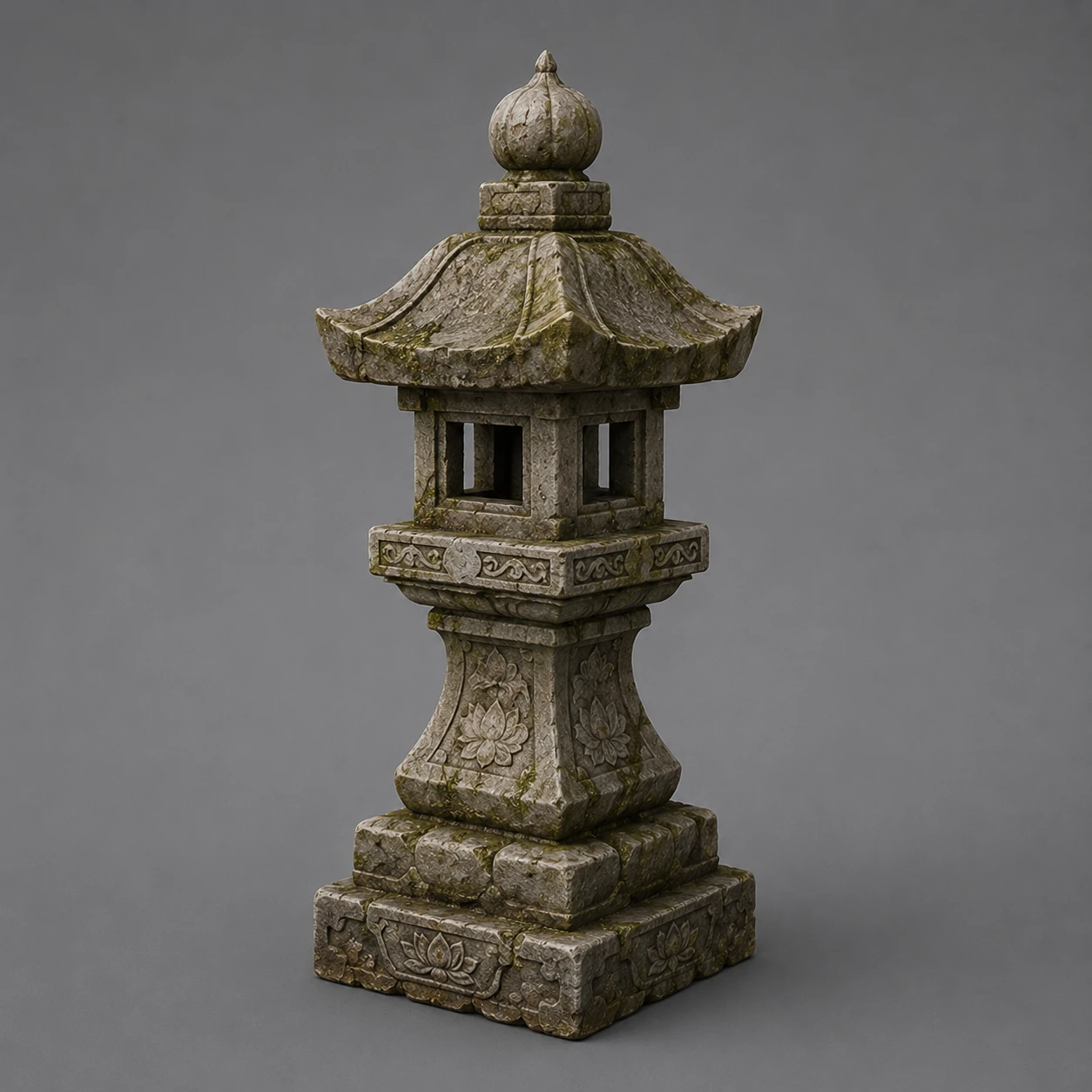
Line one or two lanterns along a gravel path between torii and the main hall, staggered rather than in a rigid grid. Scale them to waist or chest height on the shaft and leave room for moss and uneven ground. Our Shinto Shrine Relics pack includes a stone lantern sized for a shrine approach beside komainu and a shrine bell.