What Is a Shrine Bell? Japan's Suzu for Worship and Kagura
A shrine bell in Japan is usually a suzu, a hollow crotal bell with a pellet inside that rings when shaken. You meet the large type above the offering box at a Shinto shrine, where worshippers pull a rope to announce their visit to the kami. Priests and shrine maidens carry smaller suzu clusters during kagura, the sacred music and dance performed for the gods. The sound is not decorative. It purifies the space, drives off pollution, and signals that a human has entered sacred ground.
What it is
Suzu (鈴) means bell in Japanese, but in shrine speech it almost always means a small pellet bell, not the great bronze kane heard at Buddhist temples. The Metropolitan Museum of Art describes two Shinto forms. One is a single large crotal bell, shaped like a sleigh bell with a slit on one side, often hung from a beam in front of the worship hall. The other is a handheld bell tree called kagura suzu, with many small crotal bells strung in tiers on a spiraling wire around a wooden handle.
Both types are idiophones: the metal shell and enclosed pellet make the tone without a separate striker. Cast or hammered bronze is common, though omamori charms may use tiny brass copies. The large hanging bell visitors ring is typically one heavy crotal bell on a thick cord. Kagura suzu gathers a dozen or more miniature bells into one staff so a miko dancer can shake a shower of sound during ritual dance. Britannica classifies these as pellet bells worn or shaken by ritual dancers for protective power, a pattern seen worldwide but especially visible in Shinto kagura.
Do not confuse suzu with bonshō, the suspended temple bells struck with a log at Buddhist sites. Our pack separates shrine bell from temple gong for that reason. A Shinto precinct may lack any bell at all; worshippers then clap twice to alert the kami instead.
Origins and history
Pellet bells rank among the earliest Japanese instruments named in court and shrine records. The Met notes that kagura, the umbrella term for Shinto instrumental music, song, and dance at shrines and court, entered the palace repertoire as early as 773 CE. By the Heian period (794–1185) the suzu bell tree was already treated as ancient equipment in those rites.
Britannica divides later kagura into mi-kagura for imperial palace grounds, o-kagura for major shrines, and sato-kagura for local parish shrines. The suzu appears in all three settings alongside flutes, zithers, and clappers. Meanwhile the single large crotal bell at the offering box grew into the standard visitor's greeting at countless haiden halls, though precise dates for that custom are harder to pin to a single edict. Edo-period guidebooks and woodblock prints already show the rope-hung bell as ordinary shrine furniture.
Role at shrines
World History Encyclopedia describes typical worship: after purification at the temizuya, a visitor offers a coin, rings a small bell or claps to alert the kami, bows, speaks a prayer, and claps again to close. The bell therefore sits at the threshold between everyday noise and addressed prayer. Its ring tells the deity that someone has arrived, and many shrine guides add that the tone clears stagnant ki, the ill fortune that clings to travelers.
Priests use suzu in ritual movement as well as miko dancers do. A quick shake can mark a purification beat before offerings are presented, echoing older practices of sounding bells to cleanse a performance area. The large public bell and the handheld kagura suzu share that logic even when their audiences differ. One speaks to every visitor; the other accompanies choreographed service for the kami alone.
From court kagura to the offering box
The handheld bell tree preserved elite ceremony. Twelve to fifteen crotal bells on three tiers let a dancer trace arcs of sound around a mikoshi procession or an inner sanctuary dance. The single hanging bell democratized the same signal. Parish shrines that could not field a full kagura troupe still hung one bronze crotal where the worshipper could reach it.
Over time the two forms drifted apart in daily life yet stayed linked in iconography. Prints of shrine maidens still show kagura suzu, while travel albums foreground the rope bell above the saisenbako offering box. Tiny suzu also appear on omamori amulets sold at shrine stalls, carrying the protective reputation of the full-sized instrument into pocket scale. Scholars treat these as one family of ritual sound, not three unrelated objects.
A shrine bell you can still see
The hanging bell above an offering box rarely enters a museum because it remains in use. A documented kagura suzu survives in New York. The Met holds object 89.4.94, a seventeenth-century suzu from Miwa in Soe County, Nara Prefecture, acquired with the Crosby Brown Collection of Musical Instruments in 1889. It stands 13 1/2 inches high with a 7 1/2 inch diameter (34.3 by 19 cm), built of wood and metal.
The staff carries twelve barrel-shaped crotal bells whose slits end in heart-shaped cutouts. A five-lobed hand guard with flower motifs and openwork hearts hides an inscription underneath. The text records that priestess Kuriyama Kamiko used the instrument for worship of Miwa Miyojin at Miwa and dates it to 1699. That level of detail is unusual. Most parish bells are anonymous bronze, but this piece proves how tightly a named shrine, a dated priestess, and a kagura implement could bind together in the early Edo period.
What archaeology and records show
Excavations seldom recover intact Edo shrine bells because bronze examples were recast or kept in service for centuries. Evidence instead comes from musical instrument catalogues, shrine inventories, and dated pieces like the Met suzu. Britannica treats the suzu bell tree as among the earliest-known Japanese instruments, which aligns with its constant presence in imperial and local kagura lists even when other instruments changed.
Regional workshops produced different slit patterns, pellet sizes, and guard shapes, so typology work is still active. Scholars hesitate to assign a single invention date to the public offering-box bell, since some shrines never adopted one and others added it long after founding. The sound's meaning is more stable than the chronology: alert the kami, purify the approach, open prayer.
In your scene
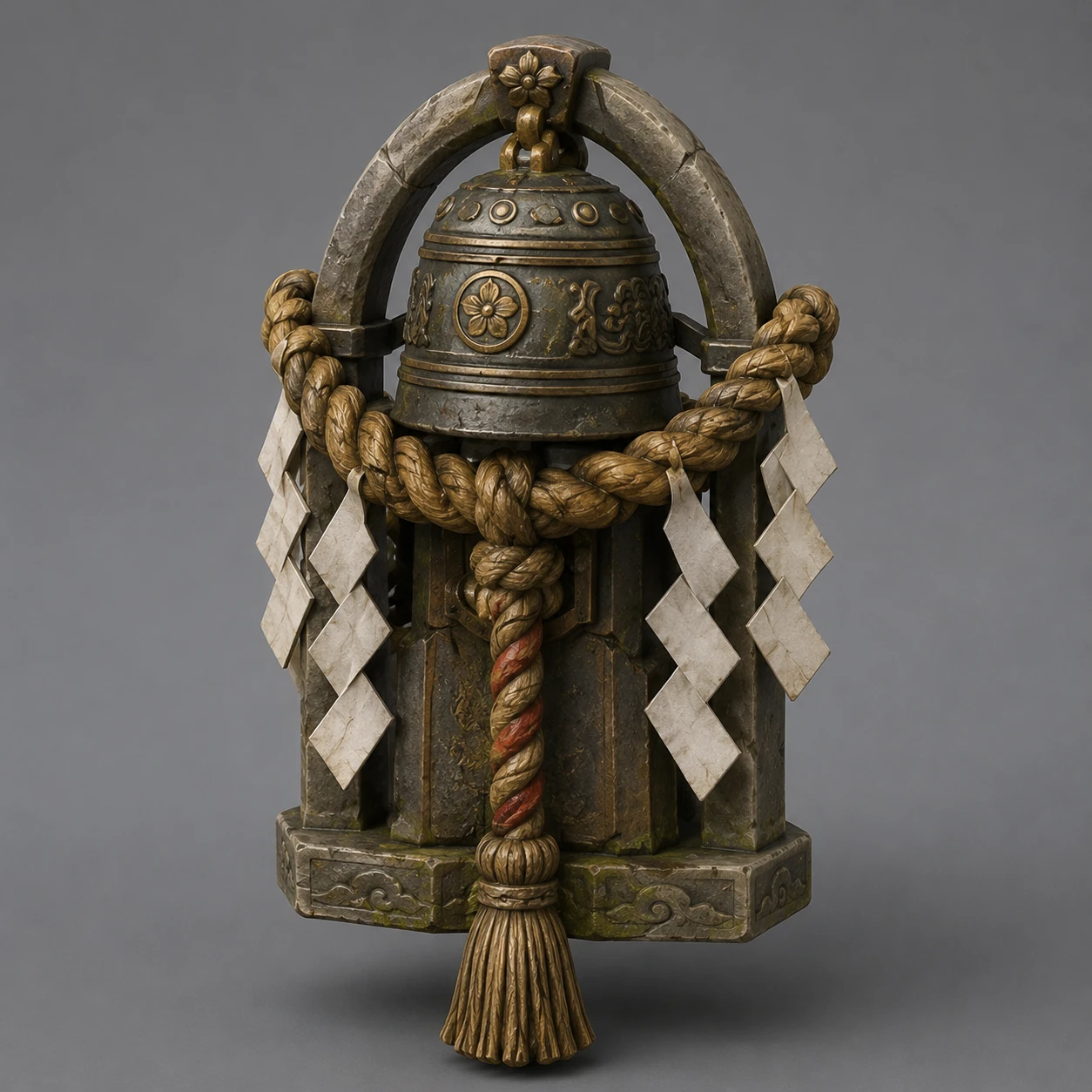
Hang a single large suzu above your shrine's offering box or place a kagura suzu in a miko's hand during festival animation. Pair the rope bell with a gohei on the torii and komainu flanking the path so the sound reads as Shinto rather than Buddhist temple ritual. Our Shinto Shrine Relics pack includes a shrine bell model sized for courtyard worship.