What Is a Gohei? Japan's Paper Streamer Ritual Wand
A gohei is the white paper wand you see at Japanese shrines, hung from a torii gate or held by a priest during ritual. It is a short wooden staff with two zigzag paper streamers called shide clipped to the top. In Shinto practice the form marks sacred ground, offers respect to a kami, and can stand in for the god's presence during worship.
What it is
Gohei (御幣), also called heisoku or onbe, is one type of heihaku, a ritual offering presented to kami. The core shape is simple: a staff called a heigushi, usually bamboo or plain wood, with a pair of shide attached so the cut paper falls in angular folds on both sides. Britannica describes the strips as paper or cloth folded so zigzag pleats hang to either side of the stick.
White paper is the everyday choice, but shrine stock also uses gold foil, silver foil, or five-color paper for festival or high-rank rites. The number of folds, the cut pattern, and the material distinguish regional and ceremonial styles. Do not confuse the handheld gohei with the larger ōnusa, a longer wand carrying many shide used in sweeping purification, or with the haraegushi, another purification wand whose strips are often linen or paper and are waved slowly so they rustle. A gohei carries only the twin shide pair.
Origins and history
The wand grew out of cloth offerings, not paper. In early Shinto practice precious textiles were clipped to a wooden staff and presented to a kami as heihaku. Over time rectangular paper replaced cloth for many shrines, and the cut streamers developed into the shide shape seen today. The same object class once matched offerings called mitegura, but the word gohei narrowed to this staff-and-streamer form.
Written ritual codes of the ritsuryō state, including lists of heihaku in the Engishiki, treat cloth, weapons, and sake among items offered to major shrines. That framework helps explain why a paper wand still counts as an offering before it counts as a tool. By the medieval period gohei stood inside the sanctuary as well as at the gate, and priests treated some examples as yorishiro, objects where a kami could dwell, or even as a shintai, a physical seat of the spirit.
Role at shrines
Shrine priests (kannushi) and shrine maidens (miko) use gohei to purify people, offerings, and ground before a festival begins. Britannica notes that the wand can signal that a kami is present and attentive during rites. In that sense it works like a portable mark of holiness moved through space rather than fixed in the inner hall.
You also meet gohei where no priest is holding them. World History Encyclopedia describes torii gates festooned with twin paper or cloth strips, each ripped in four places, to show the kami's presence at the threshold. The same streamer logic appears on shimenawa ropes that cordon off sacred trees or rock outcrops. At a roadside shrine a single gohei tied to the lintel can mark the whole plot as divine ground without a full precinct wall.
Home kamidana altars sometimes hold a small gohei beside the mirror or tablet that honors household ancestors. The scale shrinks, but the job is the same: mark purity and invite the kami to attend.
From cloth offering to paper wand
Material change tracks broader shrine history. Cloth heihaku belonged to state-sponsored offerings distributed to major shrines on the ritual calendar. Paper copies made the form cheap enough for village shrines and seasonal replacement. Outdoor display meant streamers weathered and were renewed, which is why fresh white paper on an old wooden staff is a normal sight rather than a sign of neglect.
Color followed function. Plain white served daily worship. Gold and silver paper signaled higher rank or New Year rites. Five-color paper linked the wand to broader Chinese-influenced cosmology without replacing the simple white pair most visitors recognize. Even today, mass-produced paper shide kits supply festivals, while hand-cut streamers still appear at local matsuri where the parish replaces gate decorations each year.
A gohei you can still see
Working shrine wands rarely enter museum collections because they stay in ritual use and are replaced when worn. A durable image of the form survives in arms and armour. The Metropolitan Museum holds a helmet crest, or maidate, made in the shape of a gohei. Dated to the 18th to 19th century, the crest is Japanese work in wood, copper, gold, lacquer, pigments, silver, and textile, bequeathed by George C. Stone in 1935 and catalogued as object 36.25.240.
The museum label explains that the traditional gohei is a staff with pleated paper or cloth streamers used to purify worshippers and offerings, to draw a god's attention at the start of worship, and to represent divine power during the rite. The samurai crest borrows that sacred silhouette for the battlefield helmet. It is not a priest's tool, but it proves how widely the twin-streamer profile was read as Shinto symbolism by the Edo period.
What archaeology and records show
Paper streamers do not survive centuries in the open air, so archaeology rarely produces intact historic gohei. Evidence comes instead from shrine inventories, festival accounts, and the durable arts that quote the shape. Armour crests, woodblock prints of shrine gateways, and metal fittings on ritual stands all show the same zigzag pair.
What does survive in quantity is variation at the gate. Some torii carry metal gohei strips rather than paper. Some precincts hang shide from shimenawa without a full staff. The family of forms is stable even when the material differs. Scholars describe the type as one branch of heihaku rather than a single frozen design, which matches what you see walking a shrine approach today.
In your scene
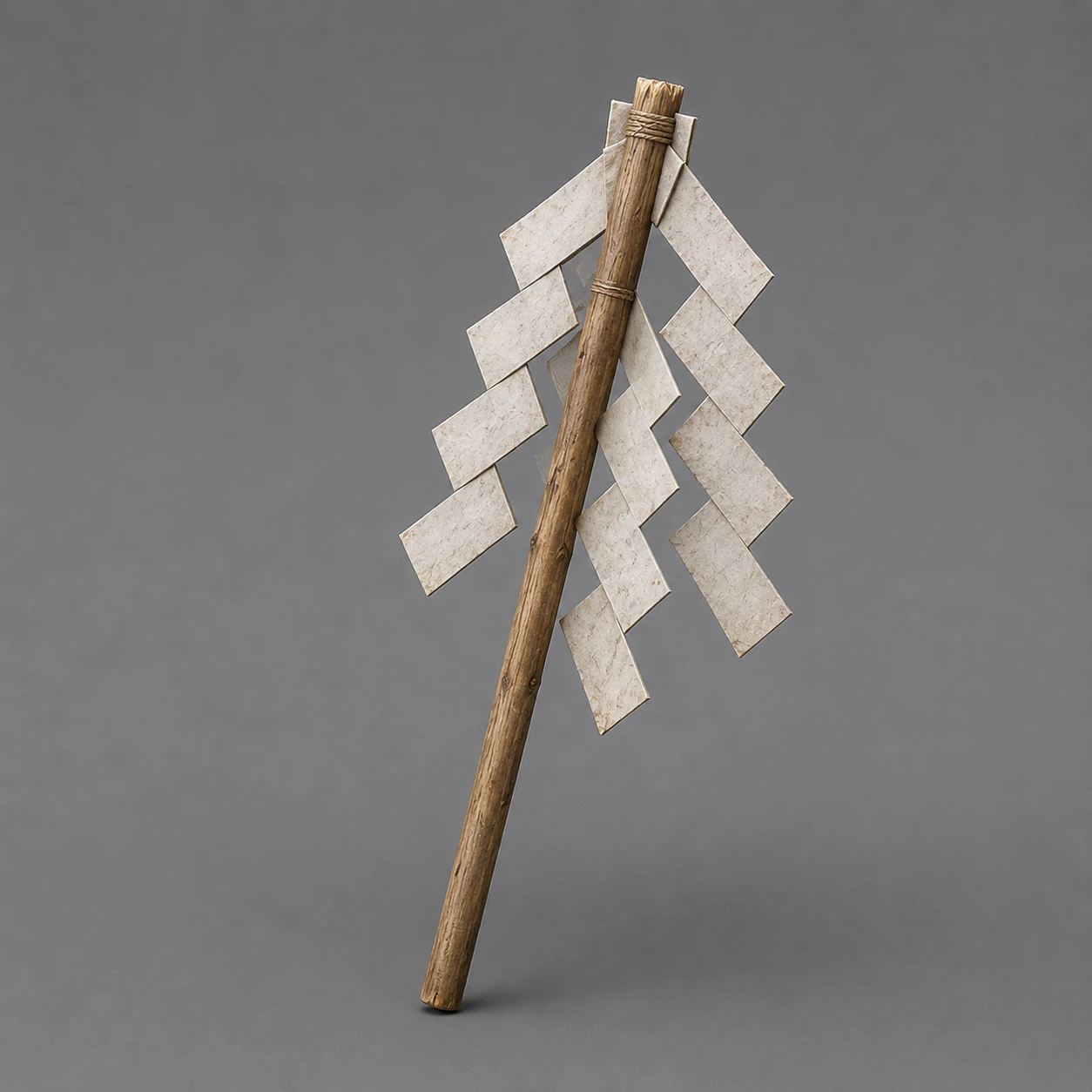
Place a gohei on a torii crossbar, beside a komainu pair, or in a priest's hand at festival scale. White zigzag streamers read as sacred markup even when the rest of the set is stone and wood. Our Shinto Shrine Relics pack includes a gohei wand model sized for shrine gates and courtyard rituals.