Rowing the Longship: Oars, Crew, and Fjord Speed
A Viking ship oar was a long wooden lever that turned muscle into motion when wind failed or when a crew needed tight control in a fjord. On a typical longship, oars worked alongside a single square sail: rowers could drive the hull up a river, hold position beside a beach, or sprint away from a raid while the mast lay lowered. The oar itself was usually pine, lighter than oak hull planks, with a broad blade at one end and a handle the rower gripped through the stroke.
Pine loom, blade, and the oar-port rowlock
Norse shipwrights called the oar ár in Old Norse, and the opening in the strake a habora (oar hole). Each oar passed through that port and rested on the gunwale or a simple lock, pivoting as the rower pushed and recovered. Archaeological oars from Gokstad and related finds are far longer than everyday boat paddles on the largest craft, with blades a few inches wide and looms that taper toward the grip.
Unlike a Roman galley with fixed rowing benches bolted to the frame, many Viking Age warships left the interior open. Rowers often sat on sea chests that doubled as storage for food, tools, and personal gear. When the crew switched to sail, those chests could be stowed and the oarports sealed on some later hulls, which kept following seas from swamping the bilge.
From paddle canoes to sail-and-oar hulls
Scandinavian boatbuilding did not begin with dragon-headed raids. Stone carvings show vessels by the third millennium BCE, and the Nydam boats of about 350 CE already used oars with clinker-built planks riveted in iron. Sails returned to northern waters toward the end of the 7th century CE, probably through trade contact with peoples who had long relied on woven cloth for propulsion.
Once sail and oar shared the same hull, ship types diverged. Broad karfi and knarr types could cross open water with fewer oar stations, while slender longships kept long rows of ports for speed and maneuver. World History Encyclopedia notes that by the 10th century CE specialised warships grew longer and narrower, using both oars and sails for the hit-and-run tactics that made Viking raids so hard to intercept.
Rowing for raids, rivers, and beach landings
Britannica's longship entry describes the type as a sail-and-oar vessel, clinker-built, ranging from about 14 to 23 metres, with a shallow draft that let crews beach on shelving shorelines. Oars made that flexibility possible. A square sail needs room to run before the wind; oars let a ship creep along a lee shore, thread a river mouth, or leave a landing ground before defenders could muster.
Medieval writers also describe steering with a large rudder oar fixed to the starboard quarter, the side that gives English its word "starboard." The helmsman worked that blade while rowers adjusted pace to his calls. Saga poetry and later law codes assume that free men learned to row young, because coastal travel was faster by water than by foot through forested headlands.
Crew benches, chests, and who pulled the stroke
Ship size in Old Norse texts is often counted in rúm, spaces for pairs of rowers, one on port and one on starboard. A karfi might carry roughly 13 to 16 pairs, while saga longships could exceed 30 pairs plus extra warriors who did not row. The Gokstad ship, buried around 900 CE, has 16 oar holes per side; the slightly earlier Oseberg ship has 15 per side, enough for 30 rowers plus a helmsman and a lookout at the bow.
Not every person aboard pulled an oar on every voyage. Traders and settlers on knarr cargo ships relied more on sail and a smaller crew. Even on warships, warriors could rest between bursts of rowing while the sail carried them. The rhythm mattered as much as raw strength: a missed stroke on a narrow longship could throw off the whole line.
The Oseberg oars in Oslo today
The best-preserved Viking oars come from the Oseberg burial, discovered in 1903 near Tønsberg and now displayed with the ship in Oslo. Britannica dates the hull to about 820 CE and notes pine oars with traces of painted decoration. Crucially, the blades show little wear, which suggests they were made for the 834 CE funeral rather than for years of hard service at sea.
Standing beside the ship clarifies scale. Fifteen ports per side sit in a hull about 22 metres long and 5 metres wide. Fully rowed, the vessel could reach speeds up to about 10 knots in favourable conditions, according to the same museum summaries. The oars therefore belong to the same status display as the carved prow and the rich textiles in the mound: they prove the dead women could command a crew, even if these particular blades never touched open water.
What survives in mud and what we still guess
Wood rots quickly outside anaerobic burials, so complete oars are rare. Most knowledge comes from a handful of ship graves, depictions on stones and tapestries, and iron rivets that outline lost hulls. Scholars still debate how often crews rowed versus sailed on long crossings, and whether every oar hole implies a full complement or a smaller crew skipping stations.
Experimental replicas such as the modern Saga Oseberg have shown the burial ship could sail, which keeps rowing speeds and techniques partly reconstructed rather than measured. New finds under Norwegian farmland continue to add hull outlines, but oar fragments remain precious. Treat any single number of rowers in art or games as an ideal fully manned deck, not the everyday reality of coastal ferry work.
In your scene
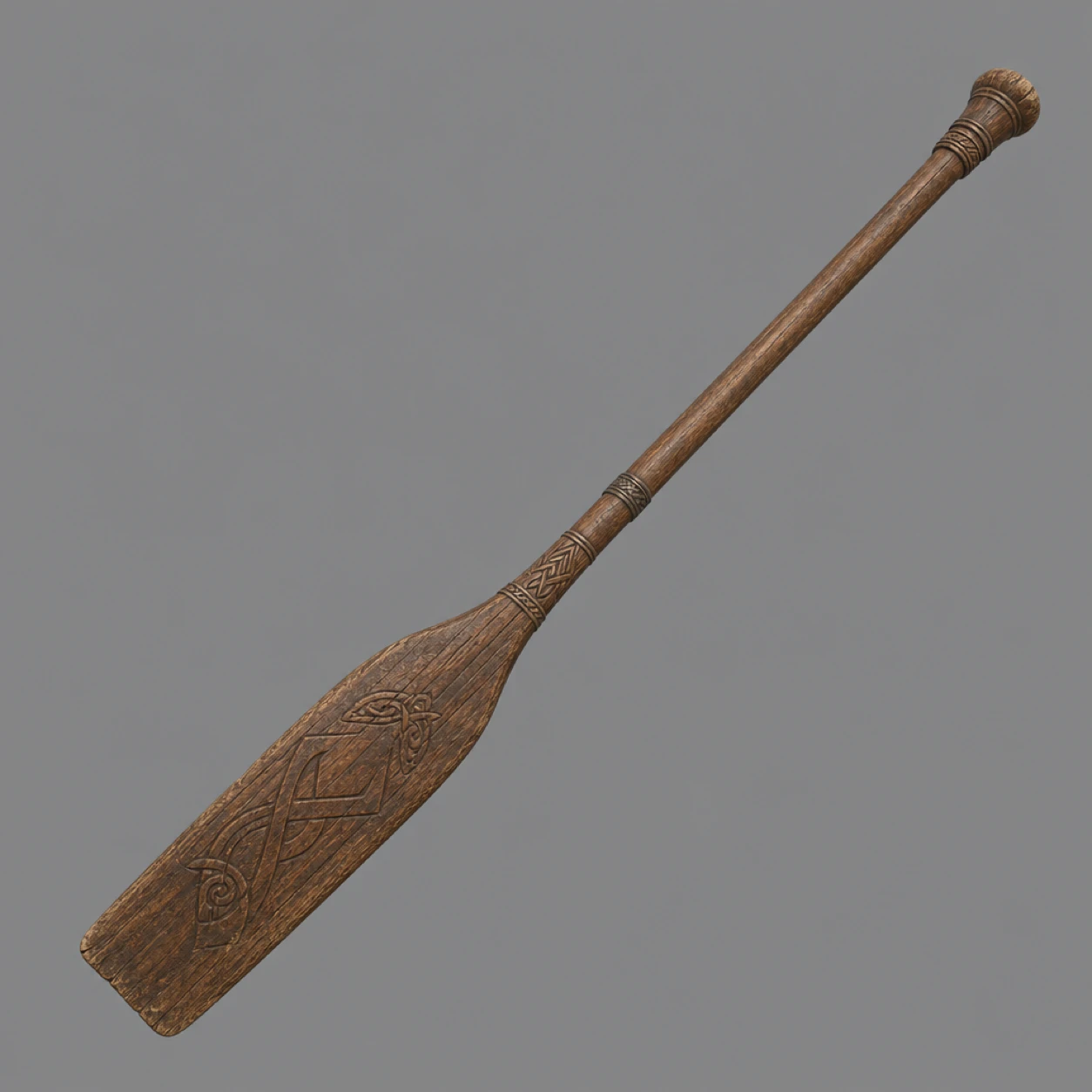
Lean oars against a longship rail or stash them in a boathouse beside a funeral ship mound to signal a crew-ready Norse coast. Pair a rack of blades with shields along the gunwale for a raid staging beach. Our Viking Hall Relics Vol. 2 pack includes a ship oar scaled for hall interiors, workshops, and fjord camps.