Hannya: Horns and Gold Eyes on the Noh Stage
A Hannya mask is a carved wooden face used in Japanese Noh theatre to play a woman consumed by jealousy until she becomes a vengeful spirit. Two sharp horns rise from the brow, the eyes are often gilt, and the mouth opens in a fixed grimace. The name is written 般若. On stage the mask is sacred equipment, not a Halloween prop: it lets a male actor in the shite role become Lady Rokujō or another onryō without speaking most of his lines aloud.
Hannya, jya masks, and the namanari before
Noh today has more than 250 mask types, grouped by age, gender, god, warrior, and demon. World History Encyclopedia notes that only the shite, waki, and tsure principals wear masks; the chorus and musicians do not. Hannya belongs to the jya (蛇, snake) family that charts a woman's slide from human resentment into demonic fury.
Below Hannya sits namanari (生成), a mask with short horns for a spirit still partly attached to earthly love. Above it lie sharper snake masks called shinjya (真蛇) with protruding tongues for the most possessed moments. Hannya itself, also called chūnari (中成), is the standard demonic woman: horns, metallic eyes, disheveled hair, and a mouth that cannot close. Carvers build horns separately and peg them into the forehead after the main block is hollowed from hinoki cypress.
Do not confuse Hannya with oni masks from festival floats or with the fox-faced kitsune of folk lore. Our pack places Hannya beside shrine props because Noh grew from sarugaku performances at temples and shrines, and some kagura dances still borrow Noh masks for spirit roles.
From sarugaku records to a named type
Noh crystallized in the 14th century CE when Kan'ami (1333–1384) and his son Zeami (1363–1443) shaped sarugaku into a warrior-class art. Britannica traces the form to shrine and temple festival drama by the 12th or 13th century and places its mature masks in the Muromachi period (1338–1573).
Early written lists of Noh masks name only a dozen or so types and never the word hannya, yet they already record the play Aoi no Ue, where a jealous noble woman's spirit attacks a rival. Scholars think snake-like demoness masks of that story were ancestors of the Hannya we know. The label hannya seems to have settled in the late 16th century, when actor-monks such as Shimozuma Chūkō wrote about mask names in performance notes. One folk etymology links the word to Hannya-bō, a carver-monk of the 1460s; another to a line about the Heart Sutra in Aoi no Ue. Both stories may be later glosses. The written characters 般若 transcribe Sanskrit prajñā, wisdom, which is why the demon's mask borrows a Buddhist term for insight.
Jealous spirits in Aoi no Ue and Dōjōji
Hannya appears most famously in demon plays (kiri or kichiku), the fifth category in a full Noh program. World History Encyclopedia lists demon plays last in a five-play day, after god, warrior, and woman pieces.
In Aoi no Ue the shite first appears as a court lady, then returns masked as Hannya to torment the pregnant Lady Aoi. The white mask marks Rokujō's high rank; the horns and gilt eyes mark her rage. In Dōjōji the rejected Kiyo-hime becomes a serpent; companies may use a red Hannya or the longer-tongued shinjya when she breaks into the temple bell. Momijigari and Kurozuka use darker reds when a noblewoman or spinning crone is revealed as a man-eating demon. The plots differ, but the mask always signals a woman whose attachment turned destructive.
White, red, and the tilt that changes the face
Paint color encodes class and stage of transformation. A white Hannya suggests an aristocrat like Rokujō. Red marks a commoner or a hotter, less restrained spirit, as in many Dōjōji stagings. Deep red-brown appears when the demon is fully revealed after posing as human.
The carving is only half the expression. Noh acting tilts the mask: chin down and the brows read as grief; level gaze and the same face snarls. Britannica describes Noh masks as wood coated for a restrained realism that lets subtle angles carry feeling. Gold leaf on eyes and teeth, gofun chalk ground, and furubi staining build the weathered skin. A finished mask may take weeks of carving, gesso layers, and hair-by-hair painting.
A demoness Hannya in the Met collection
Stage masks rarely travel, but museums hold studies and heirloom pieces. The Metropolitan Museum of Art owns object 29.100.444, titled Noh Mask of a Demoness (Hannya), in the style of Ogawa Haritsu (Ritsuō, 1663–1747). It is an 18th-century Edo work: color on papier-mâché in relief, mounted as a circular painting 10 3/4 inches across (27.3 cm). It is not a performance mask, but it fixes the Hannya silhouette, horn curve, and open mouth the way ukiyo-e painters and lacquer artists copied for inrō cases.
Wildform's model echoes that silhouette for real-time lighting: exaggerated horns and teeth read instantly on a shrine path or temple gate even when the polygon count stays low.
Hinoki, schools, and what survives in use
Carvers still split commissions among schools tied to shite lineages (Kanze, Hosho, Konparu, and others). A mask must fit one actor's face, balance on the nose, and leave a narrow eye slit. Because hinoki is light, a shite can wear it through a slow forty-minute play.
Museum collections preserve masterworks from the Edo period and copies made for export in the Meiji era. Many families handed masks down inside Noh troupes; others entered Western collections in the late 19th century when Japan opened its ports. Dating an unsigned Hannya often relies on carving style, peg holes for horns, and pigment recipes rather than a maker's stamp. What matters for readers is the cultural job: Hannya makes jealousy visible, lets a male actor embody a female ghost, and still startles audiences who never bought a theatre ticket.
In your scene
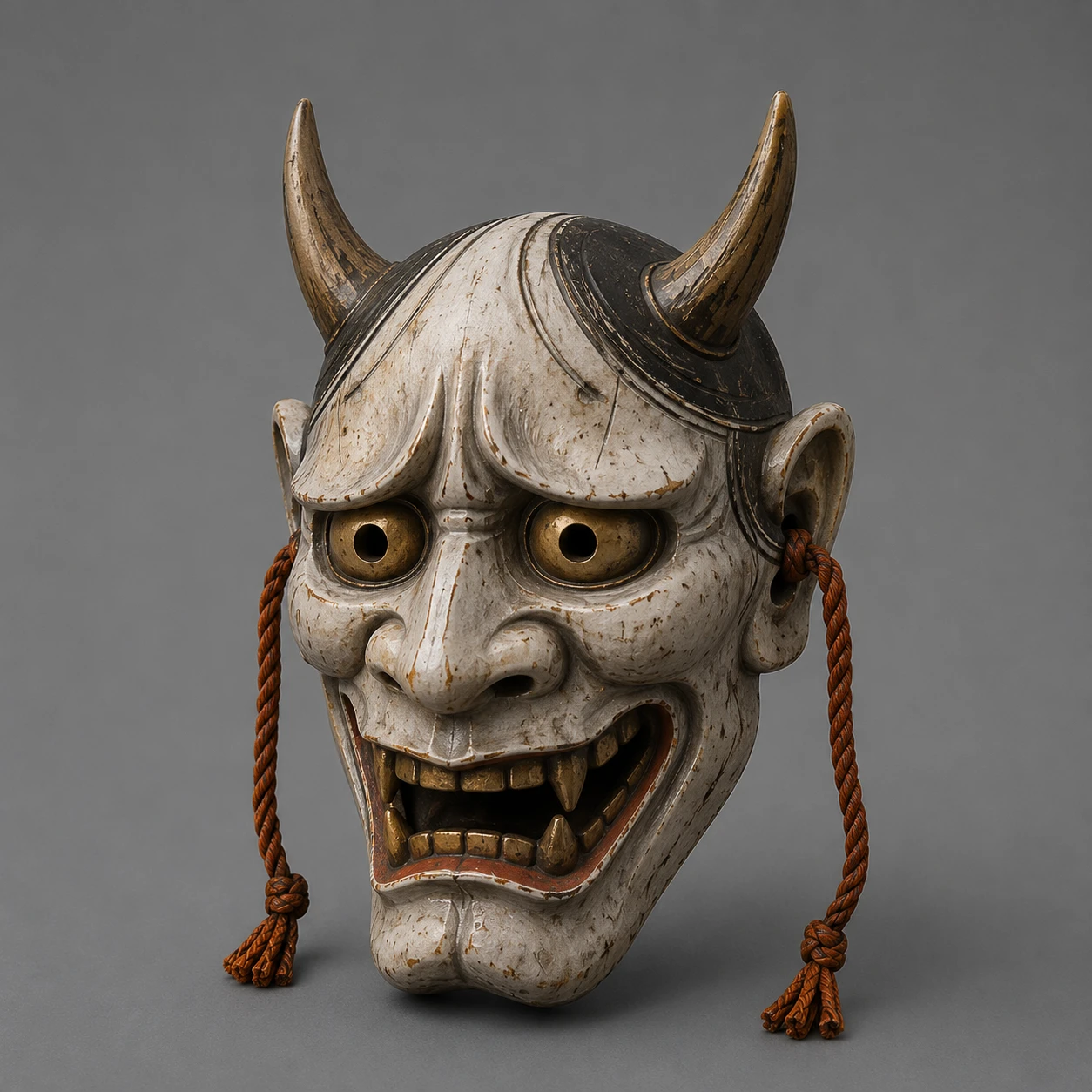
Hang a Hannya on a shrine wall or place it on a stand near a Noh-style stage as a warning spirit, not as casual set dressing. Pair it with a shrine bell if your scene hints at kagura, or a kitsune mask nearby to contrast fox possession with demonic jealousy. Our Shinto Shrine Relics pack includes a Hannya model sized for courtyard display.