Queen's Lyre: Bull-Headed Music from Ur's Royal Cemetery
When Leonard Woolley lifted the lid of Queen Puabi's burial chamber at Ur in the late 1920s, he found more than jewellery and cylinder seals. Lyres fronted by bull heads in precious materials lay among the grave goods. The wood had rotted in the earth, but the gold, shell, and lapis lazuli still held their places. One of those instruments, now called the Queen's Lyre, is the usual museum anchor for what people mean by a Sumerian bull lyre: a stringed instrument whose sound box forms the body of a bull and whose face stares out from the front in sheet gold and bright stone.
Gold mask, lapis beard, and a lyre shaped like a bull
A bull lyre is a Mesopotamian lyre, not a harp. The distinction matters for anyone placing it in a scene. On a lyre, two arms rise from the sound box and meet a crossbar that holds the upper ends of the strings. A harp carries its strings on a single curved arm. The Royal Cemetery examples at Ur all follow the lyre frame, with the resonating box shaped and decorated to read as a bull's torso and a naturalistic bull's head mounted at the front.
The Queen's Lyre bull mask is covered in gold. The British Museum names the eyes as lapis lazuli and shell, and the hair and beard as lapis lazuli. A broad panel below the head carries mosaic in shell, red limestone, and more lapis, set in bitumen. Fallow deer, lions, and plants appear in those inlays on related Ur lyres and match banquet and animal imagery common on Early Dynastic luxury goods. The horns on the display reconstruction are modern replacements. The ancient parts are the decorated head, the mosaic facing, and the inlays, not the wooden box you see today.
Woolley's Royal Cemetery and Puabi's tomb
Sir Leonard Woolley excavated the Royal Cemetery at Ur between 1922 and 1934 for the British Museum and the University of Pennsylvania. Among the richest finds was the tomb of Puabi, sometimes written Pu-abi or Shub-ad. Multiple lyres came from burials across that cemetery. The one known as the Queen's Lyre carries excavation number U.10412 and British Museum registration 1928,1010.1.a.
The cemetery dates to the Early Dynastic III period, around 2600 BC in the British Museum record and often about 2600 to 2400 BC in catalogues. Woolley's team also uncovered the Great Death Pit near Puabi's tomb. Those burials made Ur synonymous with Sumerian court splendour in the mid-third millennium BC.
Music at feasts, graves, and temple rites
Music mattered in Mesopotamian celebration and cult. Banquet scenes on contemporary art show seated figures with lyres while servers bring food and drink. In royal graves, an instrument could accompany the dead as a prestige object used in life rather than as a silent prop.
The most ornate Ur examples may have been ceremonial showpieces for court feasts and funeral rites, while simpler bull-headed lyres from the same cemetery could have been played in daily life.
From rotted wood to museum reconstruction
None of the Ur lyres survived as playable wooden instruments. When Woolley uncovered them, the timber had decayed and only the inlays, metal facing, and bull heads remained in position. He poured plaster into the cavities to capture the shape, a standard rescue method that preserved the outline when the wood failed. The Queen's Lyre on display is a reconstruction. The British Museum states plainly that the wooden parts, pegs, and strings are modern, while the gold bull head, lapis and shell features, and bitumen-set mosaic are ancient, apart from the horns.
The object has been rebuilt more than once. Heat in a gallery in July 1961 partially melted the field wax and loosened the beard; conservators rebuilt the piece again in 1971 to 1972. Treat the visible wooden body as a twentieth-century armature holding third-millennium decoration, not as timber from Puabi's reign.
The Queen's Lyre you can still study at the British Museum
The named anchor is the British Museum's Queen's Lyre, museum number 121198,a, online as object W_1928-1010-1-a. It stands about 112.5 centimetres high. Materials listed on the collection record include gold, shell, lapis lazuli, red limestone, bitumen, and modern wood. It was excavated at the Royal Cemetery of Ur in southern Iraq and entered the collection through the division of finds with Iraq's Department of Antiquities.
Do not confuse it with the other Ur lyres. The Golden Lyre went to the Iraq Museum in Baghdad after the division of finds. The British Museum also holds a silver lyre from the Great Death Pit. As of the museum's current online record, the Queen's Lyre is not on public display, though it remains in the collection.
What survives, what is restored, and what we cannot hear
Archaeology gives the bull lyre its face and its story, not its sound. Gut strings and wooden pegs do not survive in Mesopotamian soil the way gold and lapis do. Scholars still debate string count and how the animal panels relate to mythic themes such as Gilgamesh and the Bull of Heaven.
What is secure is the visual grammar: a bull's body as resonator, a precious head at the front, and a panel crowded with animals in shell and stone. That combination marks elite Sumerian taste at the Early Dynastic cemetery. The object biography is clearer than the acoustics: buried with a queen, lifted by Woolley, rebuilt for the museum, and still one of the most recognisable faces of ancient Mesopotamian music.
In your scene
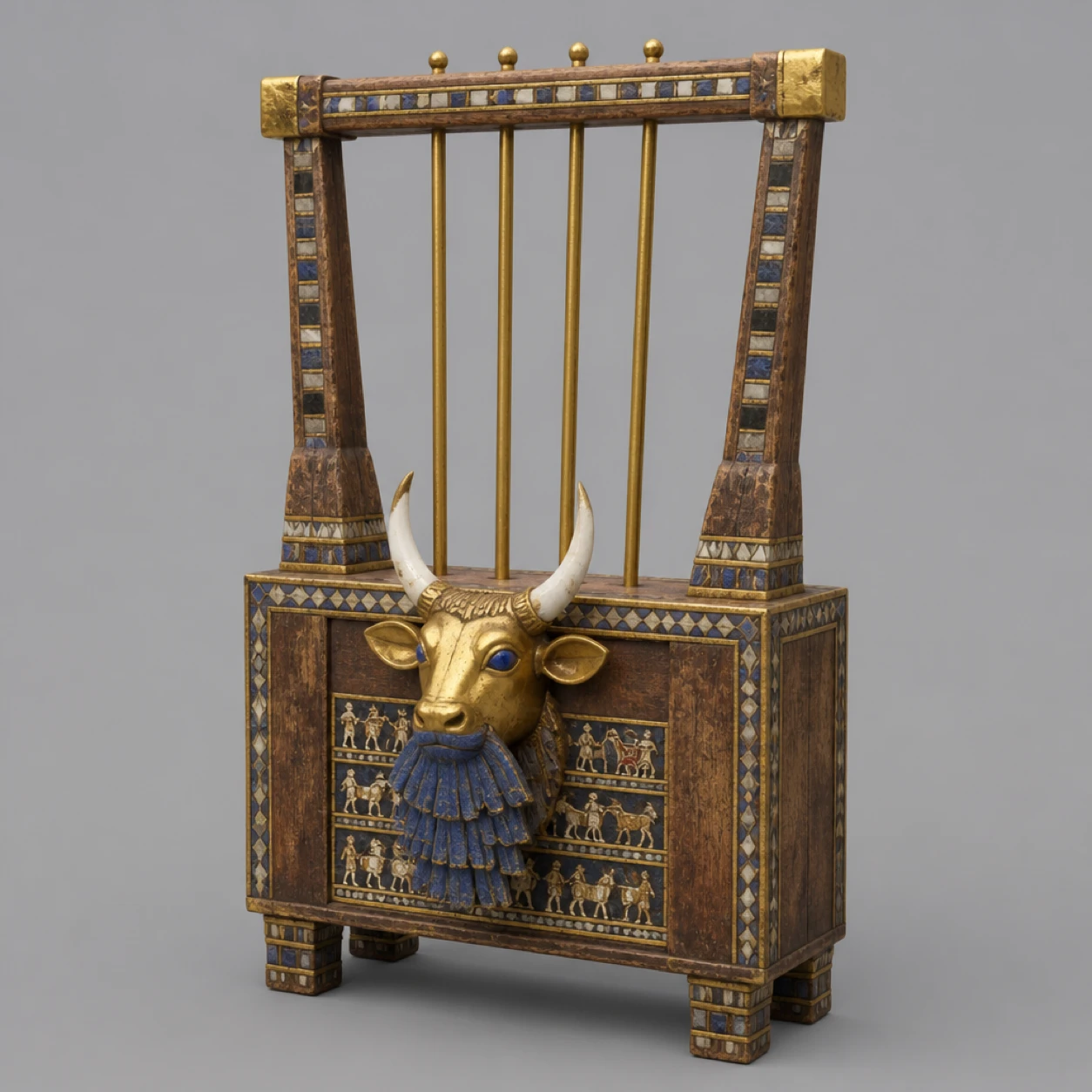
A bull lyre belongs with banquet furniture, temple musicians, or royal grave goods, not as a random tavern prop. Place the gold head forward, keep the mosaic panel visible, and remember the wooden box is a modern stand-in for lost timber. The Mesopotamian Temple Relics pack includes a bull lyre model sized for ziggurat courts and palace interiors.