What Is an Ushabti? Egypt's Answerer in the Tomb
An ushabti is a small mummy-shaped figure the ancient Egyptians placed in a tomb to work for the dead in the afterlife. When the gods called the deceased to dig, plant, or haul sand, the figure was meant to step forward and answer in their place. Egyptians also called them shabtis, and in earlier spellings, shawabtis.
What it is
An ushabti is a substitute worker. Most are mummiform: a wrapped body with crossed arms, usually holding a hoe, a pick, or a basket cord that marks the figure as a field hand. Many also carry the owner's name and titles next to a short spell.
The name is generally tied to the Egyptian word wsb, "to answer," which is why ushabti is often translated as "the answerer." An older reading links it instead to swb, a stick. The three spellings track time more than meaning: shabti and shawabti are the earlier forms, ushabti the later one that had become standard by the first millennium BCE.
Origins and history
The idea is older than the figures most people picture. A forerunner of the spell appears on Middle Kingdom coffins, related to Coffin Text Spell 472. By the New Kingdom the text was fixed as Chapter 6 of the Book of the Dead, the version cut into countless later figures.
Dates for the New Kingdom vary between scholars, from roughly 1570 to 1069 BCE in some references and about 1550 to 1070 BCE in others. The gap is a question of dynastic chronology, not of doubt that this is when the ushabti became standard burial equipment.
Role in burial belief
Egyptians pictured the afterlife as a better copy of life on earth, work included. The blessed dead were expected to dig irrigation channels, tend fields, and move sand in the realm of Osiris. The shabti spell hands that duty to the figure. It tells the ushabti that when the owner is called "to make arable the fields, to flood the banks, or to carry sand from east to west," it must answer, "Here I am."
That one line explains the tools. A figure holding a hoe is ready to till; one with a basket is ready to haul. The spell, not the carving, was thought to bring the worker to life.
From one figure to an army
Early New Kingdom burials might hold a single, carefully made figure. Over the centuries the custom grew until a wealthy tomb could hold hundreds. The ideal set settled at 401: 365 workers, one for each day of the year, supervised by 36 overseers, one for each ten-day week of the Egyptian calendar.
Overseers are easy to spot. They appear in the Third Intermediate Period (c. 1069–747 BCE) wearing the long kilt of a daily-life official and carrying a whip, their arms no longer crossed over the chest. Each overseer was meant to keep about ten workers in line, turning a box of figures into a small organised workforce.
A set you can still see
The Metropolitan Museum holds part of a real set that shows how the theory met practice. Around 400 shabtis were buried with a woman named Nauny at Deir el-Bahri early in the 21st Dynasty, about 1050 BCE. Of the figures recorded, 355 were workers and 37 were overseers, close to the ideal 365 and 36 but not an exact match. They were packed into seven boxes; five came to the Met and two went to Cairo.
This is also why ushabtis fill museum cases. Apart from scarabs, they are the most numerous objects to survive from ancient Egypt, made in such quantity that whole sets could be turned out from moulds.
What archaeology shows
Material and quality tracked the period and the owner's budget. New Kingdom figures are often wood or stone, though faience was used too, including for royalty: the Met's faience shabti of Ramesses VI (c. 1143–1136 BCE) shows the king holding two hoes, its cartouche altered in antiquity from an earlier ruler. From the 21st Dynasty onward, bright blue faience with black detail became the standard, and the best Late Period workshops produced the most refined figures of all.
In your scene
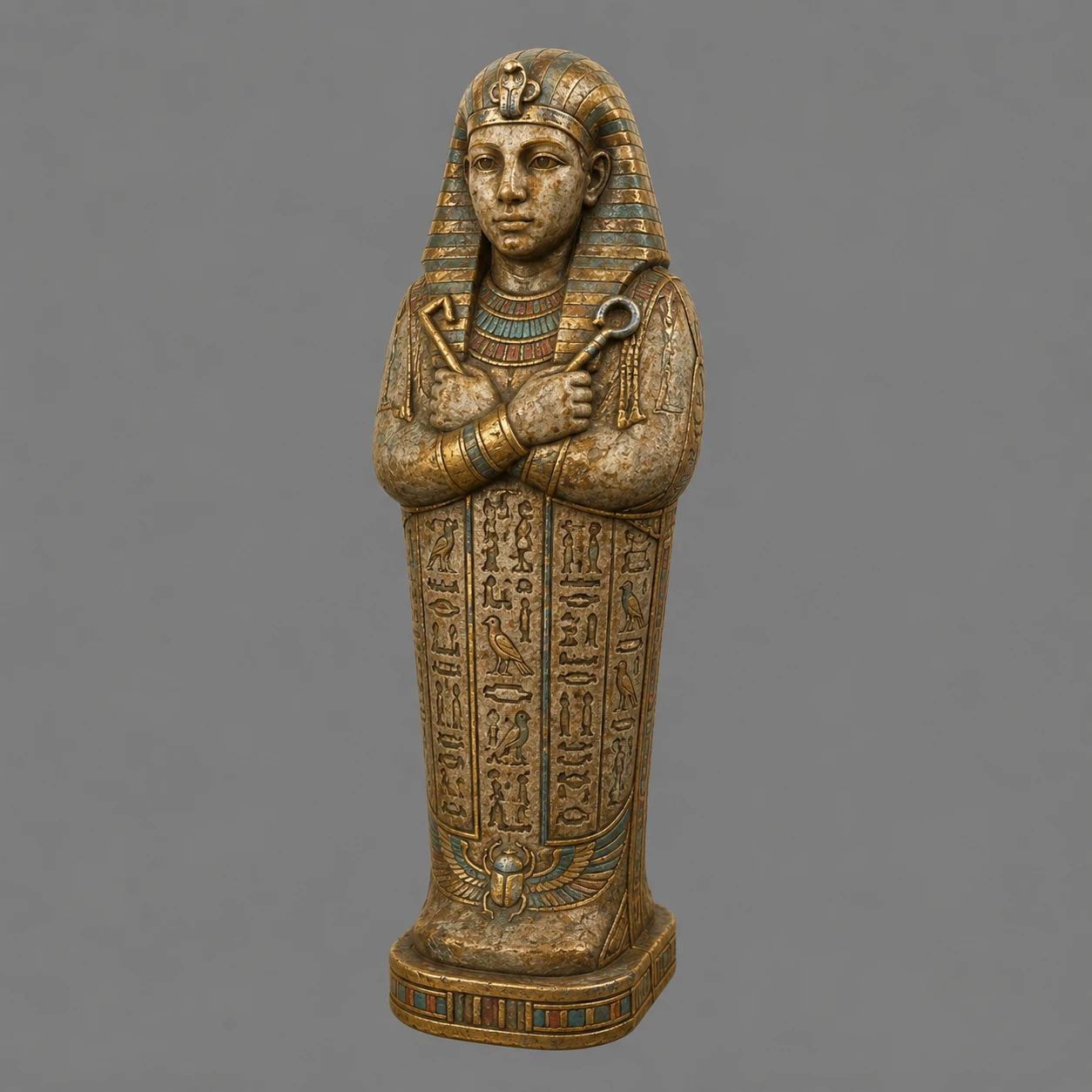
One ushabti on a niche shelf or offering table reads as a burial chamber faster than a scatter of copies across the floor, and warm, low light catches faience and painted stone well. Our Egyptian Tomb Relics pack includes a stylised ushabti if you want a ready-made mesh.