Bonshō: Japan's Bronze Bell in the Temple Tower
A Japanese temple gong is usually a bonshō, a large bronze bell hung mouth-down in a roofed tower called a shōrō. It has no clapper inside. A priest or visitor swings a heavy wooden beam, the shūmoku, against a reinforced striking panel on the bell's side. The tone is deep, long, and meant to carry across hills. In Buddhist practice the sound marks dawn and dusk, calls monks to prayer, and on New Year's Eve rings out 108 times to shed the year's mental afflictions.
Bonshō, tsurigane, and the shūmoku striker
Bonshō (梵鐘) means Brahma bell, pointing to the bell's Buddhist role. You may also hear tsurigane (釣り鐘, hanging bell) or ōgane (大鐘, great bell). All three names describe the same family of temple bells, not the small pellet shrine bell called suzu that worshippers shake at a Shinto haiden.
The bell hangs from a dragon-shaped loop called ryūzu (竜頭) at the crown. Raised bosses called chi or nyū (乳) ring the upper body and help the bronze ring. The tsuki-za (撞座) is the lotus or chrysanthemum panel where the striker hits. A suspended shūmoku (手木), often a log on ropes, does the work. Handheld mallets appear at smaller sites, but the image most people carry is the beam swung by two or more people on a great bell.
Because the bell has sloped shoulders and a flat base, many temples treat it as a seated Buddha in bronze. Those who sound it bow three times first, the same courtesy shown to a statue.
From Chinese zhōng to Nara bronze
Large hanging bells entered Japan with Buddhism. Britannica traces bronze bells in the islands back to Yayoi dōtaku, cast ritual objects that were not played like later temple gongs. When Buddhist monasteries took root in the 6th century CE, they imported the Chinese habit of sounding a zhōng to order the day.
Early Japanese examples kept elongated proportions scholars call the Asuka style, shaped by Korean and Chinese models. By the Nara period (710–794 CE) casters produced broader, thicker bells with richer relief bands and the long decay that still defines bonshō tone. Each bell was cast in a one-use clay mould; a failed pour meant starting again, so surviving pieces were treasured.
Dawn, prayer, and joya no kane
World History Encyclopedia lists the shōrō bell tower among the standard buildings of a monastery, there to call monks to prayer and other rites. The daily pattern varies by sect, but the bonshō traditionally frames morning and evening liturgy and punctuates festivals.
The best-known public ritual is joya no kane (除夜の鐘), the New Year's Eve bell. Temples across Japan strike 108 times, often beginning before midnight and finishing after. One hundred eight matches the bonnō (煩悩), the mental defilements Buddhist teaching ties to suffering. Each peal is a symbolic release as the old year ends. Visitors queue at famous temples to pull the rope on a smaller shūmoku or to hear the main bonshō rung by priests.
During the Obon season some communities ring special bells to welcome ancestral spirits and later sound a sending-back bell when the festival closes. The logic matches everyday use: the tone reaches outward, and folk belief long held that it could travel to the realm of the dead.
Cast bosses, wartime melting, and peace bells
Surface decoration is not mere ornament. Bands, grids, and nipple-like bosses tune the bronze and record donors. Edo-period bells sometimes arrange bosses in patterns that evoke the 108 afflictions, tying form to the New Year count. Inscriptions on the mei-bun (銘文) band name the temple, the caster, and the dedication year.
Many bonshō were recast across centuries, so a tower bell may be younger than the shōrō that shelters it. World War II brought a sharper break. Japan's metal-collection drives melted an estimated 70,000 temple bells, roughly nine out of ten bonshō then in existence. Postwar casting replaced many losses, and by the 1990s the national count had climbed back toward pre-war levels. Survivors are treated as historic artifacts; some communities later commissioned new bells as memorials after earthquakes or as symbols of peace.
Hōryū-ji's Nara bell in the shōrō
The largest bells rarely leave Japan, but one of the oldest working contexts is open to visitors. World History Encyclopedia describes the shōrō at Hōryū-ji, the Buddhist monastery Prince Shōtoku founded near Nara in 607 CE. Between the lecture hall and the main hall stands a bell tower with a flared base. Inside hangs a bonshō cast in the Nara period (710–794 CE), older than many of the wooden halls around it.
The monastery burned in 670 CE and was rebuilt by about 710 CE. Its wooden pagoda and main hall count among the oldest timber structures in the world, and the bell tower image on the encyclopedia site dates the tower itself to 710 CE. That pairing matters for scene builders: the bonshō is not a loose prop but a fixed partner to a named shōrō on a UNESCO-listed plan. Wildform's model compresses the mass for real-time use, yet the silhouette, mouth-down hang, and side striker still read as Buddhist rather than Shinto.
What survives when bells stay in service
Excavations seldom recover intact bonshō because temples kept bronze in use or melted it for recasting. Evidence comes from dated inscriptions, monastery inventories, and bells that never left their towers. Britannica still points to Yayoi dōtaku as the deep background, while medieval and early modern bonshō show how casting workshops varied boss layout, slit tone, and handle shape.
Scholars caution against pinning a single invention date on every custom. Some temples never hung a great bell; others added one centuries after founding. The meaning is more stable than the chronology: order the day, announce prayer, mark the year, and let the decaying tone fade for a full minute after the strike.
In your scene
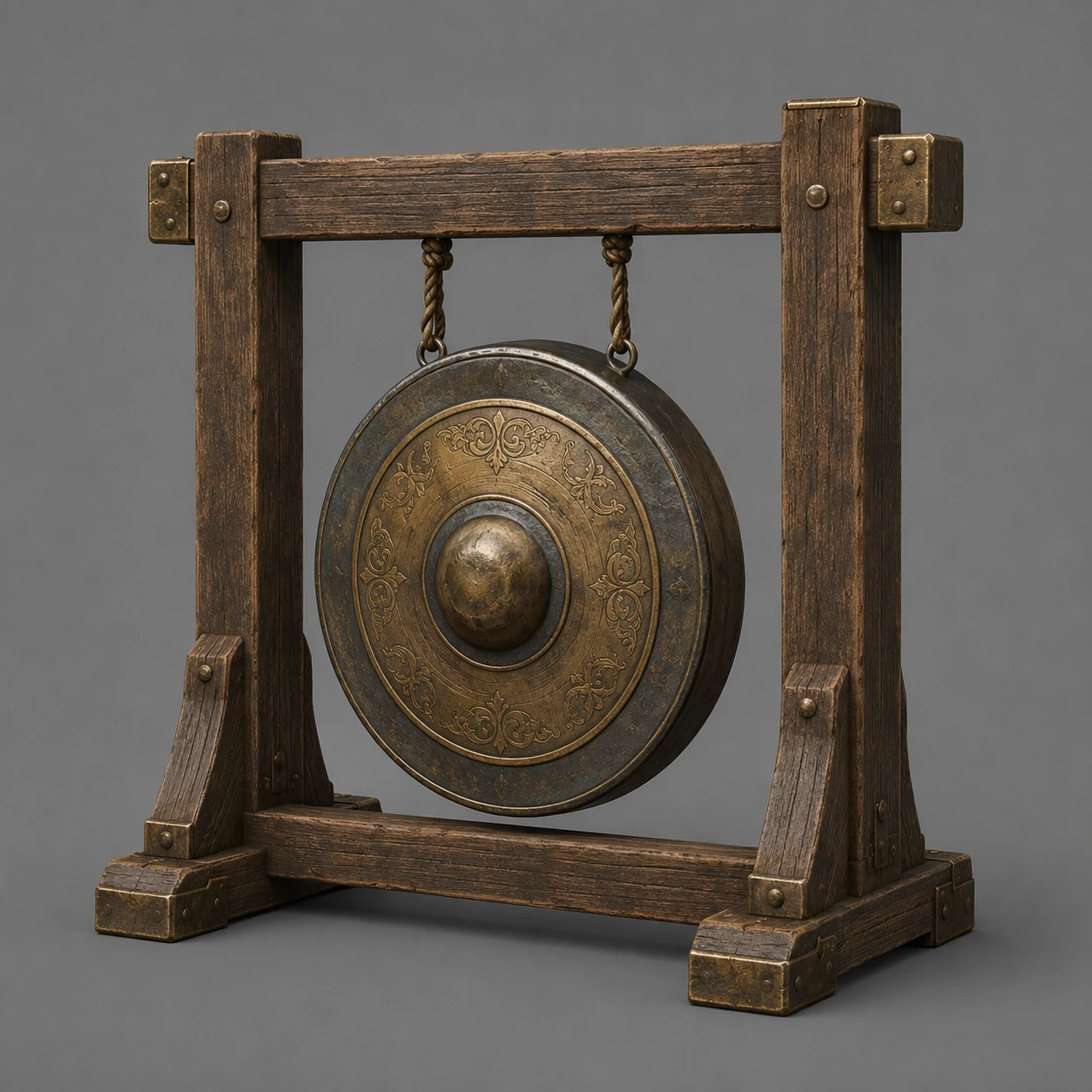
Place a bonshō inside a wooden shōrō at the edge of your temple compound, with a shūmoku beam ready for a festival cutscene. Pair it with a stone lantern along the approach and keep shrine bells at the Shinto precinct so players hear the Buddhist versus Shinto split. Our Shinto Shrine Relics pack includes a temple gong model sized for courtyard towers.