Raven Totem: Huginn and Muninn in Wood and Silver
A raven totem is a carved or cast image of a corvid used as a ritual marker, grave gift, or hall decoration in Viking Age Scandinavia and the wider Norse world. Ravens were not generic birds in this culture. They belonged to Odin, flew over battlefields, and sat on the shoulders of the chief god in poetry and art. A wooden pole with a raven head, or a small silver chair with two birds on the backrest, carried the same symbolic weight as a hammer pendant or a Valknut cut into stone.
Huginn, Muninn, and the raven-god
Old Norse texts name Odin's pair of ravens Huginn and Muninn. Snorri Sturluson, writing around 1220 CE in the Prose Edda, has them perch on Odin's shoulders and whisper everything they see and hear. Each morning they fly over the whole world; by mealtime they return. Because of this habit, poets call Odin hrafnaguð, the raven-god.
The names are usually glossed as Thought and Memory, though scholars note that Old Norse hugr and munr overlap in meaning and the birds act as a matched pair rather than distinct characters. In the poem Grímnismál, Odin admits he fears Huginn may not come back, and worries even more about Muninn. World History Encyclopedia treats the ravens as old mythical elements already fixed on ornaments and rune stones before about 800 CE, which matches their frequent appearance on Viking Age metalwork.
War banners with a black bird
Separate from seated totems, Norse armies reportedly carried a raven banner, Old Norse hrafnsmerki. Medieval chronicles and sagas from the 9th to 11th centuries describe a triangular war flag marked with a raven. No complete banner survives in the ground. Our picture comes from coins, tapestries, and written accounts that may mix memory with propaganda.
A silver coin minted at York around 924 under the Viking ruler Anlaf shows a bird on a pointed banner with tabs along the lower edge. The Bayeux Tapestry, woven after 1066, includes panels where Norman knights carry semicircular standards with a standing black bird, which some historians read as a distant echo of Scandinavian raven imagery. Later texts even claim the banner moved on its own to foretell victory or defeat. Those magical details are literary, not archaeological, but they show how tightly the raven sign was tied to Odin and to war in Norse storytelling.
Carrion, counsel, and the field after battle
Ravens linked Odin to death as well as knowledge. Battlefields drew scavengers, and skaldic verse sometimes names Muninn drinking from wounds. World History Encyclopedia notes that bird images on cremation urns and tombs, including raven pairs, could mark respect for the dead and keep memory alive for the living. Davidson, cited there, also records ravens sacrificed at Uppsala and at funerals.
A carved raven on a hall post or burial marker therefore did double duty. It pointed toward Odin's counsel and his role as chooser of the slain, without needing a full narrative scene. That is the cultural job behind a raven totem: a visible tie between the household, the grave, and the god who watched from above.
From silver chairs to carved wooden poles
Raven imagery appears at very different scales. Miniature chair amulets from the late 10th and early 11th centuries show a seated figure with two birds on the chair back. Bird fibulae, worn in pairs on the chest, may represent the same pair; the National Museum of Denmark displays Vendel and Viking examples among its bird brooches. Picture stones and rune stones across Scandinavia carry ravens beside riders and ships.
Large wooden totems are harder to trace because timber rots. Archaeology more often recovers metal fittings from halls and graves than whole carved poles. Even so, saga scenes and the density of raven motifs on small objects suggest that a carved raven head on a post or staff would read clearly to a Viking Age audience as an Odinic sign, especially when set beside an Odin idol or ritual gear.
The Lejre chair amulet in Danish soil
One object lets a visitor connect myth to metal. In 2009 an amateur detectorist found a tiny silver and niello figurine at Lejre on Zealand, Denmark, a major Viking Age centre. The piece is only about 17.5 mm high. A figure sits on a decorated throne while two realistic corvids perch on the armrests or back, heads tilted up toward the sitter.
Curators compare it to chair amulets from Hedeby and, in 2016, to a gilt silver example from Nybølle on Lolland reported by the National Museum of Denmark. Peter Pentz, the museum's Viking specialist, notes that 15 to 20 chair amulets are known across Scandinavia, but only three Danish finds share the seated figure with two ravens on the back. The Lolland piece is fingernail-sized, dated to the late 900s or early 1000s, and was declared treasure destined for the National Museum.
The seated figure is deliberately abstract. Pentz warns it may be Odin on his high seat Hliðskjálf, but could equally be another deity or even a mortal borrowing royal symbols. The ravens, however, are explicit. They anchor the amulet to the raven-god story even when the sitter stays unnamed.
Few objects, many interpretations
Raven totems in wood rarely survive intact, so most evidence is indirect. Metal amulets are scarce counted in dozens, not hundreds like Mjolnir pendants. Banner accounts conflict on whether the bird was embroidered, woven, or painted. Modern reconstructions in museums and reenactment camps often show tall carved poles that feel plausible but are educated guesses.
What is secure is the association: ravens with Odin in text, ravens on jewellery and stones in the ground, ravens over the dead in poetry. A carved totem fits that pattern as a local, durable sign. Its exact wording in ritual is lost, but the bird itself would have been understood.
In your scene
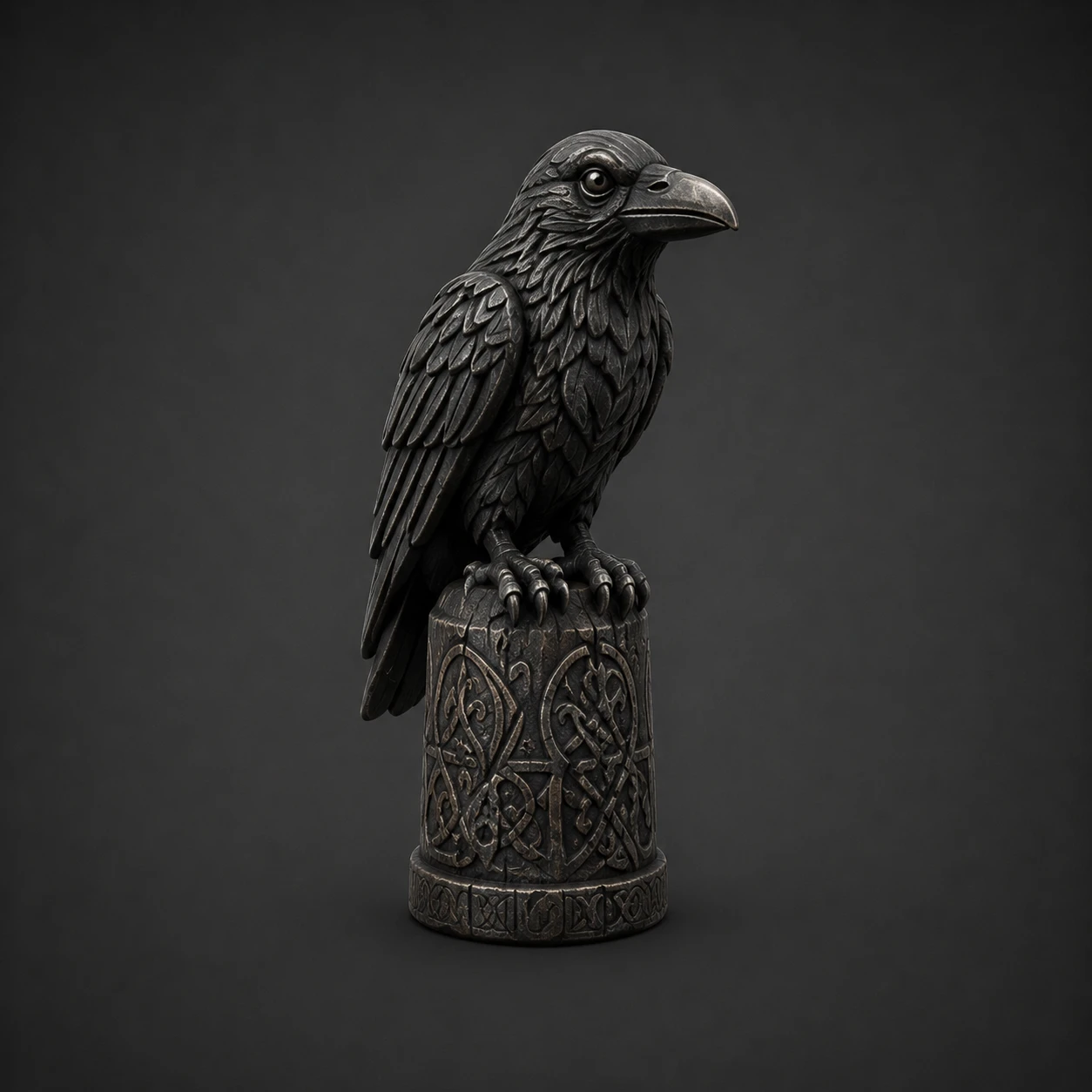
Place a raven totem where Odin is honoured: a longhouse high seat, a blót clearing, or a grave mound beside a ship burial. Keep the carving bold and readable at a distance, as banner birds were. Our Viking Ritual Relics pack includes a raven totem model for ritual corners and outdoor offerings.