Valknut: Odin's Knot Beside the Dead
The Valknut is a pre-Christian symbol made of three interlocking triangles. It turns up on a handful of Viking Age carvings and grave goods from Scandinavia and Anglo-Saxon England. No medieval text names the design, and scholars still argue over what it meant to the people who cut it into stone and wood.
Three triangles, two ways to carve them
Visually, the sign is built from three triangular loops. Archaeologists distinguish two main drawings. In the tricursal form, three separate triangles link together like Borromean rings. In the unicursal form, a single continuous line outlines all three shapes, producing a trefoil knot like a triquetra. Both versions appear on genuine early medieval objects, and most researchers treat them as variants of one idea rather than unrelated emblems.
The triangles are always compact, usually small enough to sit beside a figure on a memorial stone or to be scratched into a bedpost. Unlike the hammer pendants worn as jewellery, the Valknut survives mainly as carved decoration on larger objects.
A modern word for an unnamed sign
The English name valknut is not Viking Age vocabulary. It is a modern Norwegian compound, valr plus knut, often glossed as knot of slain warriors or knot of the fallen in battle. Britannica notes that historians coined the label in the 20th century because no Old Norse source mentions the symbol or gives it a name.
That gap matters. We know the geometry from archaeology, but we cannot read a Viking poem or sermon that explains it. Any link to Odin, Valhalla, or battlefield death is inference from where the sign appears, not from a period dictionary entry.
From Gotland picture stones to Oseberg wood
The best-known images are on Gotland, the Baltic island off Sweden's east coast. Limestone picture stones from the 7th to 8th centuries carry bands of scenes: riders, sacrifices, ships, and small knot emblems between limbs or hooves. The Stora Hammars I stone shows the triple knot above an altar scene with a human figure and ravens, motifs often read as Odinic. The Tängelgårda stone places similar knots beside a mounted warrior in a procession.
In Norway, the richly furnished Oseberg ship burial near Tønsberg, dated to about 834 CE, yielded wooden grave goods etched with the same triangular knot. Carvings survive on a bedpost and on a bucket lid inside the ship chamber. Britannica treats these Oseberg pieces among the clearest Scandinavian attestations tied to elite pagan burial.
Beyond Scandinavia, related triangle clusters appear on Anglo-Saxon cremation urns from East Anglia and on personal ornaments in England, showing that the design travelled with wider Germanic contact, not only Norse ship routes.
Beside Odin, death, and binding spells
Every dated example sits in a funerary or sacrificial context: picture stones raised near graves, items buried with the dead, or rings lost in rivers that may have held offerings. Scholars therefore connect the Valknut to death ritual and to Odin, the god who receives slain warriors in Old Norse literature.
Hilda R. Ellis Davidson, writing in the mid-20th century, compared the knot to Odin's power to bind and unbind minds in battle, a theme in skaldic poetry. Another line of argument, also reported by Britannica, compares the three corners to Hrungnir's heart in Snorri Sturluson's prose: a stone giant whose heart had three sharp points. Neither theory is proven. The symbol might mark the dead, protect the soul, invite Odin's attention, or signal membership in a cult we cannot reconstruct.
Modern Heathen groups and popular culture have adopted the Valknut widely. That reuse has loaded the sign with meanings the Viking makers never wrote down.
The River Nene ring at the British Museum
One portable piece lets a visitor walk up to a case. The British Museum holds a gold Anglo-Saxon finger-ring, registration number 1855,1115.1, from the River Nene at Peterborough. An eel fisher speared it from the water in 1855, a few hundred metres above the old bridge. The museum dates it to the 8th or 9th century and gives the hoop a diameter of 2.7 cm.
The ring is unusual for its double bezels. One circular face is cut with three interlaced triangles, the design commonly called a Valknut. The opposite bezel carries a continuous looping pattern that forms a quatrefoil at the centre, closer to insular Christian and Celtic interlace. Both faces are inlaid with niello, and the hoop bears engraved knotwork. Curators classify it as Anglo-Saxon workmanship with Scandinavian-looking iconography on one side. The piece is on display in the museum's early medieval England gallery.
Held beside a Mjolnir hammer pendant, the ring reminds us that small symbols moved between cultures on jewellery, not only on standing stones.
How few objects carry the debate
For all its fame online, the Valknut is rare in the ground. Researchers count only a small set of secure pre-Christian appearances spread across roughly the 7th to 9th centuries, with the Oseberg material extending into the mid-9th. Gotland's picture stones are weathered and interpretation shifts when scholars redraw worn lines as triangles versus simple triquetras.
Anglo-Saxon urns add a parallel tradition that may or may not share the Norse meaning. Without a named example in literature, each new find reframes the symbol rather than confirming one doctrine. Archaeology gives placement and date; it does not give a sermon.
In your scene
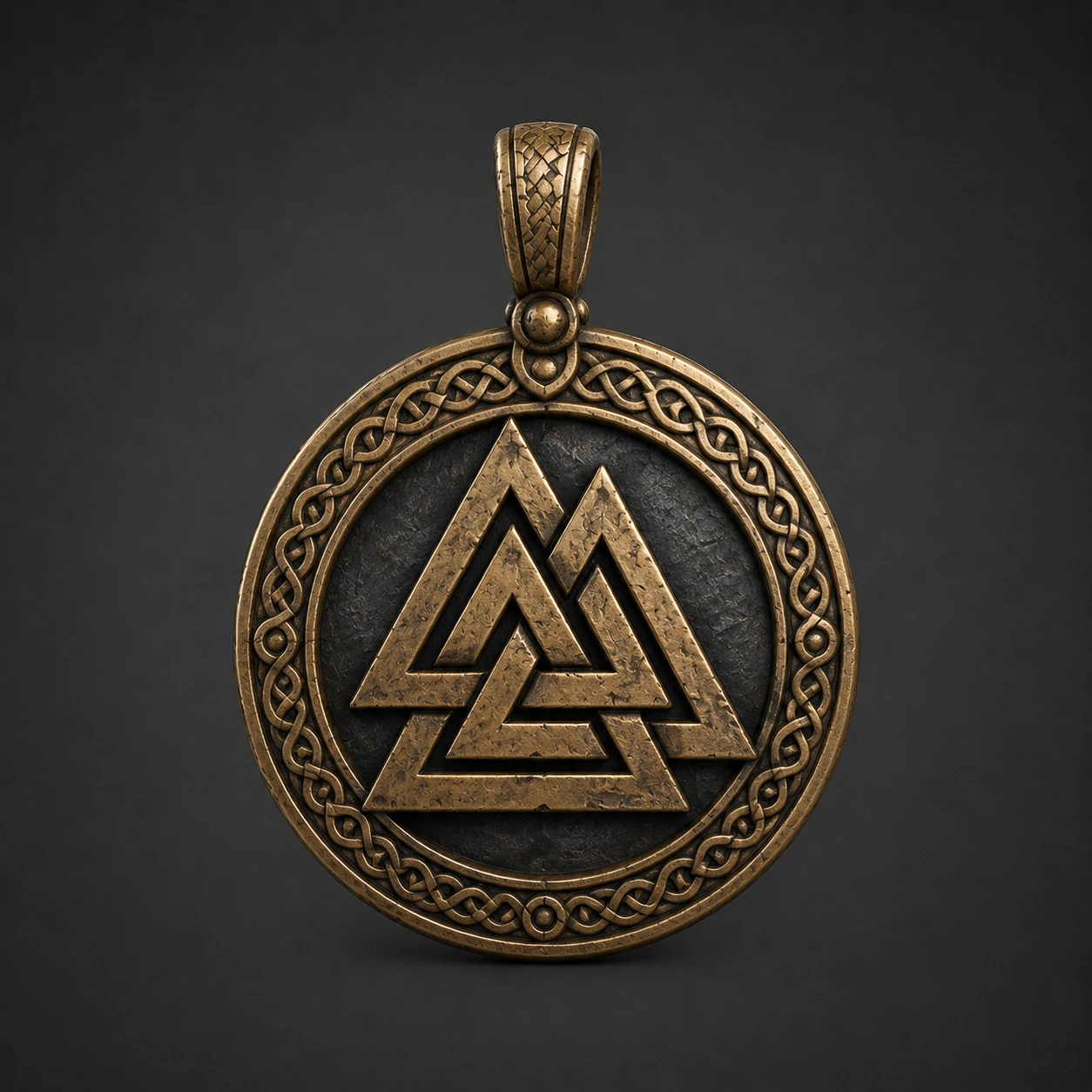
A carved Valknut reads naturally on a memorial stone, a wooden bedpost in a ship burial, or a priest's chest beside raven imagery. Keep the mark small and secondary, as on the originals. Our Viking Ritual Relics pack includes a Valknut amulet model for grave goods and ritual corners.