What Is Mjolnir? Thor's Hammer in Myth and Metal
Mjolnir is the hammer of Thor, the Norse thunder god. In medieval Icelandic writing it smashes giants and blesses weddings. In the Viking Age, people across Scandinavia, the British Isles, and the Baltic wore miniature hammers as pendants, and about a thousand of them survive.
What it is
In myth, Mjolnir was forged by dwarves, the brothers Brokkr and Sindri in Snorri Sturluson's telling. Snorri describes it in the Prose Edda as short in the handle but unbeatable as a weapon: thrown at a target, it always returns to the hand. The name probably connects to old words for crushing or for lightning, though the exact etymology is not settled.
The objects archaeologists call Mjolnirs are not weapons. They are small amulets, usually worn head-down on a loop or ring. Most are plain, cast in iron or silver with no decoration. Only around a hundred are finely worked, with punched patterns or filigree, out of the roughly thousand known.
Origins and history
Hammer pendants belong mainly to the 10th century, with a span running through the 9th to 11th centuries. They turn up across the Norse world: Denmark, Sweden, and Norway yield most, but examples come from England, the Baltic lands, and the eastern river routes into Russia as well.
For a long time the identification rested on context rather than proof. The pendants clustered in pagan areas, appeared alongside images of Thor, and sat in the same graves as other ritual gear, so historians read them as the god's hammer. The shape alone was not conclusive. Some hammer pendants and Christian crosses look close enough that a single piece could be worn either way, and the two symbols are sometimes found together, as if hedging for double protection.
Role in Viking Age belief
Thor's hammer was a protective sign more than a badge of rank. The National Museum of Denmark stresses that hammer pendants turn up in women's graves as often as men's, and reads them as amulets rather than as anything specifically masculine. Both men and women wore them.
Their survival is uneven. Many Viking burials were cremations, and plain iron hammers corrode away, so the decorated silver pieces are over-represented in museum cases compared with how common the plain ones once were.
A hammer that names itself
For all the indirect evidence, no pendant actually said what it was until 2014. That year a metal-detectorist, Torben Christjansen, found a hammer at Købelev on the Danish island of Lolland and reported it to the local museum. It is cast bronze with traces of tin or silver plating and gold, only about 2 cm across, now in the National Museum of Denmark as object C 40005 and dated by the University of Copenhagen runic database to 900 to 1000 CE.
Along the head runs a short runic inscription, the words "hmar" and "is" divided by a cross-shaped mark, transliterated hmar : is and read as "this is a hammer". It is the only hammer pendant ever found with runes on it, and that one line settled the old debate: critics had called the head too symmetrical or the shaft too short to be a real hammer, but the Viking maker labelled it plainly. Fragments of a brooch mould found nearby suggest the piece was made in a local workshop.
What archaeology shows
The Købelev find is exceptional, but it fits a wide pattern. Around a thousand hammer pendants are known, the great majority plain and undecorated. Beyond the pendants, Thor's hammer appears in other Viking-Age contexts: it is invoked for protection in runic charms such as the Kvinneby amulet from Öland, and it was cast in moulds that could turn out hammers and crosses side by side. The picture is of a common, portable symbol, worn for safety rather than display.
In your scene
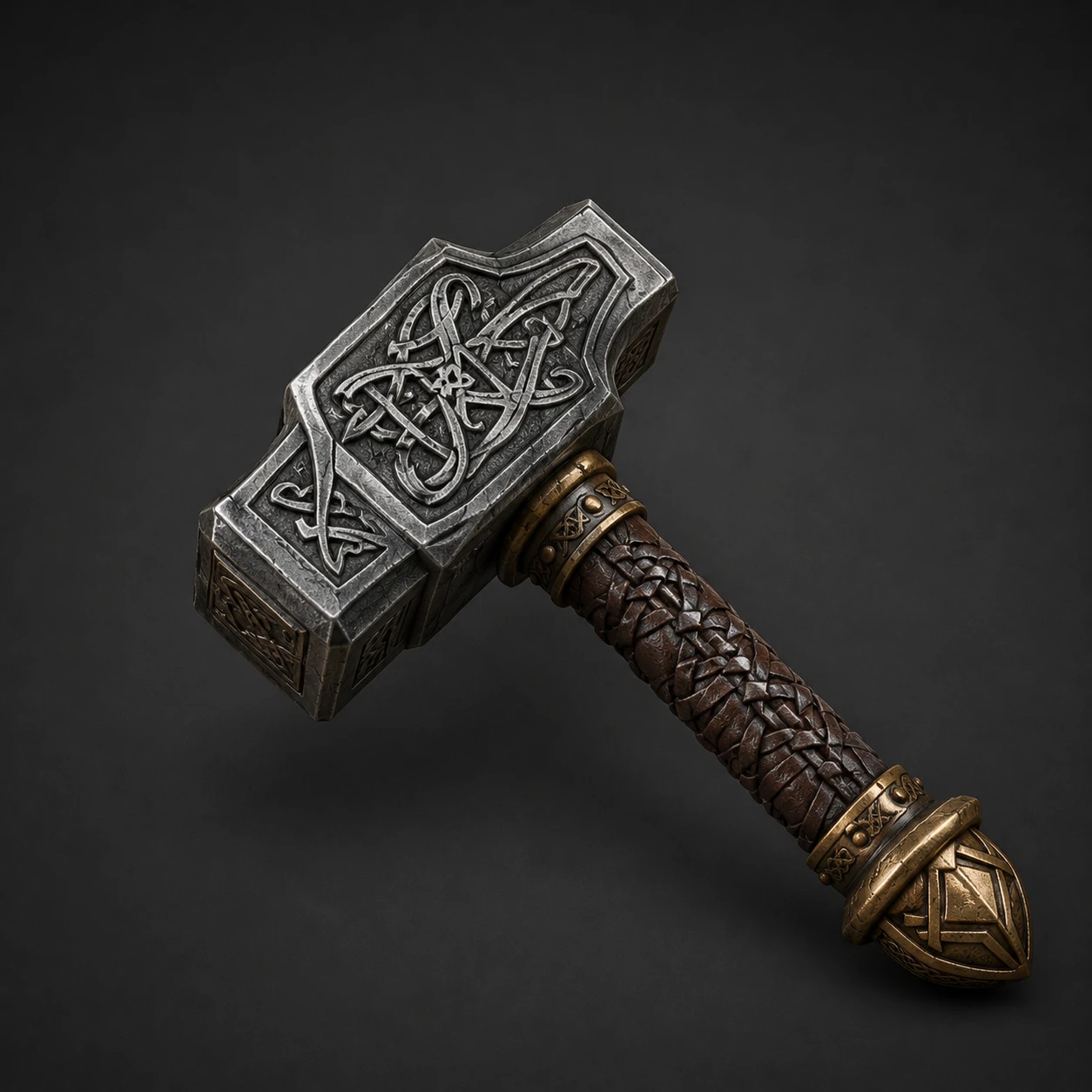
A hammer pendant reads well on a burial chest, an altar, or an NPC's belt. Keep it small: most originals are only a few centimetres long, like the Købelev piece. Our Viking Ritual Relics pack includes a Mjolnir amulet model for ritual props and grave goods.