Painted Amphora: Wine Jars, Black-Figure Battles, and Red-Figure Myth
A painted amphora is a two-handled storage jar from ancient Greece, usually made of fired clay and decorated with figural scenes in black-figure or red-figure technique. Unlike the shallow kylix used for drinking at the symposium, the amphora was built to hold and move bulk goods: wine, olive oil, grain, olives, and sometimes ashes after cremation. When potters added narrative painting to the belly and neck, a practical cargo container became one of the main canvases for Greek myth, athletics, and daily life.
Two vertical handles and the neck-amphora profile
The word amphora comes from Greek roots meaning "carried on both sides," and the shape is defined by those paired handles. Most examples rise from a foot through a rounded or pointed belly to a narrower neck, though ancient workshops produced many subtypes. The neck-amphora, where the neck meets the shoulder at a sharp angle, was among the most common painted forms in Archaic and Classical Athens.
World History Encyclopedia's pottery glossary describes the amphora as one of the standard shapes in Greek ceramics, always with two vertical neck-handles and often fitted with a lid that rarely survives in the ground. Heights vary widely, from small amphoriskoi only a few inches tall to outsize grave markers. A typical neck-amphora stands near 45 to 50 cm, large enough to be useful in a pantry or sanctuary store room yet still liftable by one person using both handles. Painted decoration usually wraps the main figural zone on the belly, with subsidiary ornament on the neck, shoulder, and foot.
Black-figure narrative on Attic storage jars
Before red-figure painting dominated Athenian exports, black-figure was the prestige style for figured pottery from roughly 700 to 530 BCE. Potters painted human and animal forms in glossy black silhouette on the natural reddish clay, then incised details such as drapery folds, musculature, and facial features into the black surface. Corinth developed the technique first; Athenian painters later turned it toward complex mythological storytelling on large vessels, including amphorae.
Britannica's account of black-figure pottery notes that Attic masters such as Exekias and the Amasis Painter perfected narrative scene decoration around the mid-sixth century BCE, moving beyond the animal friezes that earlier Corinthian ware favored. On amphorae, those scenes often filled one side of the belly with a single dramatic moment: heroes at combat, gods in procession, or athletes at contest. The Amasis Painter's Dionysos and satyr amphora in Basel is a well-known black-figure example of how storage shape and mythic decoration were paired. Black-figure amphorae remained in production after red-figure appeared, especially for certain prize and ritual types, but figured neck-amphorae for household use increasingly shifted to the newer technique.
Red-figure painting from c. 530 BCE onward
Red-figure reversed the color logic. Artists outlined figures in black, then filled the background around them with black glaze, leaving the bodies in the warm red of the fired clay. Details that black-figure had to incise, such as interior lines, eyes, and subtle folds, could now be brushed on, which allowed more natural poses, overlapping figures, and expressive faces.
Britannica on red-figure pottery dates the style from the late sixth to the late fourth century BCE and stresses that most important vases of the Classical period were painted either red-figure or in the older black-figure manner. On amphorae, red-figure painters used the tall belly for multi-figure compositions and the neck for subsidiary scenes or ornament. The red surface read like sun-bronzed skin against a dark field, a contrast that suited heroic narrative. Workshop attribution often rests on drawing style, since many potters did not sign their work; when a name survives, as with Exekias on black-figure pieces or later masters on red-figure jars, it helps anchor dating for entire groups of amphorae found from Athens to South Italy.
Wine, oil, and freight across the Mediterranean
Practical amphorae were the cardboard boxes of the ancient economy. Britannica's entry on the amphora as a vessel form explains that amphorae in great numbers stored and transported olives, cereal, oil, and wine. A standard Athenian wine measure, the metretes, held about 39 liters, and commercial transport jars were sized to match trading and taxation habits. Stoppers, resin linings, and painted labels helped merchants track contents; graffiti and dipinti under the foot sometimes record prices, ownership, or shape names.
Painted figural amphorae were not all shipping containers. Many served in dining rooms, sanctuaries, and tombs as display pieces, prize vessels, or grave gifts. Wide-mouthed painted amphorae could decant wine at table, while tall Panathenaic prize amphorae, filled with sacred olive oil, were awarded at the Athenian festival games from the sixth century BCE onward and often bore Athena between columns on one side and a contest scene on the other. The same shape family therefore spans humble pantry storage and state-sponsored trophy ware. Shipwreck assemblages from the eastern Mediterranean show plain amphorae in the hundreds; painted examples more often come from tombs, sanctuaries, and Italian sites such as Capua, where Greek pottery was buried as luxury goods.
Achilles and Penthesileia in the British Museum (1873,0820.368)
One of the clearest red-figure neck-amphorae still on display is British Museum object 1873,0820.368, attributed to the painter Polygnotos and dated to about 450 to 430 BCE. The jar stands roughly 51 cm high and was found at Capua in Italy, a reminder that Attic painted pottery traveled far beyond Athens as trade goods and grave offerings. It entered the museum in 1873 through the collection of Alessandro Castellani.
On side (a), Achilles strides left to strike Penthesileia, the Amazon queen, with a kopis sword raised overhead. She retreats, battle-axe raised in defense, wearing eastern dress: anaxyrides, shoes, a short chiton, and a kidaris cap. Her horse prances behind her; her bow falls to the ground. Achilles' name is inscribed on his shield. The moment is taut with violence, yet scholars have long noted the tragic irony that, in some versions of the myth, Achilles falls in love with his victim at the instant she dies. Side (b) shows a bearded man with a sceptre flanked by two women in Ionic dress, one holding a burning torch, a quieter scene that may allude to departure, marriage, or funerary ritual. Purple and brown added color pick out reins, flame, and inner markings. The vase is on view in the Greek vases galleries (Room G20a), and it rewards comparison with earlier black-figure treatments of the same subject, including the famous signed amphora by Exekias that Britannica discusses as a landmark of sixth-century narrative painting.
Panathenaic prizes, tomb markers, and what survives in the ground
Not every amphora carried painted myth. Plain utilitarian jars outnumber figured ones in most excavations, and survival skews toward burials and ritual deposits that protected pottery from daily breakage. Large outsize amphorae served as grave markers; the loutrophoros, a related slender shape with elongated handles, appears in wedding and funeral rites. Nolan amphorae, a neck-amphora subtype named after finds at Nola, sometimes carried triple handles and appear often in red-figure work.
Attribution and exact findspot are not always secure. A vase attributed to a known painter may rest on stylistic comparison rather than a signature, and pieces bought on the nineteenth-century art market, like the Castellani amphora, sometimes lack full excavation records. Graffiti under the foot, such as the abbreviated merchant mark on 1873,0820.368, can hint at workshop or inventory practice without telling modern readers every step of the jar's life. Even so, the combination of shape, painted narrative, and documented museum holdings gives historians a fixed point for dating trade, myth iconography, and the shift from black-figure to red-figure dominance on one of Greece's most recognizable vessel forms.
In your scene
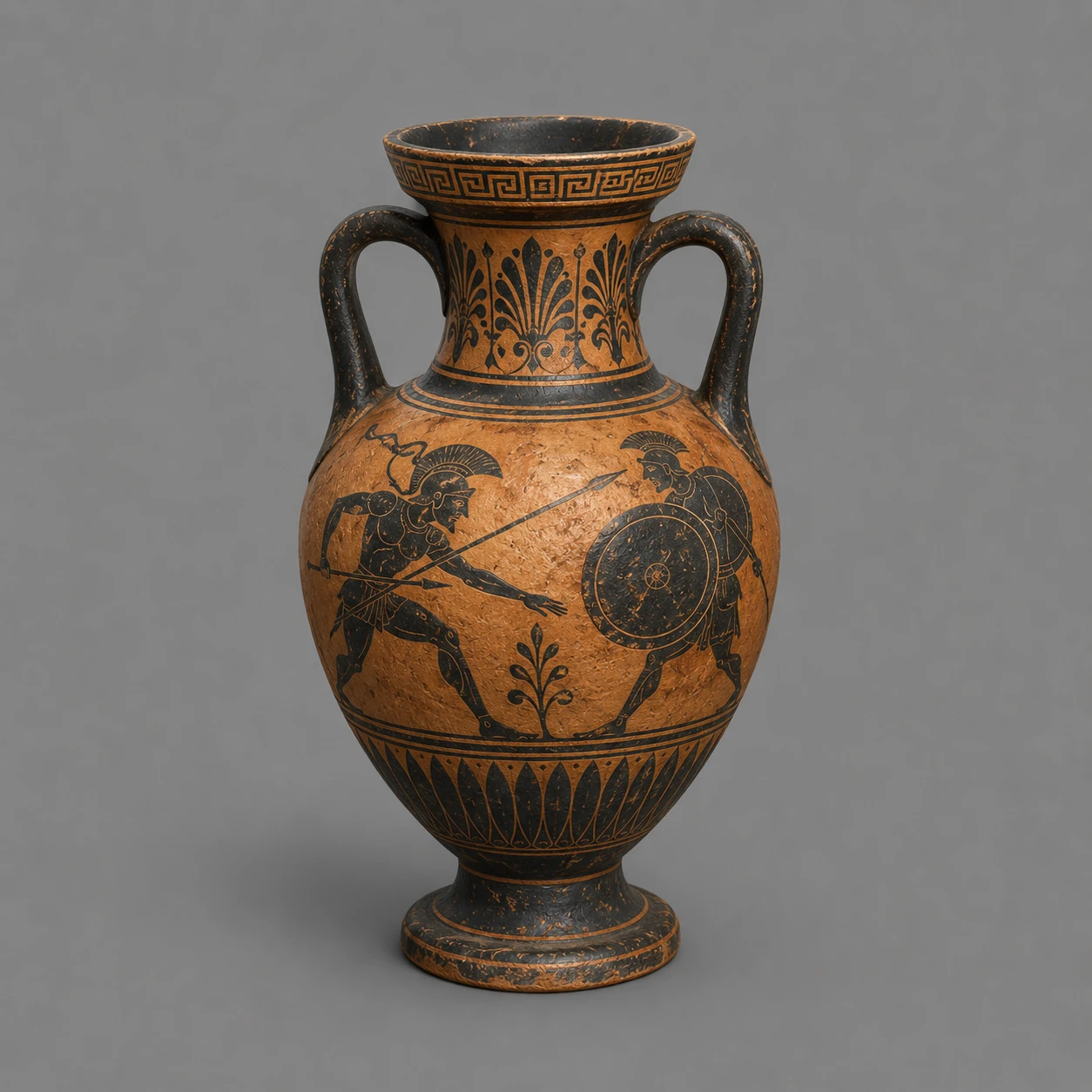
Stand a painted amphora in a temple treasury, a merchant's storeroom, or beside a krater and kylikes at a symposium where wine has been poured from bulk storage into mixing bowls. Side A and side B decoration reads best when the jar is rotated in a still life or placed with one narrative panel facing the camera. Our Greek Temple Relics pack includes a painted amphora model suited to sanctuary interiors, classical villa props, and looted trophy rooms.