Kylix: Shallow Bowls, Painted Tondos, and Symposium Wine
A kylix is a shallow, stemmed drinking cup from ancient Greece, usually made of fired clay and fitted with two horizontal handles. It was built for wine drunk at the symposium, the formal male drinking party where guests reclined on couches and mixed their drink with water before conversation, music, and games took over the evening.
Shallow bowl, stem, and two horizontal handles
The shape is easy to spot once you know what to look for. The bowl is wide and relatively flat, set on a tall stem and a small foot so the cup can be lifted from the floor while the drinker lies on his side. Two handles project from the rim, often curving slightly upward, giving a secure grip without tipping the shallow liquid.
Greek pottery specialists count dozens of kylix variants across the Archaic and Classical periods, from Komast cups and Siana cups to the later Type A, B, and C forms. Not every shallow cup in a museum case is a textbook kylix, and ancient Greek had several words for drinking vessels that modern scholars do not always map cleanly to one shape. Still, when archaeologists say kylix, they usually mean this stemmed, two-handled wine cup, and painted examples dominate symposium scenes on pottery from Athens and its export markets.
From Mycenaean stem cups to red-figure Athens
Stemmed drinking cups reach back into the Bronze Age. Mycenaean potters made two-handled stemmed cups that later potters refined into the classical kylix profile. The form took its familiar proportions in Athens during the sixth century BCE, when black-figure and then red-figure painting made the exterior frieze and interior tondo into standard fields for narrative art.
Britannica's entry on the kylix traces the type from Mycenaean times through the Classical Athenian period, when sets of cups were produced to match larger wine vessels such as the krater. Red-figure kylikes, with figures left in the natural clay color against a black-glazed ground, became the dominant painted cup from roughly 525 BCE onward. Production was concentrated in Attica, though painted sympotic ware traveled widely to Greek colonies and trading partners across the Mediterranean.
Wine cut with water at the reclining symposium
The kylix was not a solo mug for standing drinkers. Its natural setting was the symposium, a choreographed evening where elite men, and sometimes professional entertainers, shared a room lined with couches. After food and libations, wine arrived mixed with water, not neat. The Metropolitan Museum's essay on the symposium notes that by the late sixth century BCE a standard sympotic set included coolers, jugs, a central krater for mixing, and an array of personal drinking cups. The symposiarch set the strength, commonly three or four parts water to one part wine, and slave attendants filled pitchers from the krater before pouring into each guest's cup.
World History Encyclopedia describes how drinking continued through the night alongside poetry, music on the lyre, riddles, and political talk. The shared cup passed around the room, and painted pottery shows symposiasts garlanded, propped on cushions, and reaching for a kylix set within arm's length of the floor. That low placement is why the stem matters: without it, a shallow bowl would be awkward to lift from a couch.
The tondo revealed and kottabos played with the dregs
Two features make the kylix unusual among Greek tableware: the interior tondo and its tie to sympotic games. The tondo is the circular picture field at the bottom of the bowl. While wine remained, the guest saw only the rim and the shifting surface. As the cup emptied, the painted scene inside appeared, a deliberate surprise that turned drinking into a slow unveiling of myth, athletics, or flirtation.
Exterior friezes carried narrative too, often wrapping around the cup so the story shifted as the vessel rotated in hand. Symposium scenes were especially common, which makes sense: the cup depicted the very occasion for which it was made. Guests also used the shallow bowl in kottabos, a game in which they flicked the lees, the sediment of wine dregs, toward a target. The wide, flat interior suited that flicking motion, and painted cups sometimes show young men aiming their throws amid laughter. The game belongs to the same convivial world as the mixed wine and the shared conversation, not to temple sacrifice.
Hieron and Makron's cup in the Met (20.246)
One of the clearest surviving statements of what a kylix could be is Met object 20.246, an Attic red-figure cup dated to about 480 BCE. The potter Hieron signed the vessel; the painting is attributed to Makron, among the most admired red-figure cup painters of the early Classical period. The cup stands about 13.8 cm high with a diameter near 33.2 cm, a scale that fits the hand while leaving room for figural decoration inside and out.
On the interior tondo, a flute-playing satyr pursues a maenad, followers of Dionysos rendered with the formal restraint Makron favored for mythic figures. The exterior is busier and more documentary: on both sides, symposiasts recline amid the equipment of a real drinking party. A wreathed column-krater stands ready for mixing, a large skyphos waits for a symposiast who needs relief, and a lamp stand holds a ladle and strainer. Krotala, castanets, and a picnic basket hang from the back wall. The cup is on view in Gallery 157 at The Met Fifth Avenue, and it rewards close looking because the painter treated the symposium as a still life of objects as much as a scene of men at leisure.
Stemless cups and the late fifth-century turn
The kylix did not keep its dominance forever. Painted stemmed cups remained fashionable through much of the fifth century BCE, but by the end of that century Athenian drinkers increasingly favored stemless cups and deeper shapes such as the skyphos. Fashion, the wear of delicate stems in public dining, and the political turbulence after the Peloponnesian War all likely played a part. Scholars who study cups from the Athenian Agora note that the stemmed kylix becomes less common in sympotic assemblages after the late fifth century, while black-glazed stemless forms take over before the kantharos rises in the fourth century.
That shift does not mean the kylix vanished overnight. Thousands survived in tombs and sanctuaries, and painted examples remain among the most reproduced images of classical Greece. It does mean that a scene set in 420 BCE might still show kylikes on every couch, while one set in 380 BCE might mix stemless cups among the krater and wine jugs. For historians, the cup is also a dating tool: handle shape, lip profile, and tondo composition change in steps that help attribute fragments in excavation reports.
In your scene
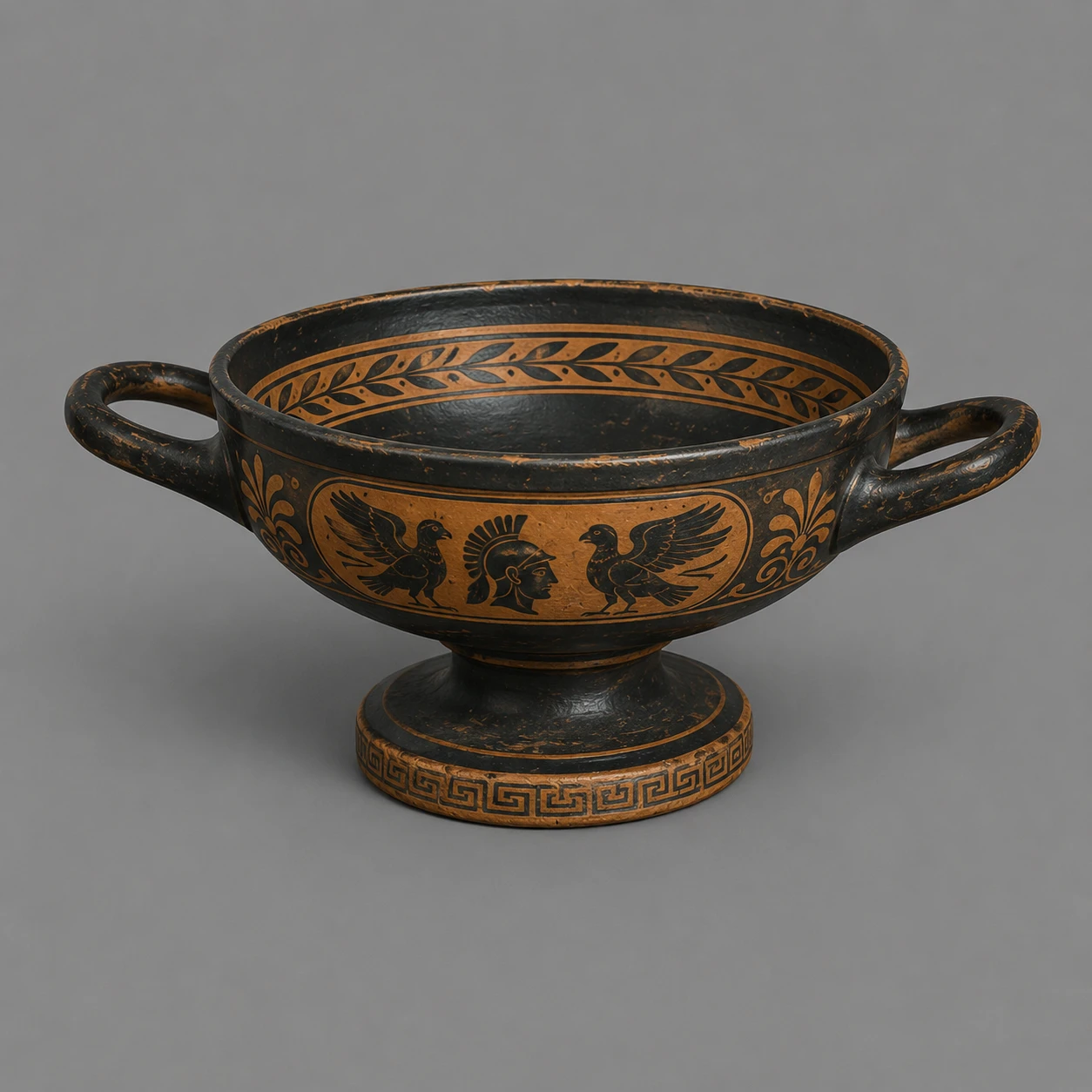
Place a kylix on a low table beside a krater, or in a symposiast's hand as he reclines on a couch. An interior tondo reads well when the cup is tipped or half empty in a still life. Our Greek Temple Relics pack includes a ceremonial kylix model suited to painted-cup props in banquet halls, priestly quarters, or looted trophy rooms.