Lyre: Tortoiseshell, Plektron, and Apollo's Wisdom
A lyre is a stringed instrument from the ancient Greek world with a U-shaped frame: two arms joined by a crossbar, with strings stretched from that bar down to a soundbox at the base. Greeks plucked it with a plectrum (plektron) and used it to accompany song, recitation, and dance. As an attribute of Apollo, the lyre stood for measured wisdom and the civilized arts, in contrast to the wilder aulos, or double pipe. The word covers several related shapes, from the small tortoiseshell chelys at a drinking party to the larger wooden kithara heard at public festivals.
Yoke, arms, and gut strings to the crossbar
The frame is the defining feature. Two curved arms rise from the soundbox and meet in a horizontal yoke, or crossbar, that holds the upper ends of the strings. The lower ends attach at the base of the resonator. Most Greek lyres were plucked, not bowed. The player held the instrument vertically or at a slight angle, often with a strap around the left wrist, and struck the strings with a pick in the right hand while the left fingers damped notes that should stay silent.
Bowl lyres use a rounded body, frequently with a tortoiseshell back covered by skin, while box lyres such as the kithara have a wooden soundbox with a flat base. String count varied over time. Homer knows lyres with few strings; by the Classical period seven was common, though some instruments carried more. Gut or sinew strings ran over a bridge to the crossbar, and pitch could be adjusted by tension or, on some types, by shifting the string windings.
From Bronze Age cups to the classical chelys
Stemmed cups and lyre shapes both reach deep into Aegean prehistory. Mycenaean art already shows two-handled stemmed cups and lyre players, and the tortoiseshell-backed form appears in Greek art from the Archaic period onward. Myth credits Hermes with inventing the first lyre from a tortoise shell in the Homeric Hymn to Hermes, a story that explains why Greeks called the small bowl lyre a chelys, from the word for tortoise.
Britannica's account of the lyre distinguishes the amateur's lyra from the professional's kithara, both played with the same technique but built for different rooms and audiences. Red- and black-figure pottery shows Apollo, the Muses, and symposiasts holding lyres, which makes the instrument one of the best-documented sounds of classical Greece even though almost no wooden frames survive.
Song at the symposium and hymns at the festival
Music belonged at both private banquets and civic religion. At the symposium, guests reclined, mixed wine with water, and listened to poetry and song. A lyre or barbitos, another tortoiseshell-backed type, could accompany the singer without drowning out conversation the way an aulos might. World History Encyclopedia notes poetry, lyre music, and riddles among the evening's entertainments, and painted cups such as the kylix often show symposiasts with cups in one hand and music nearby.
Public life had a louder register. The kithara with its deep wooden box suited choral performance, competitive recitation, and festival processions. By the end of the seventh century BCE it had found a major role in civic spectacle. Panathenaic and Dionysian festivals, school training, and even warships are all contexts where Greek writers mention stringed instruments. The lyre family was never far from prayer, praise, and the education of elite boys, whom Plato and later authors expected to study music on a clear-toned lyre before tackling more complex forms.
Chelys on the couch, kithara on the stage
Size and material separated social settings. The Met's essay on the kithara contrasts the tortoiseshell lyra, which any well-bred citizen might play, with the kithara reserved for professional kitharodes who stood before crowds. The chelys was light enough to play seated or reclining, which matches symposium scenes on pottery. The kithara rested against the shoulder, supported by a sling, and projected over competing voices in theater and contest.
That division was cultural as much as technical. Apollo carries the lyre on vase paintings as a sign of order and prophecy; satyrs and komasts might hold lyres in looser poses, but the instrument still signals cultivated pleasure rather than battlefield frenzy. Scholars caution that ancient Greek used lyra loosely in poetry, so a line in tragedy may mean chelys, kithara, or a generic "lyre" without specifying wood or shell. For historians, the safest approach is to follow the image: tortoiseshell and a reclining player point to symposium use; a standing figure with a large box lyre points to public performance.
A Cypriot lyre player in the Met (74.51.1667)
One compact witness to how Greeks imagined the instrument is Met object 74.51.1667, a Cypriot terracotta figure of a standing male lyre player dated to about 750–600 BCE. The statuette stands roughly 12.2 cm high. The lower body is wheel-made and hollow; the upper part and head are handmade. The musician holds a lyre in the familiar upright position, giving a clear view of the arm shape and the player's grip generations before the finest red-figure symposion scenes.
The piece belongs to the Cesnola Collection of Cypriot art in Gallery 171 at The Met Fifth Avenue. It is not an actual instrument, but terracotta votives like this one matter because wood and shell rot while clay survives. They confirm that lyre players were a standard subject for dedication and grave goods outside Athens itself, and that the silhouette Wildform's prop echoes was already fixed by the Archaic period.
Wood, shell, and why so few lyres survive
Unlike bronze helmets or marble reliefs, lyres were biodegradable. Britannica notes that Greek wooden kitharai are lost except in depictions. Tortoiseshell chelyai fare slightly better: a few fragments and reconstructed examples, including the so-called Elgin lyre in the British Museum with Archaic arms and crossbar, hint at original proportions. Most of what we know comes from pottery, sculpture, and texts that describe music's social role more often than its pitch.
That gap leaves room for debate. Musicologists argue over tuning systems, the sound of the plektron stroke, and how closely Cypriot terracottas match Athenian practice. What is not in doubt is the lyre's place in Greek self-image: companion to epic recitation, marker of Apollo's domain, and the sound a symposiast expected when poetry replaced small talk. A lyre prop in a temple treasury or banquet hall reads correctly to anyone who knows painted cups and festival hymns.
In your scene
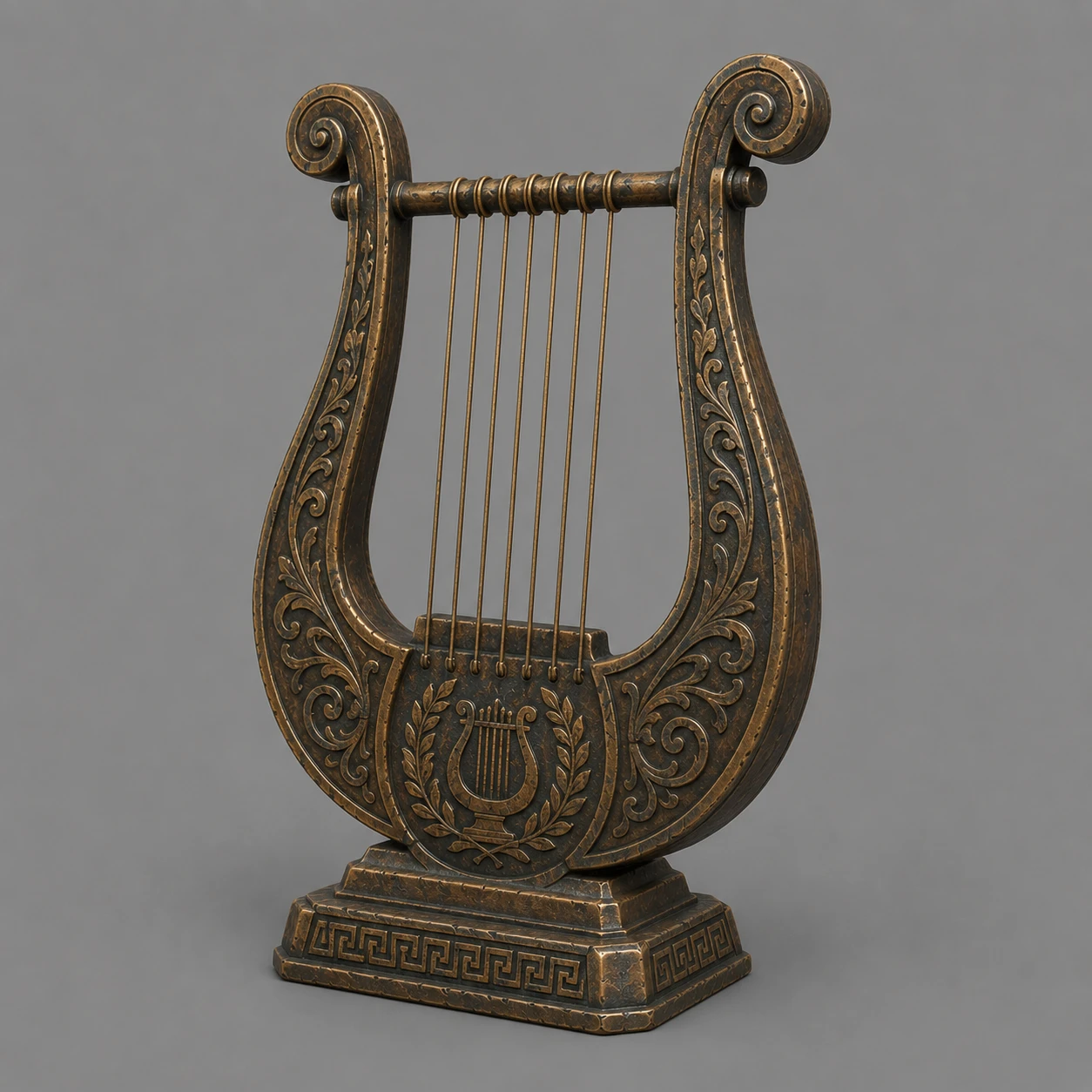
Rest a lyre against a couch at a symposium, or stand one beside a cult statue where Apollo or the Muses receive offerings. The curved arms read well in lamplight near painted pottery and wine vessels. Our Greek Temple Relics pack includes a lyre model suited to banquet interiors, music rooms, and sanctuary corners where stringed instruments marked civilized worship.