Gelede Festival Masks: Yoruba Helmets for the Mothers
A Gelede mask is a carved wooden helmet worn in Yoruba Gelede festivals to honor and appease àwọn ìyá wa, "our mothers": living elder women, female ancestors, and deified female powers. Men dance the masks. The wooden headpiece sits over the head as part of a larger cloth-and-costume body, and the performance mixes entertainment, satire, and serious ritual work. Western museums often show the carved helmet alone. In town squares and marketplaces across southwestern Nigeria, the Republic of Benin, and Togo, that helmet is only the top of a moving ensemble.
Helmet face, gele wrap, and carved superstructure
Most Gelede masks are helmet masks: the dancer wears the wooden form over or above the head rather than as a small face mask held on a stick. A calm, idealized face usually fills the lower half. Above it, carvers build a superstructure that can show animals, market scenes, hats, sewing machines, or other social types. The Met notes that animal fights and seizures often stand for competing personalities or spiritual powers, and that the stacked forms can echo a gèlè, the cloth headwrap women wear, which also appears in Gelede costume.
Paint, metal staples, and added cloth can complete the look. The Art Institute of Chicago stresses that the museum helmet is only one piece of a mixed-media kit that may include fabric, beads, seeds, bones, and other attachments on the body. Regional styles vary. Among Egbado (Yewa) communities, one Art Institute headdress marks an "outsider" with an oblique facial scar called baamu and hat flaps called abetiaja ("dog ears"), which may also read as bird wings linked to women's spiritual messengers.
From Ketu origins to marketplace festivals
The Met describes Gelede as a theatrical genre believed to have originated in the Ketu region on the Nigeria-Benin border during the eighteenth century. Britannica places the height of the ritual festival in Ketu-Yoruba villages of Nigeria and Benin. The tradition is not limited to one town: Yoruba and Nago communities across that border zone keep annual and occasional performances. Staging often favors the marketplace, where women hold economic power, or a public square at night.
Exact founding dates remain soft. Museum labels lean on the eighteenth-century Ketu origin as a scholarly belief, not a dated founding charter carved on wood. Many surviving helmets in American collections are nineteenth- or twentieth-century works because painted wood is used hard, repaired, and eventually retired. What is clearer is geography and social frame: western Yoruba lands, festival sponsorship by communities or families, and a public audience that includes the mothers the dance addresses.
Appeasing awon iya wa, the mothers
Gelede is not a private shrine object. It is a public technology for managing spiritual and social power attributed to mothers. The Art Institute calls the powerful older women iyami and says Egbado communities use the annual festival to recognize their powers and ask for benevolence so the town can prosper. The Met uses the fuller phrase àwọn ìyá wa. Britannica's festival notes link the midnight Efe appearance to placating witches and then to a stamping dance in honor of the great Earth Mother and women elders.
Male dancers masquerade, often in costumes that play with female dress and cool demeanor. The calm carved face is not weakness; Art Institute commentary reads that composure as the cloak under which elder female power hides. Songs and satire can tease gossip, fashion, or bad manners while still aiming to please the mothers. Fertility, rain, wartime support, and cleansing of pestilence all appear in the wider festival repertoire described in encyclopedic summaries, so the mask's job is broader than a single fertility charm.
Efe night, daytime satire, and changing patronage
A full cycle often pairs night and day. Britannica's Efe-mask entry and African-dance notes describe the great Efe mask appearing at midnight in Ketu-Yoruba villages: the wearer utters potent incantations, then moves into a powerful stamping dance and may praise people of rank in careful seniority order. The Art Institute's Efe Gelede headdress label adds that the night performance lasts until dawn, uses light paint for visibility, and culminates with Efe speaking with the authority of the Great Mother through song, poetry, and satire.
Daytime Gelede brings the broader cast of satirical and social types into clearer light. Carvers keep inventing new superstructures, so twentieth-century helmets can show colonial-era hats, market stalls, or animals as moral metaphors. Patronage shifts with towns, tourist interest, and diaspora stages, but the core pair remains: honor the mothers, educate the community, and keep spiritual force on the side of social order. Drummers and singers open many performances; a talking drum belongs to that same Yoruba sound world even when a given festival uses other ensembles.
The Met's Ketu Gelede helmet you can still see
One named museum object is the Metropolitan Museum of Art's Gẹ̀lẹ̀dẹ́ helmet mask, object 1990.336, gift of Paul and Ruth W. Tishman in 1990. The Met dates it to the mid-twentieth century, places it in southwestern Nigeria or the Republic of Benin in the Ketu region, and lists the medium as wood. Dimensions are height 57.2 cm, width 38.7 cm, and depth 45.7 cm (22 1/2 × 15 1/4 × 18 in.). The label describes a standardized face at the base with a dynamic upper composition in which serpents devour the hind legs of a porcupine. Snakes seizing prey signal competing powers; porcupines, for their appetite and slow movement, reference gluttony and selfishness. The intertwined animals also reimagine the flourish of a woman's gèlè wrap.
A second collection witness is the Art Institute of Chicago's Headdress for Gelede (Igi), reference 1963.843, wood, 31.8 × 29.3 × 24.2 cm, from the Egbado region of Nigeria, early to mid-twentieth century, gift of Winter and Hirsch, Inc. Together the two objects show the museum habit of isolating the carved helmet while the living festival treats that helmet as one part of costume, music, and speech.
What labels still leave uncertain
Carver names are often missing. The Met Ketu helmet is credited to an unnamed Yoruba artist; only some later works carry workshop attributions such as Fagbite Asamu or Falola Edun on other Gelede pieces. Village of first use, exact festival year, and whether a helmet danced Efe night or daytime Gelede are frequently unrecorded on gift paperwork. Paint layers may be refreshed or stripped before a piece enters a collection, so color is a weak guide to original night-versus-day function.
Origin dating also needs a soft edge. "Eighteenth-century Ketu" is a scholarly reconstruction on Met labels, not a single excavated foundation layer under every mask. Encyclopedic festival descriptions concentrate on Ketu-Yoruba practice; they do not inventory every town that later adopted or adapted Gelede. And the wooden helmet alone can mislead: without cloth, drumming, and the marketplace crowd, the object looks like a static sculpture when its historical job was motion, satire, and address to the mothers.
In your scene
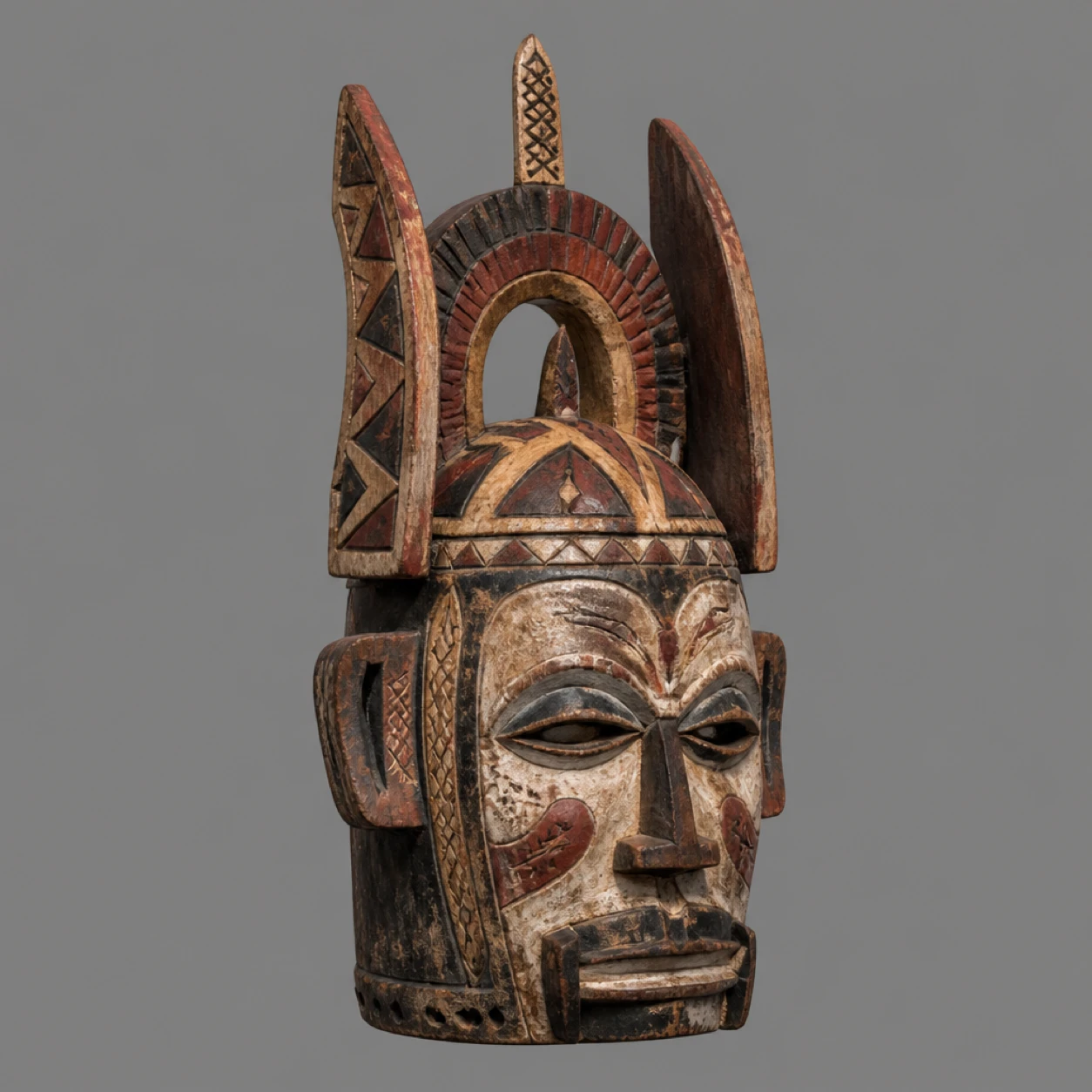
A Gelede mask reads as a festival helmet with a calm face and a busy superstructure, not a small handheld face mask. Give it marketplace or night-square space, cloth below the wood, and room for dancers and drummers rather than a silent shelf alone. For a matching Yoruba and West African court set, see the African Kingdom Relics pack.