Dùndún: Yoruba Pressure Drums That Speak in Tone
A talking drum, in the Yoruba sense most collectors mean, is a dùndún: a double-headed, hourglass-shaped pressure drum from southwestern Nigeria that can imitate the tones and glides of spoken Yoruba. English speakers call it a talking drum because a skilled player can render praise poetry, titles, and messages that listeners hear as language-like speech. It is not Morse code tapped out as dots and dashes. Yoruba is a tonal language, so pitch contour carries meaning; the drum follows that contour by tightening and loosening the hide through leather thongs while a curved stick strikes one head.
Hourglass body, thongs, and the curved stick
The wooden body is waisted: narrower in the middle than at either end. Two skin membranes face outward, linked by many leather tension cords that run the full length of the shell. The player usually hangs the drum from the left shoulder. The left arm presses the cords against the torso to raise pitch; releasing pressure lowers it. The right hand holds a curved stick that strikes one membrane. Britannica calls it a pressure drum because of that waisted body shape; the same entry describes the thong grip and curved stick as how the player changes pitch and articulates sound.
Many dùndún ensembles treat drums as a family. The lead instrument is the iya ilu (also written iya'lu or ìyá ìlù), literally the "mother" drum. Smaller supporting drums fill other roles. Lead drums often carry brass bells on the straps that add a metallic shimmer when the body moves. Only one head is struck in normal dùndún technique, even though both heads are present and linked by the thong system that changes tension across the whole instrument.
Speech surrogate, not a coded telegraph
Because Yoruba contrasts words by tone as much as by vowels and consonants, a drum that can produce level tones and sliding glides can stand in for speech. Classic ethnomusicology on Yoruba talking drums stresses that the instrument reproduces tonal melody rather than a secret letter code. A strong player can deliver ritual praise to a deity or king, recite lineage formulas, and comment on events in a public gathering. Listeners who know the poetic formulas and the local speech community can understand far more than outsiders who only hear rhythm.
This is also why "talking drum" is a loose English label. Related hourglass pressure drums exist elsewhere in West Africa and beyond, and Yoruba musicians use other drums that talk in more limited ways. The bàtá set associated with the thunder deity Shango, for example, can speak but lacks the thong pressure system that makes dùndún so fluent with glides. When game art or museum labels say "talking drum," they usually mean the Yoruba dùndún family, especially the mother drum.
Court praise, ritual, and everyday performance
For centuries dùndún musicians have worked inside Yoruba social hierarchies of title and seniority. They recite history and oral literature, announce presence, and shape public discourse at ceremonies. Britannica notes ritual praise poetry directed to a deity or king as a core skilled use. The same instrument family appears at funerals, festivals, and contemporary concerts. In modern Nigeria and in diaspora scenes, players also seek government, tourist, and recording patronage, turning a court-and-town speech art into a national and global heritage sound without erasing its local grammar.
The mother drum leads the ensemble. Supporting drums answer and thicken the texture. Bells on the strap are not mere decoration; they mark motion and add a second sonic layer while the stick articulates speech-like phrases on the head. Context decides whether the performance is sacred praise, social commentary, dance groove, or stage spectacle. The underlying technique stays the same: pressure for pitch, stick for attack, memory for the words the tones imply.
From palace towns to museum cases and world stages
Dùndún practice did not freeze in a single century. Museum collections mostly hold twentieth-century instruments because hide, cloth, and played wood wear out, and older drums were used until they failed. Players still train apprentices in southwestern Nigeria, and touring musicians carry the instrument into jazz, popular music, and educational demos worldwide. What changes is patronage and venue: palace and town square, then radio, festival stage, and classroom.
Scholars tracking transnational dùndún scenes describe a double move: musicians keep reproducing the speech tradition and its seniority rules, and they also reframe the drum as Nigerian cultural heritage for wider markets. That history matters for how you read a silent museum drum. The object on a shelf is a toolkit for living language performance, not a fossil of a lost code.
The Met's Dundun (iya ilu) you can still see
One named example is the Metropolitan Museum of Art's Dundun (iya ilu), object 1986.467.4, gift of Herbert J. Harris in 1986. The Met dates it to the twentieth century, attributes it to Yoruba makers in Nigeria, and lists the medium as wood, cloth, hide, and metal. Length is 47.6 cm; head diameter is 28.5 cm. The museum classifies it as a double-headed waisted membranophone and notes the broader African pattern of drum "families" in which a mother drum plays the central role, sometimes with tone modifiers such as bells.
A second, closely related museum witness is the Smithsonian National Museum of African Art's Iya ilu Dundun ("Mother" Talking Drum), mid to late twentieth century, wood, hide, cloth, and brass bells, measuring 51.8 × 25.4 × 25.4 cm. Smithsonian text states that pitch changes when the player squeezes the ties between arm and torso while striking with a curved stick, and that the iya ilu leads the ensemble. Together the two objects show the same instrument type in American collections: mother drums built for speech mimicry, not abstract percussion alone.
What labels still leave uncertain
Exact village workshops and makers are often unrecorded on twentieth-century gifts. Provenance notes may stop at a donor rather than a named carver. How much any one silent museum drum "could say" depends on the missing player, the missing poetic repertoire, and the missing speech community. Ranges of pitch also vary with the strength and skill of the drummer; older literature sometimes cites about an octave for a strong iya ilu, but that is a performance claim, not a stamped specification on the wood.
Do not collapse every West African drum into this type. Conical bàtá, cylindrical social drums, and non-Yoruba hourglass drums belong to other jobs and other speech limits. And "talking" does not mean the drum invents free prose for strangers. It means the instrument can carry tonal speech formulas that insiders already know how to hear.
In your scene
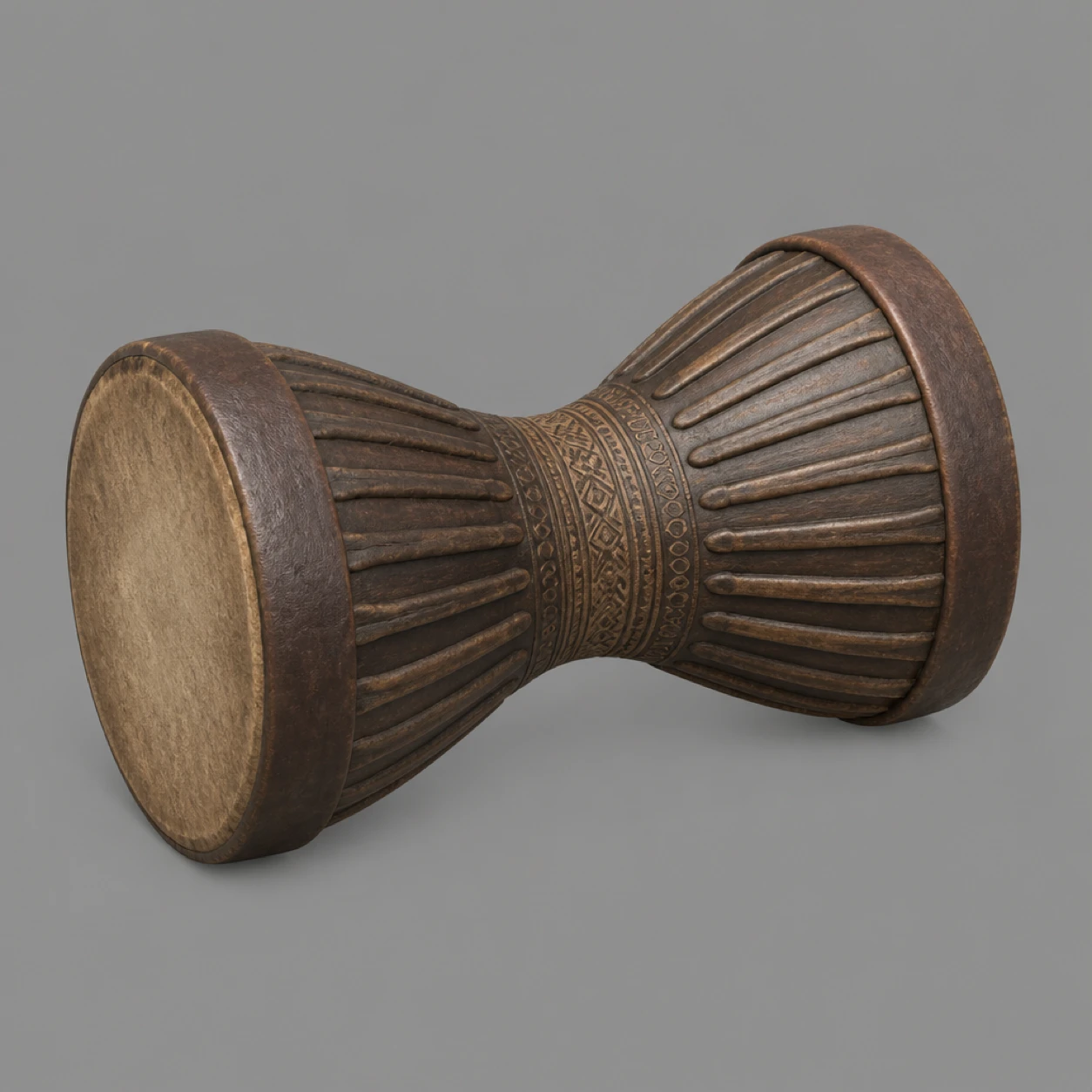
A Yoruba talking drum reads as a carried speech tool: strap on the shoulder, thongs under the arm, curved stick in the free hand, optional bells on the cloth. Give it space in a court, festival, or roadside performance rather than treating it as silent set dressing. For matching court props, see the African Kingdom Relics pack.