The Taylor Prism: Sennacherib's Hexagonal Annals at the British Museum
In 691 BC a scribe at Nineveh pressed a long Assyrian text into wet clay, face by face, on a six-sided prism meant to outlast the king who ordered it. The object that survives is not a law stele, not a boundary stone, and not the Cyrus Cylinder that later Persian scribes would carve for Babylon. It is a foundation record: a baked clay column with flat faces covered in wedge-shaped cuneiform. Assyrian kings used such prisms to list campaigns, tribute, and palace building in one voice that could be buried under a new wing and read again if the building rose. By the end of the opening lines you know the shape: a multi-sided clay document inscribed in Akkadian, copied so the same royal story appears on every face.
Hexagonal clay and wedge-shaped lines
A cuneiform prism is a solid clay object with several flat faces, each carrying lines of cuneiform script. Scribes wrote with a reed stylus while the clay was soft, then the piece was fired so the wedges hardened into a permanent record. Prisms differ from cylinders, which are rolled surfaces meant for duplicate copies, and from kudurru stones, which are carved boundary markers with legal clauses and divine symbols. They also differ from the diorite slab of Hammurabi's law code or the barrel-shaped Cyrus Cylinder from Achaemenid Babylon. The Assyrian royal prism is a building and campaign archive in miniature: tall enough to hold thousands of signs, angular enough to stand in a foundation deposit.
The Taylor Prism at the British Museum is hexagonal, with six faces. The museum catalogue gives 82 + 83 + 82 + 80 + 85 + 75 lines of inscription across those faces, a count that shows how densely the annals were packed. Height is 38.10 centimetres; each face is about 8.57 centimetres wide. The material is ordinary clay, the same medium used for tablets, but the prism form signals permanence and public kingship rather than a single letter or receipt.
From Nebi Yunus foundations to royal annals
Royal prisms belong to the Neo-Assyrian period, when Nineveh served as capital under kings such as Sennacherib, who ruled from roughly 705 to 681 BCE. Assyrian scribes had long written annals on clay cylinders and tablets; prisms appear among the formats used for the final editions of a king's res gestae, his recorded deeds. Many were deposited in foundations when a palace or arsenal was rebuilt, so the king's words literally supported the new walls.
The Taylor Prism was said to have been found at Nebi Yunus, the mound over ancient Nineveh in northern Iraq. Colonel R. Taylor, British consul at Baghdad, purchased it in 1830. After his death the British Museum bought it from his widow through Sir Henry Creswicke Rawlinson in 1855. Because it arrived early in the age of cuneiform decipherment, it became one of the first long Akkadian texts Western scholars could study in the original wedges, not only in later copies on paper.
Campaign lists pressed into a building record
Assyrian prisms combine two jobs that modern readers often split apart. The upper portions list military campaigns, sieges, deportations, and tribute from subject rulers. The closing sections turn to construction: palaces, arsenals, city walls, and the canals that fed Nineveh's gardens. On the Taylor Prism the campaign list runs until the start of Sennacherib's final war against Babylon, then shifts to building work. That structure tells you how Assyrian kings wanted to be remembered: conqueror and builder in one continuous narrative.
The prism names Sennacherib in the first person and records officials and enemies by name. Among the Levantine entries it includes a description of tribute received from Hezekiah, king of Judah, dated to 701 BC in the museum catalogue. World History Encyclopedia's survey of Sennacherib's reign notes that the king's own inscriptions describe heavy tribute from Judah during the revolt of that year, while biblical books tell a different story about the fate of Jerusalem. The prism is Assyrian royal propaganda cast in clay; it is not a neutral court transcript, and it should not be read as automatic confirmation of every detail in later Hebrew narrative.
When hexagonal prisms replaced cylinder editions
Sennacherib's annals survive in more than one physical form. Earlier cylinders and fragments record subsets of his campaigns. Assyrian royal prisms served as foundation copies, buried with major building projects so the king's words supported new walls.
Production date on the museum record is 691 BC, tied to the eponym year of Bel-erumanni. Other prisms in the same tradition were inscribed in the same period, letting philologists compare wording line by line. When a face on one prism breaks, a sister copy can supply the missing wedges.
The Taylor Prism you can still see in Room 55
The British Museum registers the piece as museum number 91032, registration 1855,1003.1, titled both the Taylor Prism and the Sennacherib Prism, and classifies it within the Library of Ashurbanipal series. Curator's comments note that it has been on almost continuous display since entering the collection in 1855. Today it is on view in Room 55, Mesopotamia 1500-539 BC, Display Case 3. If you visit, you are looking at the same hexagonal clay that Victorian scholars illustrated in handbooks of biblical archaeology, not a modern cast.
The object names Sennacherib and Hezekiah in the inscription itself, and it associates with the later king Ashurbanipal's library tradition because of how Nineveh's archives were understood when the prism was catalogued. Condition notes mention refiring and conservation in the 1960s, yet the wedges remain readable, and the six-face layout still shows how scribes divided campaigns from building reports.
What the copies agree on, and what they leave out
Assyrian annals of this period survive in several physical copies. They agree on much of the campaign sequence and on the king's boastful tone, but they are not word-for-word identical in every column. Assyrian scribes updated editions when new wars ended; minor variants between copies reflect that workshop practice rather than random error.
What they omit is as telling as what they include. The Taylor text stops before the last Babylonian war and does not carry every official campaign from Sennacherib's final years. No prism replaces excavation reports or Babylonian chronicles; it presents the king's chosen public memory. Historians still debate how literally to read population figures and siege claims in Assyrian inscriptions. The secure core is material: a dated, named clay object from Nineveh, inscribed in Akkadian cuneiform, deposited to bind a building to royal words.
In your scene
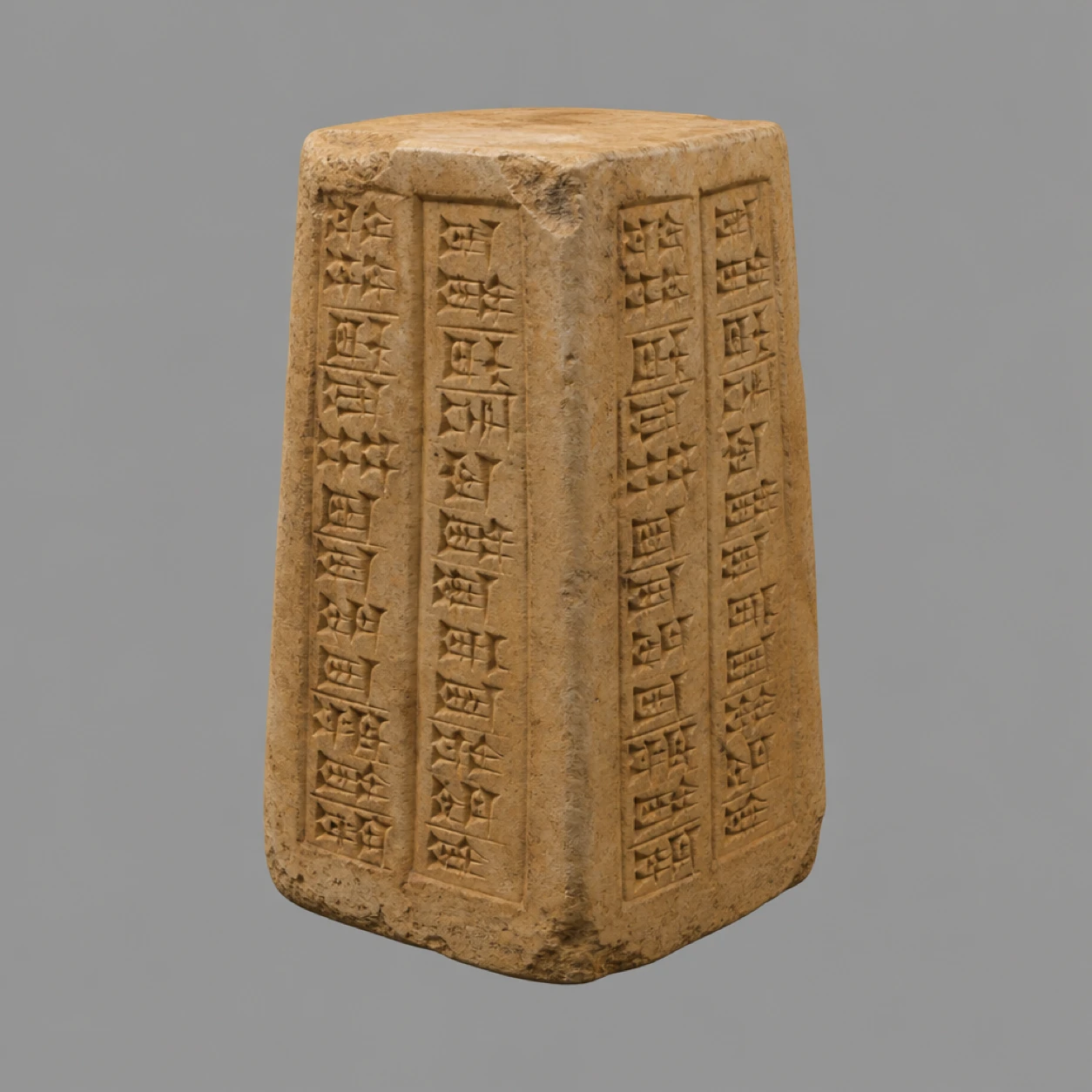
A cuneiform prism reads as temple or palace archive, not as a handheld scroll. Stand it upright on a plinth or shelf with room above for lamplight to rake the wedge faces, and keep the scale closer to a forearm-length column than to a pocket tablet. The Mesopotamian Temple Relics pack includes a stylised hexagonal prism for scribal chambers and royal foundation deposits.