The Louvre Stele: Hammurabi's Law Code in Basalt
In 1901 and 1902, French archaeologists digging on the acropolis at Susa in southwestern Iran pulled large stone fragments from the soil. When the pieces were joined, they formed a pillar taller than a man, covered front to back with wedge-shaped writing and topped by a carved scene of a bearded king and a seated god. The monument had not stood in Susa when the text was cut. It had traveled there as war booty centuries earlier, after an Elamite army looted cities in Babylonia. What the team had found was the most complete surviving copy of the laws of Hammurabi, sixth king of Babylon's First Dynasty. A Hammurabi stele is that kind of object: an upright inscribed stone that pairs royal justice with divine authority in relief and text.
Shamash, ring, and rod on a basalt column
A Mesopotamian law stele is an upright stone pillar meant to be read in public. The Louvre example is carved from black basalt and shaped as a tapering shaft with a rounded top. The upper register shows Hammurabi in a robe and high cap, facing Shamash, the sun god and god of justice, who sits on a throne and extends a ring and staff toward the king. Below that scene, thousands of lines of cuneiform run in columns down the face.
The inscription is in Old Babylonian Akkadian. The Louvre essay counts 282 legal judgments, covering prices, trade, family disputes, assault, theft, debt, and slavery. Britannica describes them as case laws collected toward the end of Hammurabi's reign, not a single statute book drafted on one day. The Louvre's own label stresses the same point: the monument is better read as jurisprudence, a record of how a Mesopotamian king decided cases, than as a modern legal code.
From Babylonian Mesopotamia to Shutruk-Nahhunte's plunder
Hammurabi ruled Babylon from about 1792 to 1750 BCE, according to the standard middle chronology used by the Louvre and Britannica. He united much of southern Mesopotamia after decades of warfare against rival city-states, including Mari. Toward the end of that career he ordered a public law monument. The stone itself was found far to the east.
Around 1150 BCE, the Elamite king Shutruk-Nahhunte raided Mesopotamia and carried trophies home to Susa. World History Encyclopedia follows the usual reconstruction: his army looted Sippar and took this stele, along with other Babylonian works, back to the Elamite capital. There it stood on the acropolis until Jacques de Morgan's French mission uncovered it in 1901 to 1902. The Louvre has displayed it since 1904. Provenance therefore runs from Old Babylonian Mesopotamia to Elamite Iran to Paris, which is why the "Hammurabi stele" most people picture is an Iranian find of an Iraqi monument.
Laws carved for a kingdom that no longer shared one custom
Earlier Mesopotamian rulers had issued law collections on clay. The Code of Ur-Nammu from Ur (circa 2100 BCE) and the laws of Lipit-Ishtar of Isin (circa 1930 BCE) predate Hammurabi's text and supplied models. Hammurabi's version is longer, more organized, and more explicit about penalties. World History Encyclopedia argues that by his reign Babylonia's population was more diverse than Ur-Nammu's homogenous patrimonial state, so the king needed sharper rules.
Each entry tends to follow an if-then pattern. Status mattered: the same injury could draw a fine, an eye for an eye, or death depending on whether the victim was free, dependent, or enslaved. The famous "eye for an eye" clause, Law 196 on the stele, is often quoted out of context. The Louvre notes that the formula aimed at proportional punishment, not endless private vengeance.
The prologue and epilogue frame the laws as Shamash's justice delivered through Hammurabi. That pairing of text and relief told subjects that the king did not invent arbitrary rules. He received and applied divine order.
When public monuments became museum trophies
For roughly five centuries after Hammurabi's death the stele likely stood in a Babylonian temple context, visible to priests and visitors who could read cuneiform or hear the text read aloud. Elamite capture broke that setting. In Susa the pillar became a trophy among other Mesopotamian spoils, still impressive but divorced from the court that made it.
Later copies of Hammurabi's laws turned up on clay tablets at sites across Mesopotamia, proving the text circulated after the stone left Babylonian control. Modern scholarship also debates whether the stele was primarily legislation, a school exercise, or a royal archive frozen in stone. The Louvre sidesteps a single label and presents the object as evidence for how early second-millennium rulers thought about justice across family, property, trade, and labor. What is clear is that survival depended on accident: a conqueror valued the stone enough to haul it east, and dry Elamite ruins preserved it until modern excavation.
The Louvre's Code de Hammurabi you can still see
The monument in Paris is inventory SB 8 in the Department of Near Eastern Antiquities. The Louvre gives its measurements as 225 cm high, 79 cm wide, and 47 cm thick. The catalogue lists the condition as broken (brisé), reflecting ancient damage and the modern reconstruction from large fragments. It is on display in Room 227 of the Richelieu wing, in the gallery dedicated to the piece.
Walk up close and the relief occupies only the curved summit. Hammurabi stands with one bare shoulder, beard carefully drilled, while Shamash sits elevated, handing symbols of authority. Then the eye drops to the text block, dense vertical wedges covering most of the shaft. Even visitors who cannot read Akkadian can grasp the intent: law made visible at monumental scale. Compared with small clay tablets in cases nearby, this stele was meant to be seen from a distance in a temple forecourt, not tucked in a scribe's archive.
French epigrapher Jean-Vincent Scheil published the editio princeps in 1902 after the discovery, which fixed the object's place in legal history before cuneiform studies multiplied other witnesses. SB 8 remains the anchor copy scholars cite in translation.
Basalt or diorite, and what the broken base hides
Material labels disagree in older literature. Britannica's overview calls the monument diorite, while the Louvre catalogue specifies basalt. Both describe a hard dark stone suited to fine carving; without lab analysis on the gallery label, treat the mineral name as a catalogue tradition, not a settled fact for lay readers.
The Louvre catalogue also records the piece as broken, and editors have long compared the stone with overlapping passages on clay tablets from other Mesopotamian sites. That backup matters if you expect one intact pillar to hold the entire text without help. For scene builders and historians alike, the honest picture is a battered, traveled monument whose completeness is editorial as much as physical.
In your scene
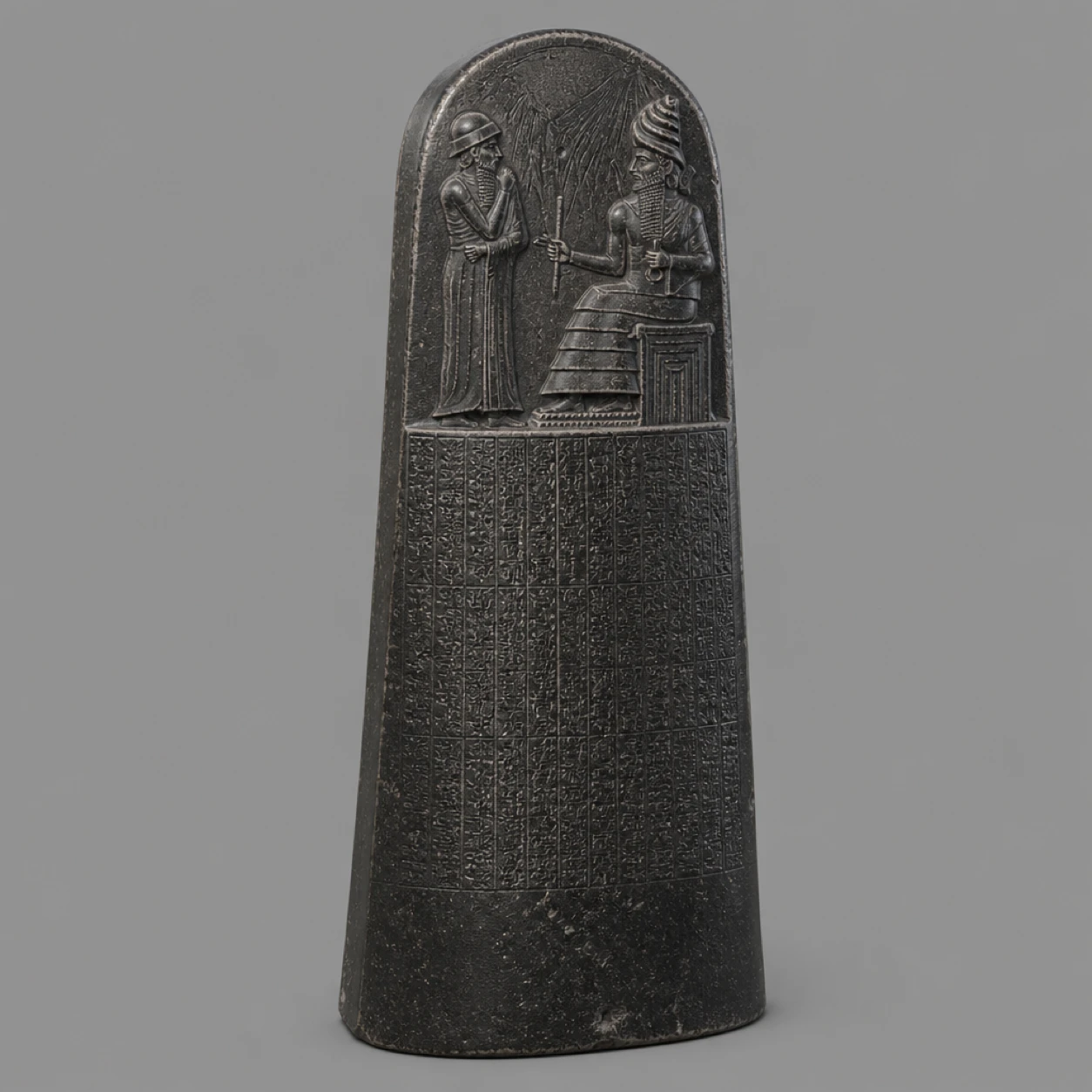
A Hammurabi stele belongs in a Babylonian temple court or a conqueror's trophy hall, not a generic dungeon wall. Give it height (the original is more than two meters), a clear Shamash-and-king relief at the top, and dense cuneiform below. For a full Mesopotamian set, see the Mesopotamian Temple Relics pack.