What Is a Kudurru? Kassite Boundary and Entitlement Stones
When a Kassite king granted fields or orchards in second-millennium Babylonia, the gift did not end with a spoken decree. Scribes drafted the terms in Akkadian cuneiform, and carvers set the contract into limestone with rows of divine symbols meant to enforce it. Those carved stones are kudurrus, often called boundary stones in modern museum labels. They are not general law codes carved for an entire kingdom. Hammurabi's famous black diorite stele lists crimes and penalties for everyone; a kudurru records one private or royal land transfer and calls the gods to witness it.
A kudurru (Akkadian kudurru, "frontier" or "boundary") is a Kassite-period entitlement stone: a block or slab of carved limestone bearing a grant of land, divine emblems, and curses on anyone who challenges the gift. Most date from Kassite rule over Babylonia, roughly the 16th to 12th centuries BCE, when almost no other monumental art from that dynasty survives.
Akkadian names and the carved block
The term ties the object to borders and property lines, though many kudurrus stood in temples rather than in the open field. The Metropolitan Museum calls this group kudurrus or narûs. Scholars once treated them as field markers; the stones more likely stood in temples, where the grant was kept sacred. Visually, a typical kudurru is a rectangular limestone stele, sometimes tapered or ovoid, carved in low relief on one or more faces.
The upper register often carries a coiled serpent, crescent, star, solar disk, temple facade, or animal tied to a god. Below that band runs the cuneiform text: names of king and beneficiary, field boundaries, exemptions from tax or military service, and a list of deities invoked as witnesses. The stone was meant to be permanent. Britannica notes that the original kudurru usually stayed in the temple of the gods who guaranteed the grant, while the landowner received a clay tablet copy. If dispute arose, the stone in divine custody was the authoritative record.
Kassite rule and the age of entitlement stones
The Kassites ruled Babylonia from roughly the 16th to the 12th centuries BCE and held southern Mesopotamia for centuries. Their kings patronized temples, repaired canals, and issued grants to relatives, officials, and cult foundations. Kudurrus cluster in that period because royal generosity and temple archives went together. When a grant transferred irrigated land, the deed had to survive the death of both king and recipient.
Dating individual stones depends on the king named in the text. What is secure is the cultural pattern: Babylonia's Kassite centuries produced a large surviving corpus of entitlement stones, where earlier dynasties left different documentary habits. After Kassite power faded, kudurru production largely ended, though later rulers occasionally commissioned stone copies of older clay deeds when walls collapsed and records were lost.
Gods on stone, curses in the text
A kudurru worked as contract and amulet. The carved symbols were not mere decoration. Each emblem identified a deity who watched over the grant. A Metropolitan Museum fragment still shows Marduk's mushhushshu dragon and spade, Shamash's sun, Ishtar's star, and Ea's goat-fish. The Louvre Meli-Shipak stone adds a crescent, coiled serpent, scorpion, lion-headed mace, Marduk's lance, and a dog tied to Gula.
The Akkadian text spells out what happens if a future official seizes the fields, alters the border, or erases the beneficiary's name. Curses call for disease, military defeat, or divine anger. That tone differs sharply from Hammurabi's stele, which addresses crimes in the abstract for the state. A kudurru protects one gift to one person or temple branch, generation after generation. World History Encyclopedia publishes a British Museum stone from about 1125–1100 BCE: Eanna-shum-iddina, governor of the Sea-Land, grants land to Gula-Eresh. The caption records curses and deity symbols, and it names no Babylonian king.
Clay copies, temple storage, and stones carried to Susa
The ritual life of a kudurru did not require it to mark a ditch in the countryside. Many were deposited before the gods whose symbols they bore. Elamite armies nonetheless carried Babylonian kudurrus to Susa as war booty in the 12th century BCE, which is why so many Kassite stones were excavated at the Susa acropolis in the 1890s rather than in Iraq.
When a wall crushed an original clay monument, descendants could commission a limestone replica. The Louvre's Nazimaruttash kudurru records that heirs had a stone copy carved under Marduk-apla-iddina I after the first clay monument was destroyed. A later Louvre stone shows another path: land granted under Melishipak, contested at his death, then confirmed by Marduk-apla-iddina I.
The Louvre's Meli-Shipak kudurru
One of the best-studied examples is the Kudurru de Meli-Shipak in the Musée du Louvre, inventory SB 22. The stone records King Melishipak II granting land to his son Marduk-apla-iddin. It measures 65 cm high, 30 cm wide, and 19 cm thick, carved in limestone with divine symbols in low relief. The Louvre describes symbols for Ishtar, Sin, Shamash, Ea, Marduk, Gula, Nusku, and others: star, crescent, solar disk, horned temple tops, a coiled serpent, a scorpion, a lion-headed mace, Marduk's lance, and a dog often linked to the healing goddess Gula.
De Morgan's team found the stone at the Susa acropolis in 1898, trench 7α. The catalogue states it was brought from Babylonia to Susa as war booty in the 12th century BCE. The object's general condition is good, though many Kassite stones were hammered in antiquity. As of the museum's online record, the kudurru is not on view at the Louvre in Paris; it is held at the Musée Bonnat-Helleu in Bayonne, France, while remaining part of the Louvre's Department of Near Eastern Antiquities collection.
Compared with the grand figural kudurru of Melishipak II (Louvre SB 23, 83 cm high, also not on view), the SB 22 stone is the symbol-register type scholars cite when teaching how to read divine emblems.
Limestone, looting, and what counts remain uncertain
Most kudurrus are limestone. A large surviving group is known, chiefly from Susa and museum collections worldwide, but catalogues still edit the corpus. Not every survivor names a king; some name governors of the Sea-Land in southern Babylonia without mentioning the crown. Provenance is often "Mesopotamia, modern Iraq," because 19th-century dealers stripped findspot detail.
Interpretation of individual symbols can be debated when a sign could belong to more than one deity. The Louvre kudurru of Marduk-apla-iddina I (SB 26) names forty-five deities in the text and shows eighteen symbols in relief, including Nusku's lamp. Whether a given kudurru ever stood outdoors as a boundary marker or only inside a shrine may vary case by case. The secure core remains: these stones were Babylonia's entitlements made visible, guarded by carved gods and cuneiform curses, at a moment when the Kassite dynasty turned land law into temple art.
In your scene
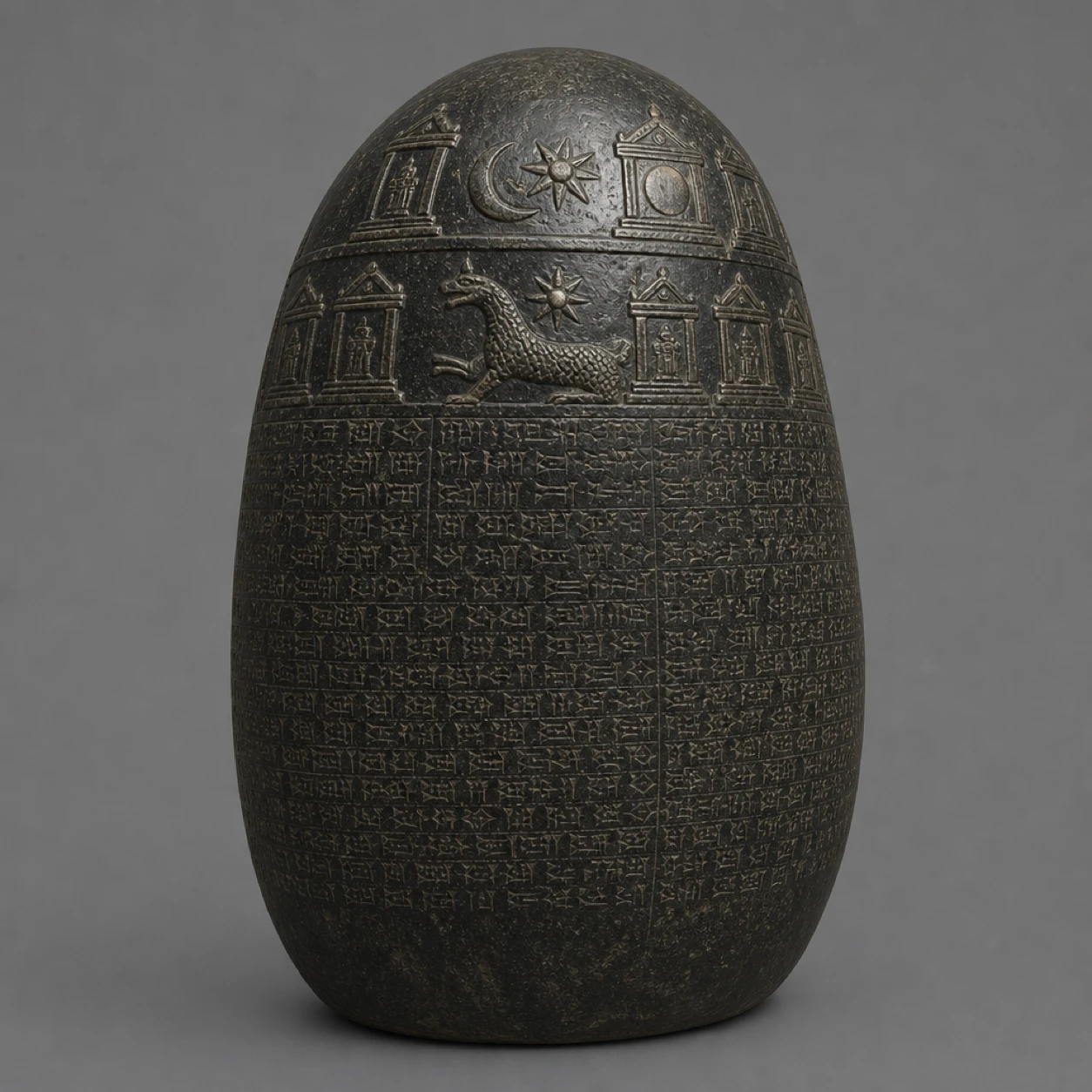
A kudurru reads as temple archive furniture or palace gift record, not as a national law code. Place it upright in a shrine niche or scribal court with symbols above text, and keep scale modest: surviving examples often stand between knee and chest height. For Lamassu guardians, law stele, and votive figures in the same set, see the Mesopotamian Temple Relics pack.
Sources
- Musée du Louvre: Kudurru de Meli-Shipak (SB 22)
- Musée du Louvre: Kudurru de Nazimaruttash (SB 21)
- Musée du Louvre: Kudurru de Melishipak II (SB 23)
- Musée du Louvre: Kudurru of Marduk-apla-iddina I (SB 26)
- Encyclopaedia Britannica: kudurru
- World History Encyclopedia: Boundary Stone from Mesopotamia
- The Met: kudurru fragment 1985.45