Norito and Kyō: Prayer Words Rolled at Shrine and Temple
A Japanese prayer scroll is usually a rolled makimono (巻物), a horizontal handscroll you unroll from right to left to read. The words inside may be Shinto norito (祝詞), ritual phrases addressed to kami, or Buddhist kyō (経), scripture copied for merit and recitation. Game packs label the prop simply "prayer scroll" because both traditions share the same object shape: paper or silk wound on a wooden roller, protected in a brocade wrapper, brought out for festival, funeral, or dedication rites. The scroll is not the prayer itself but the container that carries language toward gods or buddhas.
Norito, kyō, and two prayer traditions
Shinto has no single sacred book in the strict sense that Christianity or Islam might claim, yet it preserves fixed ritual language. Norito are formal prayers in classical Japanese, recited by shrine priests (kannushi) to praise a kami, report offerings, and ask for blessings. Buddhist temples use sutra scrolls instead, brushing the Buddha's words in columns that march down the sheet as you pull the roll.
The two lines crossed for centuries. Britannica notes that from the 8th century onward kami were interpreted as protectors of Buddhism, and monks sometimes read sutras before shrine altars. A courtyard prop therefore might sit in a haiden after a norito service or in a temple storehouse beside copied Lotus Sutra chapters. Wildform's model reads as a compact rolled scroll you can place on a lectern, in a priest's hands, or on an offering table next to a gohei wand.
Makimono: how the roll is built and read
Makimono means "rolled thing." The support is paper or silk, often joined sheets pasted edge to edge for length. A wooden rod (jiku) at the inner end lets the reader wind the text back up; an outer roller or clasp keeps the bundle tight. Reading moves from right to left, top to bottom in vertical columns, the opposite of modern Western books.
Wealthy patrons commissioned sutra copies in gold or silver ink on indigo-dyed paper, a luxury that turned scripture into painting. Shrine norito manuscripts are usually plain black ink on white, sometimes bound as folded booklets rather than endless rolls, but festival display and game art favor the visible cylinder of a makimono. When you animate the prop, a slow unwind with kanji columns appearing sells authenticity better than a flat texture.
Norito at the shrine and the Engishiki record
World History Encyclopedia lists the Engishiki, compiled in the 10th century CE, among key sources on early Shinto because its fifty books cover laws, rituals, and prayers. Major shrines received state norito for seasonal rites; local kannushi adapted the phrasing for ujigami, the clan or village guardian. The language is archaically formal, meant for vocal performance with precise cadence rather than silent reading.
Visitors rarely see norito scrolls on the sandō. Worship at the haiden is simpler: approach, toss a coin, clap twice, bow, and speak a personal wish. Priests perform norito inside the sanctuary or at a matsuri altar, often from memory or a prompt copy hidden on a stand. A prayer scroll in a shrine scene therefore signals a formal rite, a priest NPC, or a backstage preparation room rather than the everyday visitor path. Pair it with incense smoke if the ceremony is large.
Sutra copying, merit, and syncretic courtyards
Buddhist handscrolls were copied to gain religious merit for a living or dead patron. Nobles funded thousands of chapters, dedicating complete sets to temples such as Chūsonji or Jingōji. Monks read portions aloud during memorial services; lay believers sponsored copies even when they could not read every character.
When shrine and temple shared precinct walls, sutra recitation could purify the ground before a kami festival. That history matters for level dressing: a prayer scroll on a Buddhist lectern near a torii is historically plausible, not an error. After the Meiji government ordered shinbutsu bunri, formal separation of kami and buddha worship in 1868, many shrines shed visible Buddhist icons, yet scroll storage and festival borrowings continued in places. A single scroll prop can hint at that layered past without spelling out the policy date in dialogue.
Dragon Girl frontispiece: Lotus Sutra at the Met
Museum scrolls show the craft at court level. The Metropolitan Museum of Art holds "Devadatta," Chapter 12 of the Lotus Sutra (Hoke-kyō, Daibadatta-bon), a Japanese handscroll from the 12th century Heian period. Medium: gold and silver on indigo-dyed paper. Dimensions: about 10 1/16 inches high by 33 feet long (25.6 by 1005.8 cm).
The pictorial frontispiece shows the Dragon King's daughter emerging from her palace beneath the sea to offer a jewel to the Buddha on Eagle Peak, an episode famous in Heian literature and cited in relation to The Tale of Genji. The text columns that follow are one chapter from a set that once illustrated all twenty-eight chapters of the Lotus Sutra. This is Buddhist kyō, not a Shinto norito, yet it is the reference artists use for rolled prayer props: indigo field, metallic script, illustrated opening sheet, extreme length stored coiled.
For games, borrow the color contrast and the frontispiece vignette rather than the full 33-foot span. A half-unrolled scroll with a miniature painting zone and dense kanji blocks reads instantly as sacred paperwork.
Ofuda, omamori, and what is not a scroll
Shrine paper talismans confuse naming. Ofuda are flat wood-pulp sheets stamped with the shrine name and sometimes a kami emblem; you take them home to mark a wall or altar. Omamori are brocade sachets with prayers sewn inside. Ema are wooden plaques for written wishes. None of these unroll.
A prayer scroll is longer, meant for recitation or archival copying, and usually handled only by clergy or sponsors. Jizo statues and stone lanterns populate the outdoor approach; scrolls belong indoors, under a roof, or in a ceremonial tent during a festival reading. If your scene needs a visitor's wish object, use ema instead and reserve the scroll for priest interactions.
In your scene
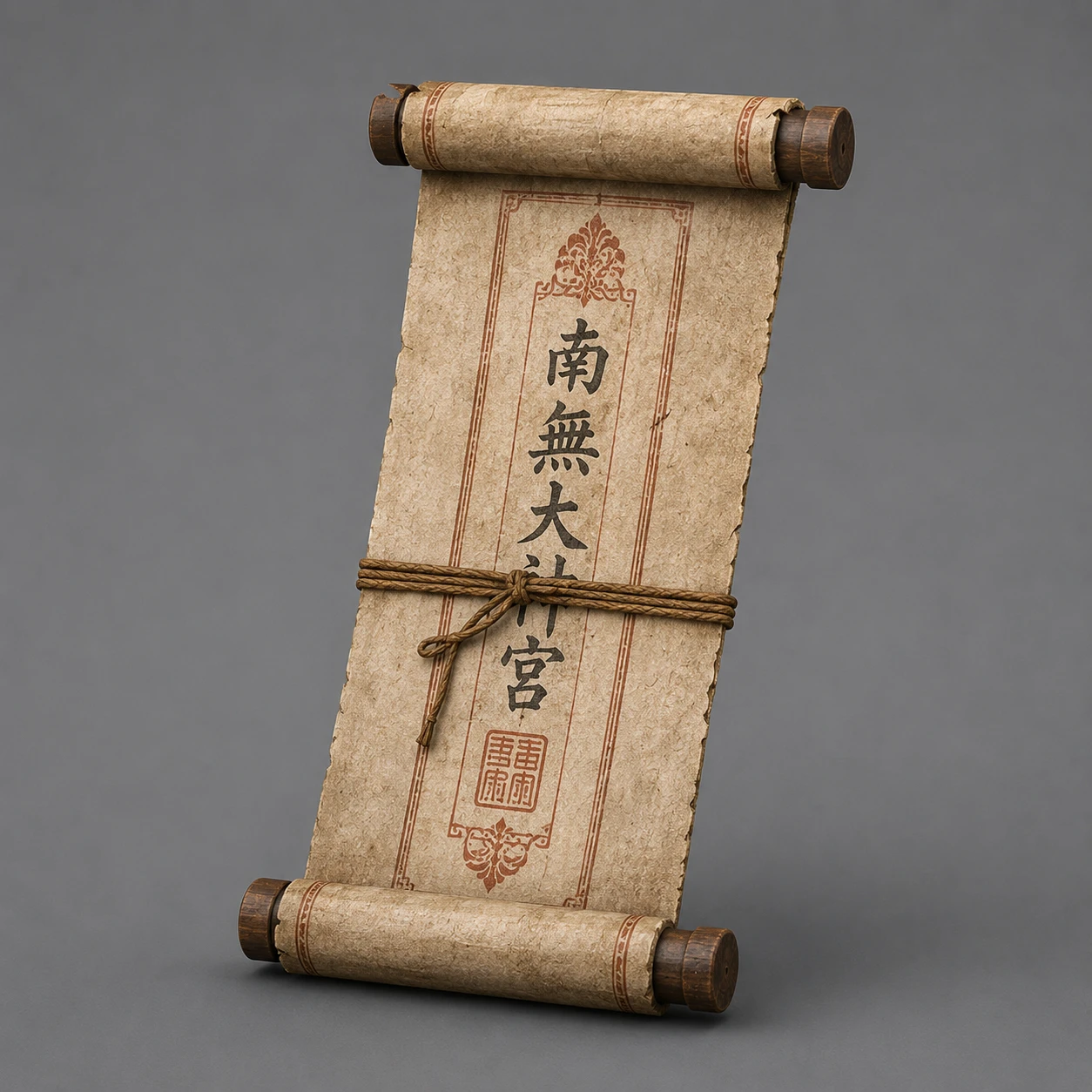
Place a brocade-wrapped makimono on a lacquered stand inside the haiden, with a priest NPC unrolling it toward the altar. Show a sliver of gold-on-indigo script or plain black norito columns, not legible fantasy glyphs. For a syncretic courtyard, tuck a scroll case beside offering boxes and a low incense burner. Our Shinto Shrine Relics pack includes a prayer scroll model scaled for altar furniture and ritual close-ups.