What Is a Jizo? Japan's Guardian Monk of Roads and Children
A Jizo statue is the small stone or wood figure of a shaven-headed monk you meet at Japanese roadsides, temple yards, and cemetery paths. Called Jizō Bosatsu in formal speech and often o-Jizō-san in daily life, he is the Japanese form of Kshitigarbha, a bodhisattva who vowed to help every suffering soul before accepting enlightenment himself. In practice he protects travelers, women in childbirth, and children, including those who died young.
What it is
Jizō (地蔵) is a bodhisattva, an enlightened being who delays final Buddhahood to guide others. Unlike crowned bodhisattvas in gilt temple halls, he almost always appears as a plain monk: shaved head, simple robe, gentle face. Britannica describes him carrying a clerical staff called a khakkara in Sanskrit, the Japanese shakujō, with rings that jingle as he walks, and a wish-granting jewel called the cintamani or hōjunotama. Sculptors often add an urna, the tuft between the brows, and elongated earlobes to mark his sacred status.
The name Kshitigarbha means "earth womb" or "earth store" in Sanskrit. Japan shortened the figure into a folk guardian as much as a temple deity. Stone roadside statues may be only knee high or less. Larger hall sculptures stand on lotus pedestals. Many outdoor figures wear red bibs and caps placed by visitors, a modern custom tied to child protection that grew alongside the cult rather than defining the medieval image.
Origins and history
Worship of Kshitigarbha is attested in India from roughly the 4th century CE. The cult spread through Central Asia into China as Dicang and reached Japan by the 8th century, where the reading Jizō took hold. Britannica notes that while Chinese tradition sometimes treats him as an overlord of hell, in Japan Emma-ō holds that judicial role and Jizō is praised for mercy toward the dead, especially children.
Devotion widened during the Heian (794–1185) and Kamakura (1185–1333) periods, when Pure Land teaching stressed the age of mappō, a time when ordinary people could not rely on older paths to salvation alone. Jizō answered that anxiety. He heard confessions, guided souls between rebirths, and promised help in the present world as well as the next. World History Encyclopedia lists him among Buddhist figures who became popular kami in the syncretic landscape of medieval Japan, alongside Kannon and Amida.
Role in Japanese religion
Jizō's jobs overlap but stay distinct. He is a protector of travelers on mountain passes and village boundaries, which is why statues sit at crossroads and path forks. He aids women in childbirth and sick children. Above all, many Japanese turn to him for deceased or unborn children, including miscarried and stillborn infants.
Britannica stresses that he does not rule hell in Japan. Instead he enters the suffering realms, opens gates with his staff, and lights darkness with his jewel. Folklore adds a gentler scene: souls of children blocked at a riverbank receive his robe as shelter. Parents dress roadside statues in children's clothes or pile small stones before them as prayers that their care on earth might ease a child's passage. None of that replaces temple doctrine, but it explains the affectionate o-Jizō-san address you hear at neighborhood shrines.
From temple icon to roadside stone
Early images followed continental models: a standing monk with staff and jewel, sometimes shown in six aspects linked to the six realms of rebirth. As the cult spread, local workshops carved cheaper granite copies for parish roads. Buddhist temples, Shinto precincts, and purely folk sites all received figures because the monk's protective role crossed sect lines.
The Kamakura period left some of the finest wooden sculptures, while the Edo period (1603–1868) multiplied small stone guardians for common budgets. Red bibs and hats became a visible layer after that spread, signaling a child's gift to a child's protector. Firefighters and pilgrims also claimed Jizō as a patron in regional lore, so a single village might name its statue for toothache relief, safe birth, or travel luck. The type stayed recognizable even when the legend shifted.
A Jizo you can still see
Outdoor stone Jizo rarely enter museums because they remain in active worship. A signed wooden masterpiece survives in New York. The Metropolitan Museum holds The Bodhisattva Jizō carved by the sculptor Intan, dated 1291, Kamakura period. It is Japanese cypress (hinoki) with polychrome pigments, gold paint, cut gold leaf, and rock-crystal eyes, catalogued as object 2023.640a-c and acquired in 2023.
The museum notes that only three surviving sculptures bear Intan's name. This one shows Jizō as a youthful monk in a patchwork surplice, staff in the right hand to rattle awake human delusion, jewel in the left to grant wishes. Height with pedestal is 53 1/2 inches (135.9 cm). The signature appears on a wood tenon that slots the feet into the lotus base, a detail you would never see on a weathered roadside stone but that records how elite workshops treated the same iconography parish carvers copied in granite.
What archaeology and records show
Granite roadside statues survive in huge numbers across Japan, yet few carry dates. Scholars rely on temple inventories, painted scrolls, and dated sculptures like Intan's for chronology. The Smithsonian's National Museum of Asian Art holds a 12th to 14th century silk painting, F1903.271, where Jizō presides over the Ten Kings of Hell and reminds the judges to temper punishment with mercy. The label ties cult expansion to periods of warfare in the late 12th and 14th centuries.
Painted and carved evidence agrees on the core silhouette: monk's robe, staff, jewel, compassionate expression. What varies is scale, material, and local legend. Uncertainty remains about the first dated stone roadside figure in any given province, so articles that quote precise century counts for folk sculpture should be read cautiously. The iconography itself is stable; the parish stone beside your path is probably Edo or later even when it copies Kamakura elegance.
In your scene
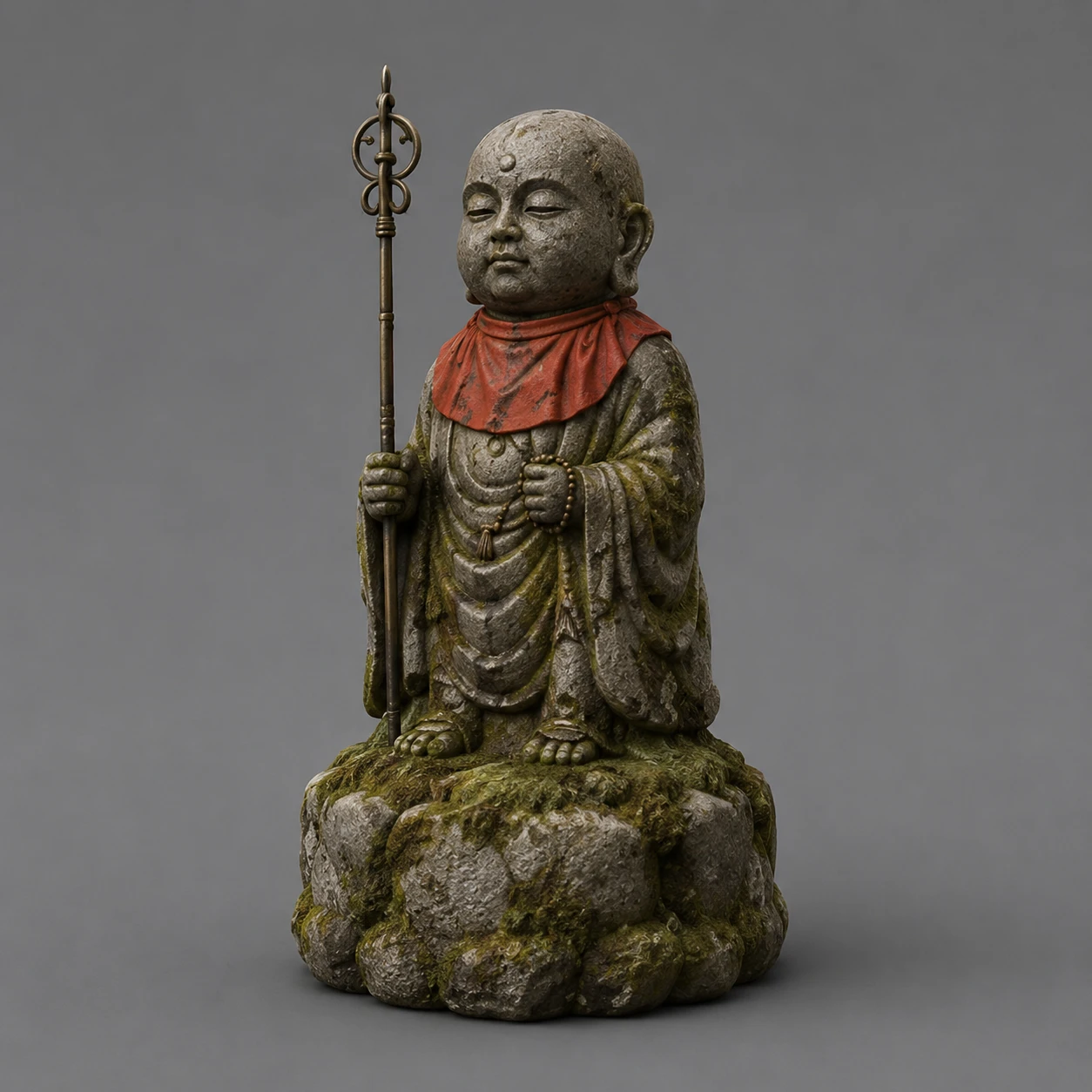
Line a forest path or cemetery edge with small stone Jizo figures, optionally with red bibs for instant readability. Pair one near a gohei-marked torii or a kitsune guardian if your shrine mixes Buddhist and Shinto props. Our Shinto Shrine Relics pack includes a Jizo statue model sized for roadside markers and temple yards.