Poseidon's Trident: The Greek Sea God's Three-Pronged Spear
When Poseidon and Athena competed for Athens, he struck the Acropolis rock with a three-pronged spear and a spring rose. The water was salt. The city took Athena's olive tree instead, and vase painters kept drawing those prongs so you could still tell the sea god in a crowded scene. An Attic cup in The Met still shows him holding them.
Three prongs and the god you are looking at
The Greek word for the implement is simply trident, from tri- (three) and the root for a tooth or prong. Vase painters and sculptors drew it as a long shaft ending in three barbed points, often modeled on a heavy fishing spear used in the Mediterranean. Once you know the silhouette, Poseidon becomes easy to pick out in a crowded frieze: mature, bearded, frequently nude or lightly draped, and almost always gripping the forked weapon in one raised hand.
Britannica's entry on Poseidon treats the trident as his primary symbol, perhaps derived from an old fish spear before it became purely divine. Zeus has the thunderbolt; Hades has the cap of darkness; Poseidon has this. Roman artists later passed the same attribute to Neptune, but the form is unmistakably Greek.
Cyclopes at the forge during the war against the Titans
The trident did not grow on a reef. Greek poets assigned its making to the Cyclopes, the one-eyed smiths who also armed Poseidon's brothers. Britannica follows Hesiod in saying that Poseidon's trident, like Zeus's thunderbolt and Hades' helmet, was fashioned by the three Cyclopes after the younger gods freed them from imprisonment. The gift came as payback during the struggle against the Titans, when a matched set of divine weapons tipped the balance toward the Olympian order.
That origin story matters for how Greeks imagined the object's power. A trident forged in the same furnaces as Zeus's lightning was not a fisherman's tool anymore. It was a piece of cosmic kit, as dangerous on dry land as in the surf.
Salt water, an olive tree, and the contest on the Acropolis
One of the best-known myths tied to the weapon is Poseidon's rivalry with Athena for patronage of Athens. Britannica lists the contest among the central tales about the god: each deity offered a gift to the city, and the Athenians chose Athena's olive tree over Poseidon's contribution. In most versions Poseidon strikes the bedrock with his trident, opening a spring. The water is salty, which underscored his command of the sea but proved less useful day to day than timber, oil, and fruit from Athena's tree.
The story was not abstract geography. Athenians pointed to marks in the Acropolis rock and to a brackish spring within the Erechtheion precinct as physical reminders of the strike. Win or lose, Poseidon remained present on the sacred hill through those traces and through cult titles that linked him to the city's foundations.
Earth-shaker, storm caller, and maker of springs
Poseidon's reach extended well beyond ship lanes. Britannica describes him as god of earthquakes as well as the sea, worshipped under epithets such as Enosichthōn and Ennosigaios, "earth-shaker." Cult titles like Asphalius ("stabilizer") show the other side of the same anxiety: communities that feared sudden tremors also prayed for the god to hold the ground steady beneath their houses.
The trident connects both domains in myth. Poseidon could smash cliffs, dry out a plain, or open a freshwater spring with a blow to stone, depending on the story. Sailors saw the same weapon raise swells and wreck harbors when the god was angered, or calm the route when he was appeased.
Polybotes, the Giants, and the trident in battle
When the Olympians fought the Giants, Poseidon's trident moved from symbol to combat gear. One recurring scene pits him against Polybotes, a son of Gaia who fled across the Aegean. In the most common version Poseidon overtakes him near Kos, breaks off a chunk of the island, and crushes the Giant beneath it, creating the smaller island of Nisyros. Painted pottery sometimes shows the boulder throw; red-figure cups from the late fifth century BCE show a more direct duel in which Poseidon raises the trident against a falling Polybotes while Gaia rises from the ground to plead for her child.
The Metropolitan Museum holds an earlier statement of the same myth on a black-figure neck-amphora attributed to the Swing Painter, object 98.8.11, dated to about 540 to 530 BCE. The Met's description names Polybotes explicitly and shows Poseidon overcoming the Giant with a boulder broken from Kos, a variant that stresses tectonic force as much as the pronged spear. Red-figure kylikes in the same Gigantomachy tradition put the trident itself in Poseidon's raised hand, a reminder that artists chose different moments from one sprawling myth cycle.
Amasis Painter's kylix: Poseidon armed at Troy (1989.281.62)
The clearest Met kylix that puts the weapon in Poseidon's grip is object 1989.281.62, an Attic cup attributed to the Amasis Painter and dated to about 540 BCE. The cup is black-figure terracotta, roughly 12.4 cm high with a diameter near 25.7 cm, and the museum's label ties the decoration to Book 13 of Homer's Iliad. On one side, grooms bustle in Poseidon's underwater stables as chariot horses rear between columns. On the other, the god of the sea moves among Greek warriors with his trident in hand, turning back to rally the army he has chosen to support.
The cup entered the collection as a gift of the Norbert Schimmel Trust in 1989. It remains a standard reference for how Archaic painters linked Poseidon's forked spear to martial intervention, not only to calm seas.
Isthmia, coastal shrines, and the god's annual festival
Poseidon's trident also marked civic religion far from Athens. Britannica notes the Isthmia, a major festival with athletic and equestrian contests held in alternate years near Corinth on the Isthmus, the narrow land bridge that tied the Peloponnese to mainland Greece. That location made Poseidon a natural patron of travelers, merchants, and anyone who moved goods by sea before switching to road.
Coastal sanctuaries from the Aegean to Magna Graecia kept the same visual language: a bearded god, dolphins or horses nearby, and the three-pronged spear that told worshippers which power they were addressing. Votives might be miniature bronze tridents, painted cups, or large cult statues whose metal weapons were replaced when they wore out. The object in a temple was less a literal fisherman's tool than a stand-in for the force that could open water routes or shake the ground beneath a city wall.
Bronze votives, marble gods, and what we cannot recover
Full-scale bronze tridents rarely survive from antiquity. What we have instead are stone and terracotta gods who once held metal weapons inserted separately, plus countless painted cups and relief fragments where the prongs are drawn in slip or glaze. Some coins from coastal cities show Poseidon with trident raised, compressing the entire identity of the god into a few millimeters of silver.
Modern reconstructions in museums therefore lean on literary descriptions and vase evidence rather than on a single excavated weapon. Scholars still debate how closely cult statues at sanctuaries such as the Isthmus of Corinth, site of the Isthmian games in Poseidon's honor, mirrored the painted type. The attribute itself is stable even when the myth scene changes: spring on the Acropolis, Giant on a cup, horses in the depths, warriors on the plain at Troy.
In your scene
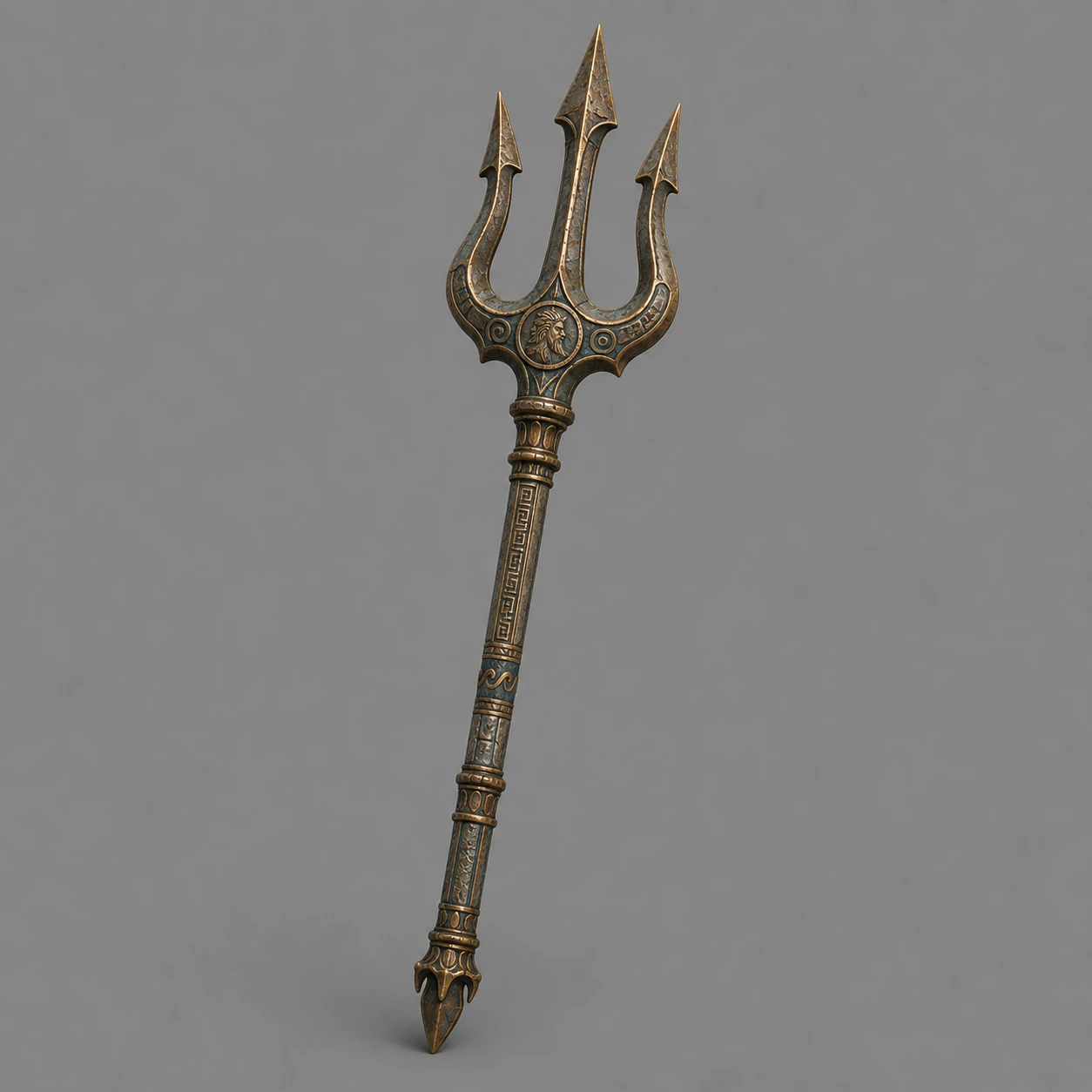
Lean a trident against a column near a basin or spring, or mount it on a wall bracket above a ship model or coastal map. The prongs read instantly at temple scale and pair naturally with a Zeus bust on an opposite niche, the two brother-gods flanking a sanctuary hall. Our Greek Temple Relics pack includes a stylised Poseidon trident for seaside altars, earthquake-shattered ruins, and looted divine armories.