Zeus Bust: King of the Gods in Bronze and Marble
A Zeus bust is a sculpted image of Zeus, the Greek king of the gods, usually showing his bearded head and upper torso rather than the full standing body. In ancient religion the same god could appear as a colossal seated idol inside a temple, as a bronze striding figure on a sanctuary terrace, or as a smaller dedicatory piece in a treasury. Modern museum labels and game props often say "bust," but the most celebrated surviving bronze associated with Zeus is a complete over-life-size nude figure from a shipwreck off Cape Artemision. That statue, inventory number NM Br. 15161 in Athens, is the anchor piece for understanding how Greek sculptors gave Zeus physical presence in the early Classical period.
Bearded king, thunderbolt, and sculptural types
Zeus in Greek art is almost always bearded and mature, a father figure rather than a youthful hero. Artists identified him with a lightning bolt, a sceptre, or an eagle at his side, and sometimes with bulls or oak trees in mythic scenes. A bust concentrates on the face and beard, the attributes that made the god readable at a glance when a viewer approached an altar or treasury room.
World History Encyclopedia notes that Zeus stands at the center of Greek religion as ruler of Olympus, weather, law, and hospitality. Sculptural types ranged from small bronzes in household shrines to monumental works that dominated entire temple interiors. The word bust as modern audiences use it does not map cleanly onto ancient categories: Greeks spoke of agalmata, cult images that could be seated, standing, or fragmentary when only the upper part survived burial or shipwreck. When archaeologists and collectors say "Zeus bust," they usually mean any upper-body or head-and-shoulders format, even though the grandest early Classical statement of the god in bronze is a complete figure.
Zeus images in Greek temples and sanctuaries
Temples to Zeus were among the largest and most prestigious buildings in the Greek world. Inside them, the cult image was often a seated colossus meant to overwhelm the visitor with divine scale. At Olympia, the Temple of Zeus housed Phidias's chryselephantine Statue of Zeus, more than 12 meters tall and built from gold and ivory over a wooden core around 430 BCE, counted among the wonders of the ancient world.
Outside the cella, sanctuaries accumulated bronze and marble gifts from cities and victorious athletes. Britannica's account of Olympia describes bronze statues of Zeus called Zanes, erected from fines imposed on athletes who broke Olympic rules and set near the stadium entrance as a public warning. Terra-cotta and bronze votives also turned up in excavations, including a half-life-size group of Zeus and Ganymede dated to about 470 BCE. A Zeus bust in a treasury or priestly room would have belonged to this same world of dedication and display: not the single image that received sacrifice at the altar, but a visible claim that the donor honored the king of the gods.
Severe Style bronzes in the early Classical period
The decades after the Persian Wars saw a shift in Greek sculpture toward clearer anatomy, calmer faces, and poses that read as controlled power rather than Archaic stiffness. Scholars call this moment the Severe Style, and bronze statuary was one of its greatest achievements. Hollow casting allowed large, balanced figures with extended arms and carefully weighted strides.
The Greek Ministry of Culture page on the Artemision statue describes the work as a masterpiece of that early classical era, with intricate hair and beard, a striding pose, and arms stretched to balance the force of a blow about to be delivered. The figure's spirit matched a period when Greek cities celebrated victory over Persia and invested in public art that projected confidence. Dating falls around 460 BCE in that source, with height 2.09 meters and arm span 2.10 meters. Other references narrow the range to roughly 460–450 BCE, which is typical when sources round differently.
Busts, bodies, and why the famous bronze is whole
It is worth stating plainly: the Artemision Bronze is not a bust. It is a full-length nude male god, recovered in pieces from the sea and reassembled into a standing warrior of divine scale. Game assets and modern reproductions often compress Zeus into a head-and-shoulders format because that reads well on a shelf, a pediment niche, or a loot pile in a temple interior.
Ancient viewers more often met Zeus as a complete body. Seated temple images filled the gaze from floor to ceiling; striding bronzes filled horizontal space with extended arms. What survives today skews toward fragments: marble heads without torsos, bronze feet without bodies, and cult statues lost to metal recycling. A "Zeus bust" in a museum case is frequently a Roman copy or a salvage piece from a larger monument. The Artemision figure matters precisely because it escaped that fragmentation: bronze resisted shipwreck, and the pose still communicates action across more than two meters of height. When you place a bust prop in a scene, you are evoking the recognizable face of Zeus; when you study fifth-century religion, the full figure is the benchmark.
The Artemision Bronze at the National Archaeological Museum
The statue known as the Artemision Bronze, Zeus of Artemision, or Poseidon of Artemision holds inventory number X 15161 (often cited as NM Br. 15161) in the National Archaeological Museum, Athens. Britannica lists it among the museum's finest Classical pieces, a bronze of about 450 BCE possibly associated with the sculptor Kalamis, though ancient attributions for large bronzes are rarely secure.
The god stands with left foot forward, weight settled into the stride, head turned slightly left, both arms extended. The right arm is bent as if launching a projectile; the left reaches forward with open hand. Empty eye sockets once held inlays, and lips, nipples, and brows could carry contrasting metals, a common luxury treatment on Greek bronzes. World History Encyclopedia's image essay on the piece places the find in the twentieth century: an arm located in 1926 CE and the rest recovered in 1928 CE off northern Euboea. The wreck context was later, around the second century BCE, suggesting the statue was cargo on a Roman-period ship rather than lost in the fifth century BCE. Today the bronze occupies a central gallery in Athens, and casts appear in university collections for teaching Classical pose and proportion.
Shipwreck recovery and whether the god holds a bolt or trident
The missing attribute in the right hand has driven a long debate. If the figure hurled a thunderbolt, he is Zeus; if he thrust a trident, he is Poseidon. The sea find encouraged Poseidon identifications for decades, yet World History Encyclopedia's Zeus article summarizes the art-historical argument that the wide stance and arm geometry match other images of Zeus launching a bolt, and that a long trident would awkwardly cross the face. The Olympic Games culture portal presents both names in its title, Statue of Zeus or Poseidon from Artemision, then describes Poseidon brandishing a trident "according to a different view" and Zeus ready to hurl his thunderbolt.
Most recent scholarship cited in general references sides with Zeus, while museum signage in Athens has shifted over time and popular books still use either name. Britannica's museum survey entry calls the piece a statue of Poseidon when describing the bronze found off Cape Artemision in 1928, which shows how even tier-one summaries disagree. For scene builders, the practical takeaway is iconographic: pair a bearded striding god with a thunderbolt for Zeus, or with a trident if you deliberately want the Poseidon reading. The related Poseidon trident article covers the sea god's weapon; here the same bronze body could have carried either attribute in the sculptor's original design.
In your scene
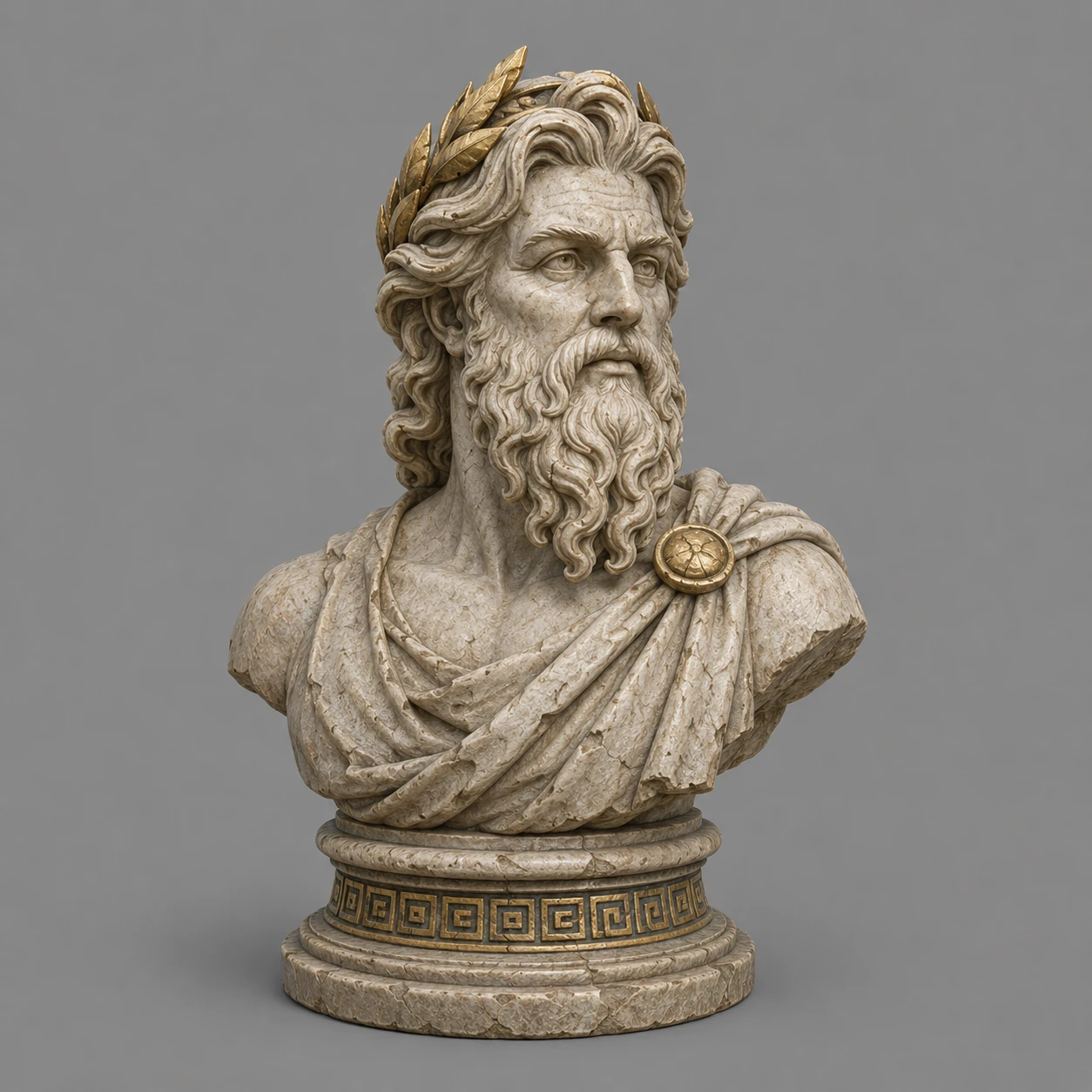
A Zeus bust reads instantly on a temple shelf, treasury table, or behind a priest's chair, especially if the beard and brow are lit from below. For a more dramatic fifth-century Greek tone, echo the Artemision pose in a full figure nearby: wide stance, one arm drawn back, the other forward, as if the god just entered the room. Our Greek Temple Relics pack includes a stylised Zeus bust suited to shrine antechambers, oracle courts, and looted sanctuary props.