Chacmool: Mesoamerica's Reclining Offering Bearer
A chacmool is a stone sculpture of a reclining human figure, elbows propping the torso, head turned sharply to one side, and a bowl or shallow dish held on the chest or stomach. The type is one of the most recognisable forms in Mesoamerican temple art. Examples stretch from the Terminal Classic period through the Aztec era, placed at entrances, beside thrones, and on pyramid platforms where priests laid offerings.
Reclining posture, bowl, and turned head
The silhouette is easy to spot once you know it. The figure leans back on bent elbows with knees drawn up. The face looks sideways, often straight at a viewer approaching along a temple axis, rather than up toward the sky. The hands grip a receptacle on the torso, a flat disk or a deeper bowl depending on the workshop and period.
Materials vary. Most surviving pieces are carved limestone or basalt, though ceramic and cement examples are known. Dress ranges from nearly naked bodies to elaborate belts, sandals, and ear ornaments. Some figures rest on rectangular bases; others lie directly on the pavement. Individual chacmools differ in whether the head turns left or right, whether the bowl sits high on the chest or lower on the abdomen, and whether the mouth is open or closed.
The ancient name is unknown. Modern scholars use chacmool as a label linking similar sculptures across regions without claiming one fixed meaning.
From Terminal Classic Yucatán to Aztec Tenochtitlan
The form first appears around the 9th century AD in the Valley of Mexico and the northern Yucatán Peninsula. Britannica places the type among Toltec sculpture at Tula and among Maya-Toltec work at Chichen Itza. Archaeologists have recorded fourteen chacmools at Chichen Itza and twelve at Tula, with further examples from Michoacán, Veracruz, Tlaxcala, and as far south as Costa Rica.
Dating depends on context. Pieces tied to architecture at Chichen Itza and Tula belong to the Early Postclassic, roughly the 9th to 12th centuries AD. Aztec chacmools from Tenochtitlan are later. The type is absent from major Classic cities such as Teotihuacan and Tikal, which helps bracket when it spread.
Whether the form originated in central Mexico or in the Maya north is still argued. Some researchers see Chichen Itza as the creative centre because the figures there show more variation in pose and dress. Others note that no clearly pre-Toltec central Mexican prototype has been found. The debate matters less for recognising the sculpture than for tracing how ideas moved between cities after the Classic period collapsed.
Offerings, hearts, and rain-god ritual
Chacmools were not idols hidden inside inner shrines. They stood in entrance bays, beside seats of authority, and near sacrificial stones where ritual action was visible. Scholars generally read the chest bowl as an offering table. Pulque, tamales, tortillas, feathers, incense, and other gifts could be placed there during ceremony.
Aztec examples often carry a cuauhxicalli, a stone vessel shaped to receive offerings, sometimes the hearts removed during human sacrifice. Several Tenochtitlan chacmools wear the goggle-and-fang mask of Tlaloc, the rain god, and aquatic motifs are carved on their undersides as if the figure floats on water. That placement fits readings of the sculpture as a messenger between the priest and the deity, receiving what was offered and passing it across the boundary between earthly and supernatural realms.
Not every function is settled. Some researchers compare the pose to bound captives in Classic Maya art and suggest the figure represents a slain warrior carrying tribute. Others propose the slab could have served as a techcatl, the stone over which victims were stretched. Multiple uses may have coexisted by region and period.
How a modern name stuck to an ancient type
The word chacmool is not pre-Columbian. Augustus Le Plongeon applied it in 1875 to a figure he and Alice Dixon Le Plongeon excavated at Chichen Itza, translating a Yucatecan Mayan name as "paw swift like thunder" and identifying the statue with a legendary ruler. His sponsor Stephen Salisbury published the find with the spelling Chac-Mool.
The sculpture became a political object. Le Plongeon wanted to send it to the 1876 Centennial Exhibition in Philadelphia; Mexican authorities refused. Yucatán seized the piece in 1877, then transferred it to the federal government in Mexico City. Museum scholar Jesús Sanchez later matched it to similar reclining figures from central Mexico, which showed how widely the type was distributed. The name was a Victorian misreading, but it gave archaeologists a shared vocabulary for sculptures that indigenous texts never labelled.
A chacmool you can still see
The British Museum holds a seated stone figure catalogued as a possible chacmool and incense burner from Mexico. It belongs to the Mexican antiquities William Bullock gathered in 1823 and displayed in London at the Egyptian Hall, Piccadilly. The Trustees bought the collection from Rev. Dr William Buckland for £100 in December 1825, registering this piece as Am1825,1210.4 among fifty-two objects.
The carving is simpler than the monumental temple chacmools of Chichen Itza or Tenochtitlan. It shows the familiar seated human form in stone, likely basalt, compact enough to have served as a ritual vessel or a table for burnt offerings rather than as a life-size platform sculpture. For visitors who cannot reach Mexico City, it is a rare chance to study the type in a European gallery and to remember how early travellers exported Mesoamerican sculpture decades before Le Plongeon gave the group its modern name.
What survives, and what scholars still dispute
Hundreds of years of weathering, colonial collection, and urban building over Aztec Tenochtitlan mean that many chacmools were moved, broken, or buried out of context. Secure architectural placements are known for only a fraction of the Chichen Itza corpus. Aztec examples are fewer but often richer in iconography, including the only fully polychrome chacmool found in situ on the Tlaloc side of the Templo Mayor, its original paint confirming the rain-god association.
Toltec transmission, Maya invention, and independent parallel development all remain live hypotheses. The sculptures agree on pose and bowl; they disagree on dress, deity ties, and regional emphasis. New finds in Mexico and Central America still reset the map more often than they settle a single doctrine.
In your scene
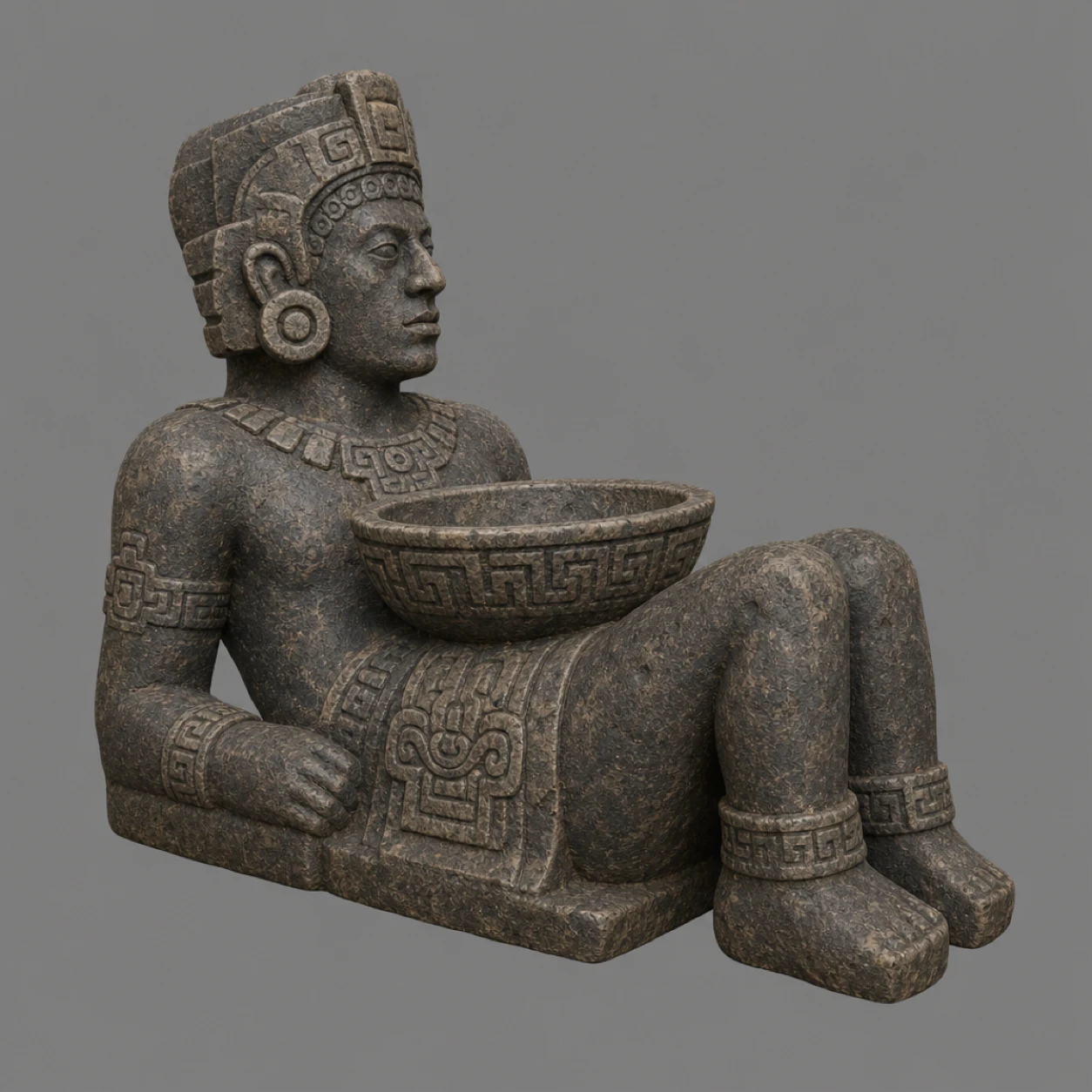
Place a chacmool on a temple platform or at the top of a stair, bowl facing the approach so offerings read clearly to the camera. Pair it with a cuauhxicalli vessel or a Tlaloc mask if you want an Aztec ritual cluster. Our Aztec Temple Relics pack includes a chacmool model sized for pyramid courtyards and inner sanctuaries.