Canopic Jars: Four Guardians for the Organs
A canopic jar is a burial vessel that held specific internal organs removed during mummification. The heart stayed in the body because Egyptians considered it the seat of intelligence and morality. The liver, lungs, stomach, and intestines were dried, wrapped, and placed in jars so the deceased could use them again in the afterlife. Lids often show the Four Sons of Horus, each protecting one organ.
Four jars, four heads, four directions
The classic New Kingdom set has four jars. Imsety, with a human head, guarded the liver and the south. Hapy, with a baboon head, guarded the lungs and the north. Duamutef, with a jackal head, guarded the stomach and the east. Qebehsenuef, with a falcon head, guarded the intestines and the west. Each son had a companion goddess: Isis, Nephthys, Neith, and Serket.
The jackal-headed lid on a canopic jar is Duamutef, not Anubis. Both share a canine face, but Duamutef appears only as one of four matching lids on organ jars. Anubis stands alone as the embalming god. Wildform's pack prop pairs an Anubis-headed jar with tomb scenes; historically, Anubis lids are less common than the Sons of Horus, though Anubis imagery did appear on chests and in burial equipment.
From plain lids to Sons of Horus
Canopic jars first appear in the Fourth Dynasty. Old Kingdom examples are often plain stone pots with flat or domed lids. Middle Kingdom jars sometimes have human-headed stoppers representing the sons in human form. By the Nineteenth Dynasty of the New Kingdom, the four animal-headed lids became the standard pattern most museums display.
Organs were not always stored in separate jars. In some periods, embalmers wrapped the packets and placed them together in a single canopic chest inside the tomb. Wooden chests of Henutmehyt in the British Museum still hold four internal jars with their bundles. The outward form changed with fashion and budget, but the idea of protected organs remained constant.
Spells, titles, and the embalmer's craft
During mummification, priests removed the organs through an incision, often on the left side of the abdomen. Each organ was treated with natron, wrapped, and assigned to its guardian deity. Hieroglyphic spells on the jars named the son and the owner. A protective formula from the Book of the Dead could be copied onto the surface so the spirit of the jar would answer for the deceased if questioned in the underworld.
High officials sometimes held priestly titles tied to mortuary cults. On the Imsety jar of Psamtek in the British Museum, the owner's name is preceded by "Greatest of Five," a title linked to the cult of Thoth at Hermopolis. The inscription shows how burial equipment carried social rank as clearly as coffin decoration.
The four jars of Psamtek in London
The British Museum holds a set of four glazed composition canopic jars made for a man named Psamtek (EA57368), probably from the 30th Dynasty. Each jar is about 21 to 23 cm tall, fashioned from dark blue-green faience. The falcon-headed Qebehsenuef, human Imsety, baboon Hapy, and jackal Duamutef each guard the organ named in the hieroglyphic text.
The set entered the museum in 1924. Curators describe the condition as good, with incised inscriptions specifying both the deity and the deceased. Sets like this were mass-produced for elite burials yet still personalised with names and titles. They are among the most recognisable objects in any Egypt gallery because the four heads read instantly as mummification equipment.
Faience, calcite, wood, and empty jars
Later periods favoured Egyptian faience for canopic jars because its blue-green glaze echoed the colour of renewal. Calcite (Egyptian alabaster) jars appear in wealthy burials at Thebes. Wood examples from the Third Intermediate Period onward sometimes survive with painted lids, though wood is fragile in damp tombs.
Archaeologists also find canopic jars that were never used, or jars buried empty when embalmers returned organs to the body in later ritual practice. The Twenty-first Dynasty saw a shift: organs were often repackaged and placed back inside the mummy, while dummy jars remained in the tomb for symbolic completeness. That change explains why some beautiful jars in museums contain no organic remains at all.
In your scene
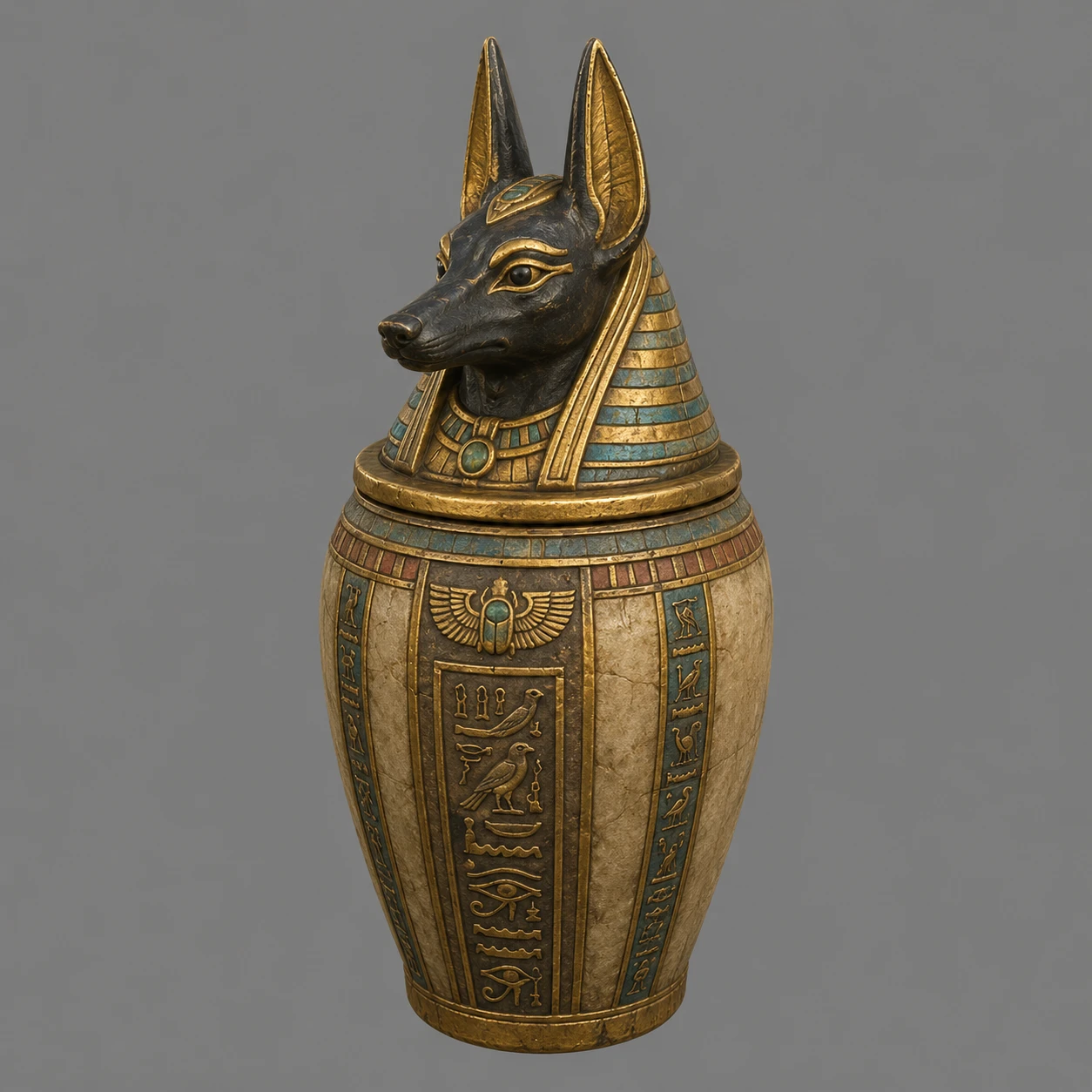
A row of four jars on a niche shelf, each with a different head, reads as a burial chamber immediately. Matching lids matter more than height. Our Egyptian Tomb Relics pack includes an Anubis-headed canopic jar suited to tomb alcoves beside a sarcophagus or offering table.