Ancestral Altar Bells in Benin: Brass Summons for the Dead
A Benin ancestral altar bell is a cast brass instrument made for the palace shrines of the Edo kingdom of Benin in present-day southern Nigeria. Guild casters set these bells along the front of royal ancestral altars. When rites began, attendants rang them so the dead would hear prayers and share the offerings left on the platform. The typical form is a truncated four-sided pyramid with a strap-like handle at the top and a clapper hanging inside. Museums file many of these pieces with the wider corpus nicknamed the Benin Bronzes, though the metal is usually brass rather than true bronze.
Truncated pyramids, clappers, and court brass
Most Benin altar bells share a clear silhouette: a four-sided, tapering body, a looped strap handle, and an internal clapper. Surfaces can stay plain or carry dense relief. Motifs range from Portuguese faces and hats to mudfish-legged kings, leaf-shaped swords, and other court emblems. The Metropolitan Museum of Art notes that more elaborate bells tend to mark altars for people of higher rank. Some examples add wire-hung miniature swords through cast loops so the instrument shimmers and buzzes when shaken, not only rings.
The Ìgùn Ẹ́rọ̀nwwọ̀n brass-casting guild made these works for the court by the lost-wax process, the same workshop tradition behind commemorative heads and palace plaques. Brass reached Benin in large amounts through coastal trade with Europeans from the late fifteenth century onward. Related pyramidal bells also appear as warrior prestige emblems. The Met titles at least one nineteenth-century example Eroro and describes it as a lattice-work bell worn to show high rank. Whether every altar bell carried that Edo name in court speech is less clear in the published museum labels, so it is safer to treat eroro as a related bell type in Benin metalwork rather than a proven label for every shrine instrument.
From Portuguese contact to nineteenth-century palace shrines
Brass altar furniture belongs to the long history of Benin court art from at least the 1500s into the nineteenth century. Portuguese traders sought commercial treaties with Benin's rulers from the fifteenth century; by about 1500 the kingdom's authority stretched toward the Niger delta and the coastal lagoon of Lagos. Exported pepper, textiles, and ivory bought imported metals that fed an explosion of palace casting. Altar bells that carry Portuguese faces sit in that exchange: European features become Edo court signs of overseas wealth and of Olokun, the ocean deity who grants prosperity.
Dating is usually stylistic. The Met places its Portuguese-heads altar bell in the sixteenth to seventeenth century and a smaller mudfish-legged ọ́bà bell in the eighteenth to nineteenth century. Exact year stamps are rare. When catalogues disagree by a century, the honest reading is a working range, not a birth certificate for each cast. Britannica's survey of the Benin Bronzes still places brass bells among the standard furnishings a new oba set on the altar dedicated to his predecessor.
Ringing the front of the ancestral altar
A newly installed oba was expected to create an altar for his father and predecessor. Britannica describes these ancestral altars as tightly packed semicircular mud platforms holding guild-made objects: brass tableaus, ceremonial swords, rattle-staffs, and brass bells. Rattle-staffs and bells both call ancestral spirits. The Met is more specific about placement and sound: bells lined the front of the altar and were rung so ancestors would hear descendants' prayers and take part in the offerings.
That sound job matters more than decoration. The bell is not a free-standing sculpture for a shelf. It is a ritual signal that opens communication across the divide Edo thought imagined as a vast body of water between the living and the dead. Portuguese imagery on some bells fits that cosmology: people who crossed the Atlantic by ship could stand, in court art, for traffic between those two realms. Leaf-shaped swords on elaborate bells also point to leadership. They are emblems carried by the oba and senior chiefs at palace ceremonies, so a richly fitted bell advertises an altar of high political weight.
The same altar often held commemorative brass heads that supported carved ivory tusks. Heads, tusks, bells, and staffs worked as one ensemble. The head held dynastic presence; the bell woke that presence so ritual speech and sacrifice could land.
How altar brass left the palace after 1897
For centuries these bells stayed inside royal and chiefly ritual. That changed in February 1897, when a British punitive expedition stormed Benin City, burned parts of the palace, and seized thousands of court artworks. The British Museum's account of the Benin Bronzes records that soldiers looted shrines and compounds, taking ceremonial objects from royal ancestral altars among other palace goods. Brass bells entered European and American collections with the wider diaspora of plaques, heads, and ivories.
Court casting did not end forever. After Oba Ovonramwen's death in 1913, his son Eweka II was restored under a British protectorate and renewed artistic patronage in Benin City. Later transfers and market gifts moved individual bells into public museums. The Met's Perls Collection gifts of 1991, for example, brought several altar bells into Gallery 342. The sound-world of an intact shrine is harder to recover than a single object under glass: photographs and watercolors from 1897 show crowded platforms, but many ensembles were broken apart in the looting.
The Met's Portuguese-heads altar bell you can still see
One clear example is the Metropolitan Museum of Art's Altar bell with Portuguese heads, object 1991.17.85, on view in Gallery 342. The Met attributes it to Ìgùn Ẹ́rọ̀nwwọ̀n artists, dates it to the sixteenth to seventeenth century, and lists brass as the medium. It measures 19.1 cm high and 10.2 cm wide and deep. A Portuguese face sits in relief on the front: thin beaklike nose, narrow nostrils, thinly rimmed eyes, long sinuous hair, moustache, and a flat ovoid beard cut with fine wavy lines. The hat carries an incised fish-scale pattern and two feathers. Three tiers of loops hold wire that supports free-hanging miniature swords. Those swords shimmer when the bell moves and add a rattling buzz to the tone.
The museum reads this imagery as a mark of high altar status. Leaf-shaped swords signal leadership. Portuguese merchants brought overseas trade wealth and were linked to Olokun. In Edo thought, the living and the dead are parted by water, so Atlantic travelers could become signs of communication with the supernatural that ancestral altars made possible. Compared with the Met's smaller mudfish-legged ọ́bà bell (1991.17.86), which stands only 14.6 cm high and is dated later, the Portuguese-heads example is larger, louder in its attached metal, and denser in foreign-contact symbolism.
What museum labels still leave open
Survival counts for altar bells alone are hard to state as one number. Thousands of Benin court works left the palace in 1897, and bells are only one class inside that corpus. Digital inventories keep growing as museums publish and, in some cases, return objects. Materials labels vary between brass, bronze, and copper alloy even when the casting tradition is the same. Not every bell carried Portuguese faces or hanging swords; plainer forms served lower-status or less richly furnished altars.
Scholars and labels also leave open how tightly the title eroro maps onto shrine bells versus warrior neck bells, and how far Portuguese motifs track real Portuguese sitters versus a settled court type. Where two catalogues print different century brackets for similar bells, treat those brackets as informed ranges. The secure core remains: these instruments were guild-made brass signals on Edo ancestral altars, rung to call the dead into the rites of living kings and chiefs.
In your scene
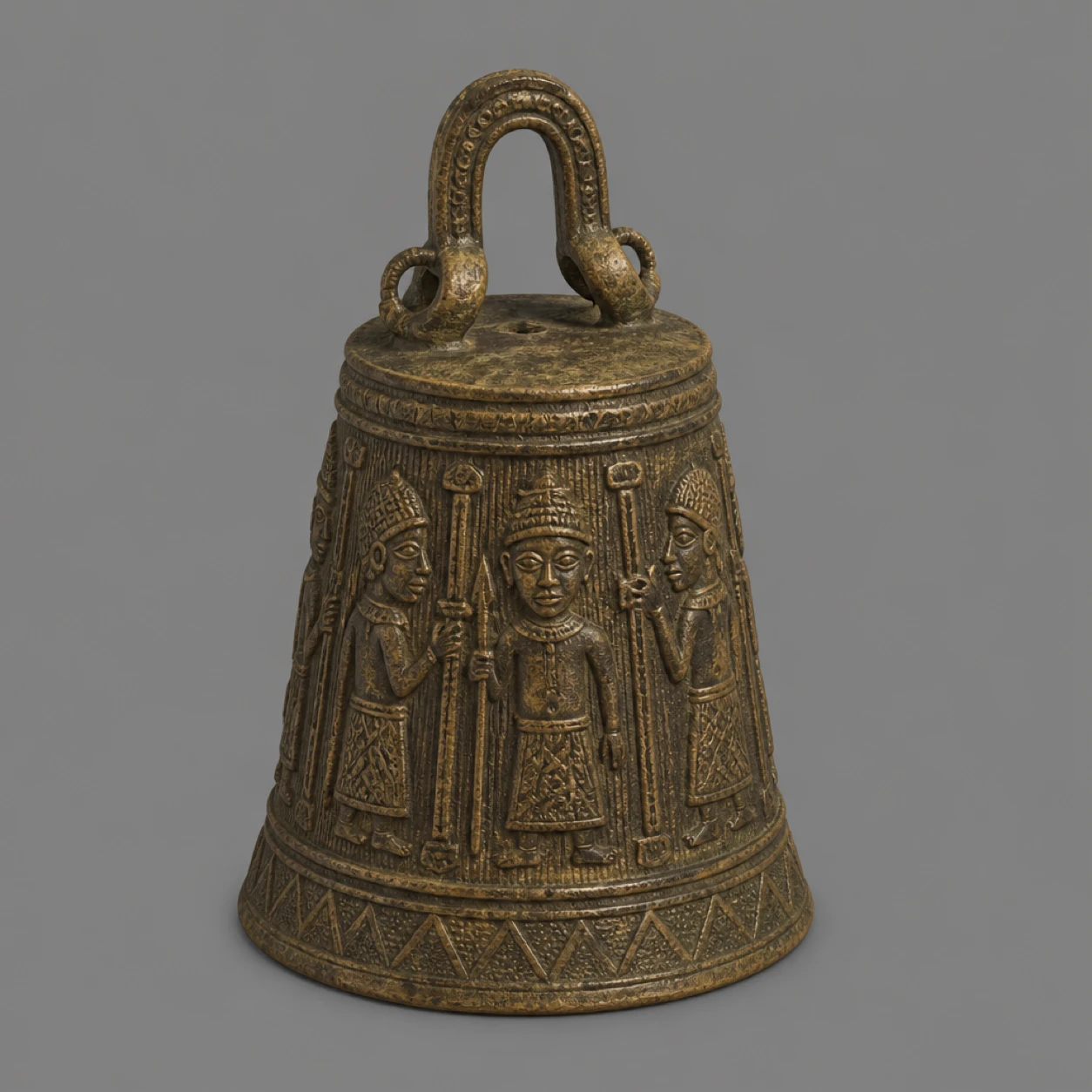
An ancestral altar bell reads as active ritual furniture at the front of a packed shrine, not a lone trophy on a mantel. Place it with room to be lifted and rung beside commemorative heads and staffs, and keep motif density matched to the rank of the altar you are staging. For a full court set, see the African Kingdom Relics pack.