Uhunmwun-Elao at the Met: A Benin Brass Head for the Altar
A Benin commemorative head is a cast copper-alloy sculpture made for the ancestral altar of an oba, the divine king of the Edo kingdom of Benin in present-day southern Nigeria. Edo speakers call these heads uhunmwun-elao (also written uhunmwu-elao or ùhúnmwèlaò). They are not portrait busts of living kings. A new ruler commissioned them to honour his predecessor, usually his father, and set them on a palace shrine where the living monarch could approach the dead. Most have a circular opening at the crown so a carved elephant tusk could rise from the metal head. Museums often group them with the wider corpus nicknamed the Benin Bronzes, though the metal is usually brass rather than true bronze.
Coral caps, iron eyes, and a hole for the tusk
A typical royal head shows an idealized young face under a coral-bead cap, with strands of beads beside the temples and a high beaded collar around the neck. Three raised marks often sit above each eye. Some casts have iron inlays for the pupils. The Met's early example also carries a single bead dropping from the headdress to the forehead, aligned with the bridge of the nose. The circular hole at the summit is the practical clue to altar use: the head was a socket and a sacred support, not a free-standing bust meant to sit alone on a shelf.
Guild casters of the Igun Eronmwon (also rendered Ìgùn Ẹ́rọ̀nwwọ̀n) made these works by the lost-wax process for the court. Coral and brass both reached Benin through coastal trade with Europeans from the late fifteenth century onward. For Edo viewers, coral pointed toward the ancestral realm of the sea; brass held a red shine associated with beauty, danger, permanence, and the power to turn away evil. The face itself stays generic on purpose. Museum labels and Edo commentary agree that exact likeness of a living person was spiritually risky. The image presents an ideal of kingship at the height of life, not a forensic likeness of one man's wrinkles.
From early thin casts to later flanged bases
Brass commemorative heads appear from roughly the fifteenth century, when the Oranmiyan dynasty used metal altar images to mark itself against earlier rulers. Art historians track about eight stylistic groups from around 1400 into the nineteenth century. Early heads of the fifteenth and early sixteenth centuries tend to be relatively thin-walled and modest in regalia. Later heads grow thicker, heavier, and more ornate: higher collars that hide the chin, denser beadwork, winged elements on the cap, and wide flanged bases carved with leopards, mudfish, and other royal signs.
Dating is stylistic, not stamped. The Met dates its light early head to the early fifteenth through mid-sixteenth century. Cleveland places a thicker ancestral head in possibly the mid-1500s or early 1600s. National Museums Scotland and other collections hold eighteenth- to nineteenth-century examples with the late winged caps and decorated flanges. When two catalogues disagree by a century, the honest reading is that the sequence is a working chronology, not a birth certificate for each casting.
Altars where a new king meets his father
When an oba died, his firstborn son inherited the title. One of the heir's first duties was to build a shrine to the previous king. Ancestral altars in the palace were packed platforms that held brass heads, bells, rattle-staffs, ceremonial swords, and other guild work. Britannica's survey of the Benin Bronzes describes these altars as tightly packed semicircular mud platforms holding guild-made objects; bells and rattle-staffs were used to call ancestral spirits. Heads were often set in pairs on either side of an altar. Bells helped wake the spirits; carved tusks rising from the heads carried narratives of royal authority.
In Edo thought the head is the seat of character, judgment, destiny, and leadership. Praise names call the oba the "Great Head" because the welfare of the kingdom rides on the living king's wisdom. The brass head on the altar keeps that idea visible across generations. It is a vessel of succession: the late king's power passes, and the new king accepts the duty to guide the realm. Annual palace rites still renew that bond in Benin City today, even after colonial disruption and Nigerian statehood folded the kingdom into a modern federation.
How court brass left the palace
For centuries these heads stayed inside royal ritual. That changed in February 1897, when a British punitive expedition stormed Benin City, burned the palace, and seized thousands of court artworks. Brass heads, plaques, ivories, and other pieces were sold into European and American collections. The objects now labeled Benin Bronzes in encyclopedias and restitution debates include altar heads taken in that campaign. Casters in Benin City continued to work after 1897, and oba Eweka II later rebuilt palace craft structures, but the great nineteenth-century diaspora of altar brass is the reason so many commemorative heads sit today under glass in New York, London, Cleveland, and elsewhere rather than on active royal shrines.
Style also shifted with material supply. As more brass became available through trade, casters had less reason to keep walls thin, and royal costume on the sculptures grew more lavish. The visual program moved from relatively naturalistic early faces toward stronger idealization, reinforcing continuity of one dynastic ideal rather than individual biography.
The Met's early Ùhúnmwèlaò you can still see
One clear example is the Metropolitan Museum of Art's Ùhúnmwèlaò (head of an ọ́bà), object 1978.412.324, on view in Gallery 342. The Met attributes it to Ìgùn Ẹ́rọ̀nwwọ̀n brass-casting guild artists and dates it early fifteenth to mid-sixteenth century. It measures 21.6 cm high, 19.7 cm wide, and 20.6 cm deep, cast in brass with iron. The youthful round face wears a woven coral-bead cap, lateral bead strands, a forehead bead on the nose line, and a rolled collar worn low on the neck. A circular opening at the crown once held a carved elephant tusk. The museum presents it as an altar honor piece from the first half of the sixteenth-century court context: a consistent visual reference that linked each living oba to the dynasty behind him.
Compared with later heads, this Met cast is light and sparing. Its thin walls and restrained regalia are exactly the traits scholars use to place a head early in the sequence. It does not name a specific historical oba. The point of the genre is succession and ideal kingship, not a labeled portrait gallery.
What brass, ivory, and museum labels still leave open
Survival counts are hard to state as a single number. Thousands of Benin court works left the palace in 1897, and commemorative heads are only one class within that corpus. Digital inventories and museum databases keep growing as collections publish and, in some cases, return objects. Materials vary too: Digital Benin notes that commemorative heads could be bronze, wood, or terracotta, while museum labels for the famous metal examples usually name brass or copper alloy. Not every head supported a tusk in the same way, and not every altar arrangement survives in photographs from before the invasion.
Scholars also debate how tightly facial naturalism maps onto century-by-century dating, and how much Portuguese trade reshaped regalia versus older internal court taste. Where catalogues print different date brackets for similar heads, treat those brackets as informed ranges. The secure core remains: these sculptures were guild-made altar instruments of royal succession in an Edo palace religion that treated the head as the seat of guiding power.
In your scene
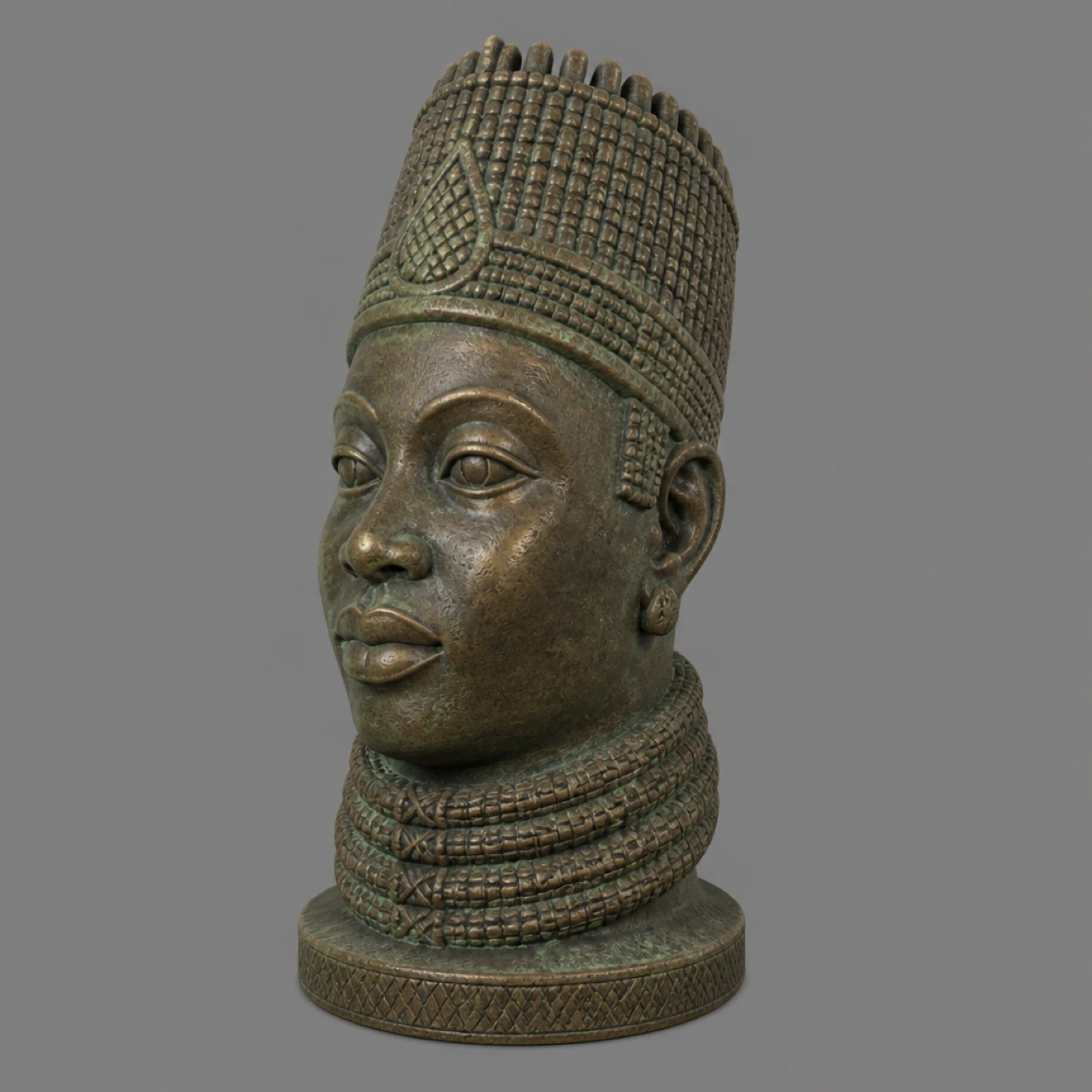
A Benin commemorative head reads as palace ritual furniture, not a random trophy bust. Place it on a raised altar platform with space above for an ivory tusk, and keep coral-bead density and collar height consistent with the period you want. For a full court set, see the African Kingdom Relics pack.