Sun Wheels in Celtic Art: Spokes, Sky, and Offerings
The sun wheel, also called a solar cross or wheel cross, is a circle with an equilateral cross drawn inside it so the arms reach the rim. It is one of the oldest geometric signs in European prehistory, appearing on Scandinavian rock carvings, Bronze Age standards, and later on Iron Age jewellery, weapons, and small bronze votive wheels. In Celtic contexts the motif is often read as a solar symbol, a calendar sign, or the emblem of a sky god, but those readings do not all agree. The shape is simple; the archaeology is not.
Four spokes, eight spokes, and the rouelle amulet
Not every wheel symbol uses the same spoke count. A cross with four arms inside a ring can stand for the quarters of the year or the solstice and equinox points in modern folklore reconstructions; eight-spoked wheels appear on later Celtic metalwork and on the famous panel of the Gundestrup Cauldron where a figure offers a half wheel with eight spokes. Miniature bronze wheels called rouelles, sometimes only a few centimetres wide, were pierced for suspension and deposited in graves and sanctuaries from the Hallstatt period onward.
The La Tène sun wheel you see on pendants, shield studs, and carved stone is part of that long chain. It differs from the medieval Celtic cross, which places a Christian cross over a ring and belongs to a much later religion. Pre-Roman wheels are rounder, more symmetrical, and tied to Indo-European sky imagery shared with chariot wheels and thunder gods across Europe.
From Nordic rock faces to Hallstatt graves
Petroglyphs on Bornholm and elsewhere show wheel shapes beside cup marks from the Nordic Bronze Age, centuries before La Tène art. Scholars connect some of these signs to the sun chariot idea known from the Trundholm gold disk, where a horse pulls a spoked sun. Wheels on real chariots arrived later than the earliest disc wheels in art, so the symbol may have preceded the technology it came to resemble.
In the early Iron Age, Hallstatt elites placed wheeled imagery on bucket lids and bronze vessels in Austria and Bavaria. Birds and spoked circles share the same panels, hinting at a sky journey rather than a single fixed meaning. By the La Tène centuries the wheel spread on coins minted by British and Gaulish tribes, on fibulae, and on relief plaques. World History Encyclopedia notes that La Tène craftsmen threw precious goods into lakes and rivers; wheels fit that habit as easily as swords or cauldrons.
Sky gods, Taranis, and the wheel debate
Roman poets named Celtic gods to a Latin audience. Lucan, writing in the first century CE, lists Taranis among deities to whom Gauls sacrificed inside great wicker figures. Later commentators described Taranis as a thunderer linked to wheels and lightning. Britannica summarises that tradition: Taranis was represented by the wheel and the lightning flash, sometimes shown riding down a serpent-footed monster on stone carvings.
Modern archaeologists split on how tightly to bind the name Taranis to every wheel in Celtic art. A figure called the wheel god appears on Romano-Celtic statuettes with a spoked wheel in one hand and Jupiter's thunderbolt in the other, yet no inscription calls that figure Taranis. Some scholars, including Miranda Green in her work on Romano-Celtic religion, argue the wheel god was a solar deity distinct from the thunderer; others keep the equation as probable but unproven. Coins from the Iceni and other British tribes show wheel motifs beside horses and ears of grain, which supports a seasonal or fertility reading as well as a sky reading.
A wheel panel on the Gundestrup Cauldron
The Gundestrup Cauldron, found in a Danish bog and made with strong Celtic iconography, includes a scene where an antlered figure oversees a procession. One participant holds an oversized wheel with eight spokes toward the centre of the panel. The cauldron dates to the second or first century BCE in most accounts and may have been made by Thracian silversmiths for Celtic patrons, which makes it a compass for how far wheel imagery travelled.
Interpreters have called the antlered figure Cernunnos and read the offered wheel as tribute to a lord of animals and the forest. Others caution that names from medieval Irish literature should not be pasted onto every horned god. What the panel shows without dispute is that a spoked wheel could be carried like sacred regalia in a ritual line, not only stamped small on jewellery. Silver repoussé catches torchlight on the spokes in a way that clay rouelles cannot, but the idea matches the miniature wheels buried with the dead.
What votive wheels prove, and what we should not claim
Thousands of wheel signs survive, yet none come with a contemporary Celtic sentence explaining them. Four spokes might map a year; eight might mark festivals between solstices; a coin wheel under a horse might mean chariot sun imagery or simply a tribal badge. Roman interpretatio equated local gods with Jupiter and Mercury, which helped writers recognise wheels as sky symbols but also blurred distinctions we cannot recover.
Modern political misuse of sun-wheel signs on flags and badges is unrelated to Iron Age religion and should not be read back onto La Tène art. In archaeology the honest position is plural: solar, seasonal, protective, and thunder-related readings all have some evidence, and the same shape could accumulate meanings over centuries. The sun wheel in a Celtic scene is therefore best treated as a ritual sign with deep roots, not as a decoder ring with one answer.
In your scene
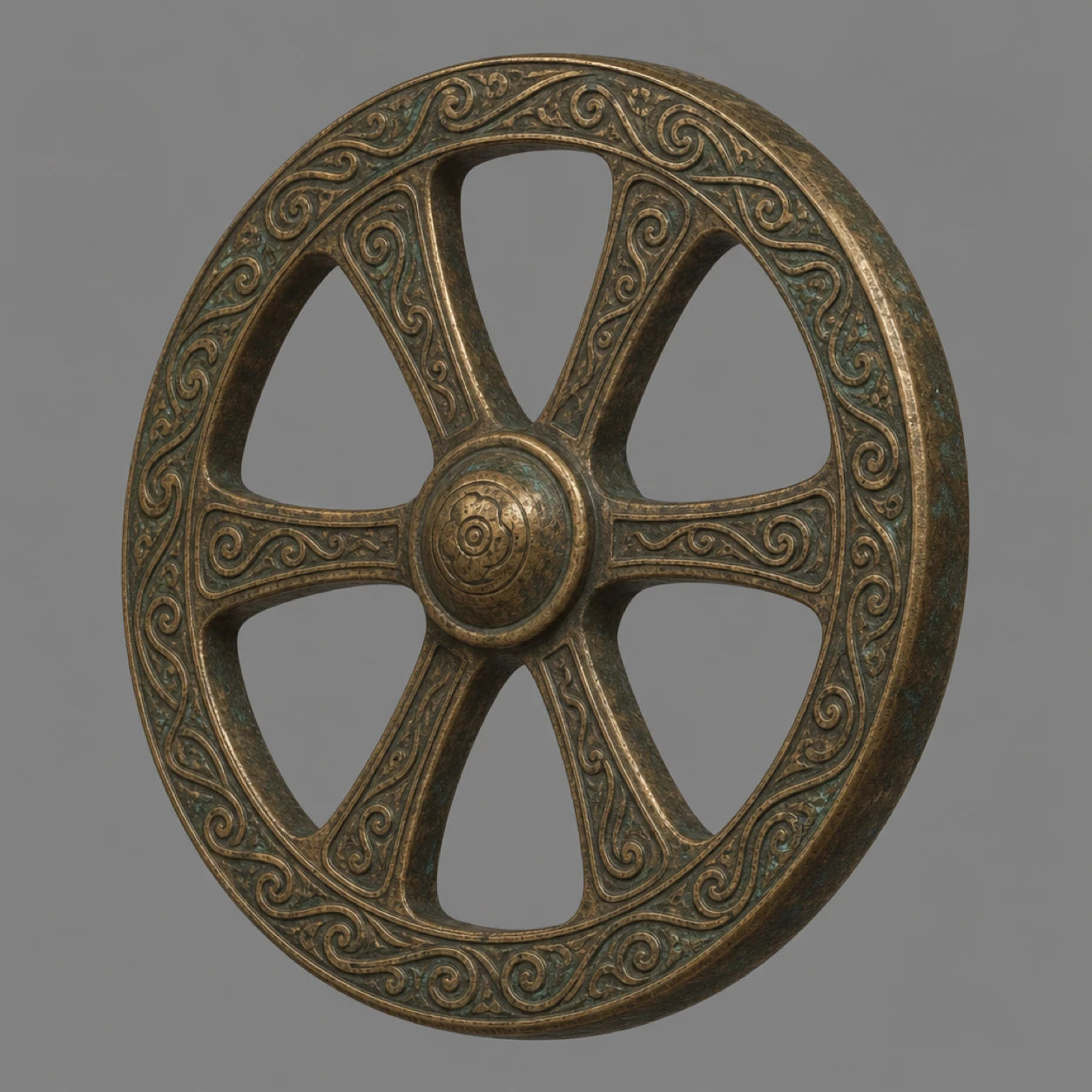
Place a sun wheel above a doorway, on a standing stone, or on a bronze disk near a fire pit rather than on every soldier's shield. Pair it with river offerings or a Battersea-style shield if you want Thames votive religion in the same set. Our Celtic Ritual Relics pack includes a sun wheel model for hill-fort shrines, grove altars, and La Tène ritual interiors.