The Battersea Shield: La Tène Bronze from the Thames
The Battersea Shield is a sheet-bronze facing that once covered a wooden or leather shield body. Found in the River Thames during dredging work in the 1850s, it is one of the finest surviving examples of La Tène art from Iron Age Britain. What survives is not a complete war shield but a decorated metal skin: repoussé scrolls, engraved stippling, and twenty-seven framed studs that once held red glass paste. The piece weighs about 3.4 kg and measures roughly 78 cm long. It now sits in the British Museum as proof that Celtic metalworkers in Britain could match continental skill while developing a local style of their own.
Repoussé roundels, S-scrolls, and twenty-seven red studs
A La Tène shield facing is judged by how the bronze sheet is worked, not by how thick the plate is. On the Battersea piece, several bronze sections are joined with rivets hidden beneath the decoration and bound at the edge. Three large roundels dominate the face, with the tallest central boss marking the shield as a British Isles product in the eyes of specialists. Between the studs, palmettes and interlocking S-shaped curves flow in relief hammered from behind.
The twenty-seven studs vary in size and sit in raised frames. Analysis cited by museum writers suggests the red glass paste inside them came from the Mediterranean world, much like the coral inlays on other British Celtic metalwork. Enamel and glass inlay were Celtic specialties in later Iron Age Europe, and here they may imitate imported coral while allowing a denser pattern. Some readers see reversible human faces where the smaller circles link to the larger roundels; others treat that as deliberate ambiguity in the scroll work. Either way, the shield reads as jewellery scaled up to parade size.
From continental La Tène to Thames-side metalwork
The shield belongs to the broad La Tène culture that spread across much of western and central Europe from about the mid fifth century BCE into the Roman conquest period. In Britain the date range usually given for this facing runs from about 350 to 50 BCE, though tighter dating is difficult because nothing else matches its exact plan. Earlier Hallstatt elites already traded Mediterranean wine and luxury goods; La Tène craftsmen absorbed Greek and Etruscan motifs and bent them into spirals, masks, and fantastic animals.
River finds cluster in the same centuries. The Witham Shield from Lincolnshire and the Wandsworth shield boss from the Thames belong to the same family of decorated bronze facings and bosses, each with its own layout of roundels, bosses, and animal ornament. Battersea sits at the ornate end of that spectrum: more roundels, more enamel, and a composition that looks built for display under torchlight or open sky.
Parade gear, river offerings, and the question of combat
Celtic fighters in the field normally carried large wooden shields with leather and a central iron or bronze boss. Greek and Roman writers describe man-sized shields with personal decoration; archaeology matches that picture with wood and hide remains far more often than complete bronze faces. Sheet-bronze coverings were different. Many are so thin that a sword could cut them unless they were mounted on a stiff backing, and several lack the dents and cuts you would expect from battle.
That pattern pushes interpretation toward ceremony. Processions, treaty feasts, and funeral display offered moments when a ruler could carry wealth on his arm. World History Encyclopedia quotes curators Julia Farley and Fraser Hunter on river finds: valuable objects repeatedly turn up in wet places in ways that look deliberate, whether as gifts to gods, markers of agreements, or offerings at life transitions. The Thames has yielded weapons, bosses, and human remains near the Battersea findspot, which fed older guesses about Julius Caesar's crossing in 54 BCE. Most scholars now treat the shield as earlier and separate from that Roman episode, more likely cast or placed in the water as a votive act than lost by accident.
Walking the facing in the British Museum
In the British Museum's Iron Age galleries you meet the shield as a flat bronze portrait, not as a bulky battlefield wall. Room displays emphasise length and width: about 77.7 cm long and near 35 cm wide in published measurements, oblong with rounded corners like other British river shields. The central boss rises under the largest glass stud, and the repoussé S-forms catch light along the curves.
Registration number 1857,0715.1 ties the object to its nineteenth-century acquisition after Thames dredging near what is now Battersea in south-west London. Conservators present it as a facing only; the wooden or leather back rotted away in the river. Standing before it, you can see why replicas are made for film and education: the patterns were meant to be seen in motion, even if the bronze itself was never meant to stop a spear on its own.
What river shields prove, and what remains disputed
Bronze facings survive because waterlogged places slowed corrosion and because someone chose to put them there. We still debate whether every river shield was purely votive: a thin facing on a strong wooden core could have been carried at least once before deposition. Battersea shows no clear battle damage, which strengthens the parade-or-offering reading but does not close the case for every similar find.
Scholars also argue over iconography. Solar readings of the stud patterns sit beside neutral descriptions of luck or whirling motion. The 1850s discovery date itself varies in print between 1855 and 1857 depending on which dredging report an author follows. What stays firm are the measurements, the British roundel scheme, the Mediterranean glass, and the object's role as the reference point for Celtic shield art in textbooks, museums, and reconstructions.
In your scene
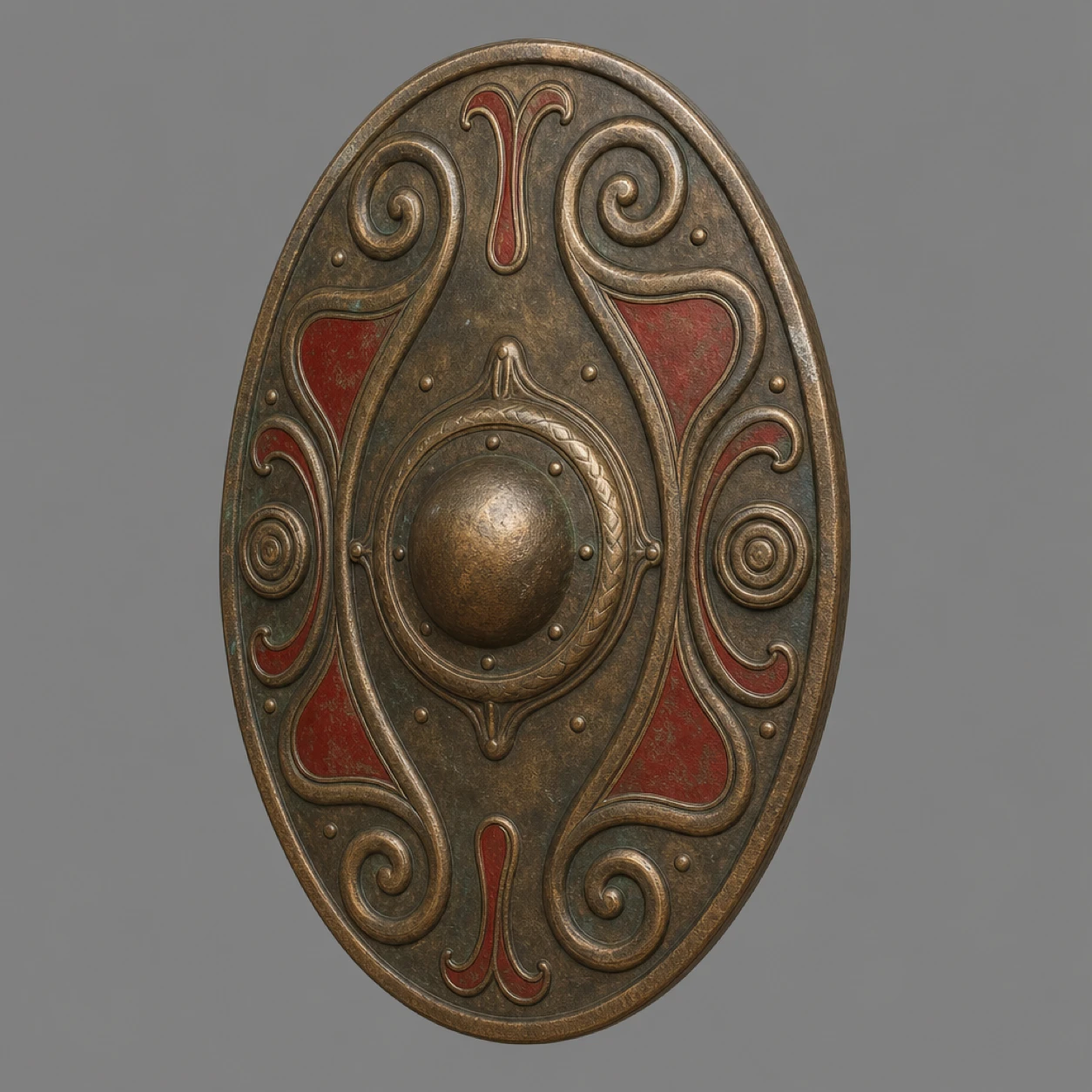
Hang a La Tène shield facing on a ritual post or chieftain's litter, not on every warrior in a hill-fort wall fight. Pair it with a wine flagon on a feast table or a sun wheel motif nearby to suggest votive religion rather than everyday kit. Our Celtic Ritual Relics pack includes a Battersea-style shield model for river shrines, druid groves, and Iron Age hall interiors.