Wine Flagons: Duck Spouts and Mediterranean Coral
A wine flagon in Iron Age Europe was a handled pouring vessel used at communal meals and drinking feasts. The word covers several shapes, but the type most often pictured in museum cases copies the bronze oinochoe of Etruscan Italy: a tall body, a side handle, and a narrow spout for filling cups without spilling. Celtic workshops from Gaul to the Rhine made their own versions in copper alloy, often inlaid with red enamel and Mediterranean coral. Wine, beer, and mead all passed through these jugs; what mattered socially was who poured, who received, and what foreign materials the host could afford to show off.
Etruscan silhouette, Celtic handle beasts, and duck spouts
The classic early La Tène flagon follows an imported outline. Etruscan bronzes supplied the basic geometry: rounded belly, arching handle, and a spout set high enough to control the flow. Celtic smiths then layered local taste on top. Handles frequently end in a dog or wolf head gripping the rim, a motif that reaches back to Greek and eastern Mediterranean art but is executed here in a stiffer, more angular La Tène hand.
On the most famous surviving pair, a small duck sits just above each spout. When liquid runs, it passes beneath the bird so the duck seems to swim on the stream of wine or beer. Ducks and other water birds recur on Iron Age metalwork across Europe, often near rivers and lakes where offerings were deposited. The spout duck is therefore both a visual joke for the drinker and a nod to wetland symbolism that sat close to religion. Red enamel panels and palmette shapes under the spout show the same mix of borrowed form and Celtic surface pattern you see on shields and torcs.
Fifth-century Gaul and the feast economy
The best-documented flagons come from early La Tène burials in eastern France, dated around the mid fifth century BCE. At that date much of non-Mediterranean Europe had no cities in the Greek sense, but it had chiefs, hill forts, and smiths who could produce work equal to anything traded up from Italy. World History Encyclopedia describes how La Tène elites replaced Hallstatt traditions with richer weapon graves, chariot gear, and imported luxuries as Mediterranean merchants pushed wine and tableware north.
Feasting was politics. Roman writers later mocked Celtic drunkenness, but archaeology tells a more precise story: large cauldrons, drinking sets, and meat joints appear in halls and tombs where authority was performed. A flagon sat between the Mediterranean wine trade and local grain beer or honey mead. Tin in some alloys probably came from Cornwall; coral and glass paste came from far south. Owning a matched pair meant access to networks, not just a full cup.
Pouring wine, beer, or mead for the dead and the living
In life, a servant or host likely carried the flagon from couch to couch at a banquet, letting guests watch the duck bob on the pour. In death, sets could accompany a leader into the grave. The Basse Yutz find, discussed below, included two flagons and two Etruscan-style stamnoi for mixing wine, implying a full service rather than a single showpiece.
Rivers and bogs across La Tène Europe received weapons, cauldrons, and jewellery as offerings; feasting gear belongs to the same worldview where alcohol bridged human and divine guests. We should not assume every flagon was ritual. Wear and repair on less famous examples point to years of use. Still, the cost of coral, enamel, and bronze made these objects statements of rank, much like the torcs and shields in the same burial class.
The Basse Yutz pair in the British Museum
The Basse Yutz flagons are the anchor case for early Celtic pouring vessels. Discovered in 1927 near Basse-Yutz in Moselle, north-eastern France, during railway works, they were reportedly part of a rich grave that also held two bronze stamnoi of Etruscan type. Looters reached the tomb before archaeologists, so the burial context is thin even though the metalwork is superb. The British Museum acquired all four vessels by 1929; registration numbers begin 1929,0511.1 for the flagons.
Each flagon stands about 40 cm tall in published measurements. Coral inlay, once bright red and now often white with age, came from Mediterranean coasts. Red enamel in the cells was opaque glass, likely from eastern trade routes. Production place is given as eastern France, but the Etruscan shape and the Greek-style handle beasts underline how Iron Age Celtic art was a remix, not an island style. Curators pair the flagons with other early La Tène masterpieces to show that non-literate societies still maintained complex taste and long-distance supply chains.
Fragile contexts, genuine metal, and modern doubt
Illicit digging haunts the flagon story. Because the Basse Yutz grave was not scientifically excavated, we lack skeletal evidence, plant remains, and the layout that would tell us whether the cups stood near the head or the feet of the deceased. When the museum bought the set, some experts thought the work too fine to be ancient; time and analysis proved them wrong.
Other flagons survive from Austria and central Europe with similar silhouettes, which helps confirm workshops and trade, not a single forgery plot. Dating rests on typology and association with La Tène I metalwork, commonly put around 450 to 400 BCE in museum labels, with room for a generation either way. What remains secure is the social reading: these were luxury pourers for display drinking in a world where a duck above the spout could amuse, impress, and point toward the river at the edge of the feast.
In your scene
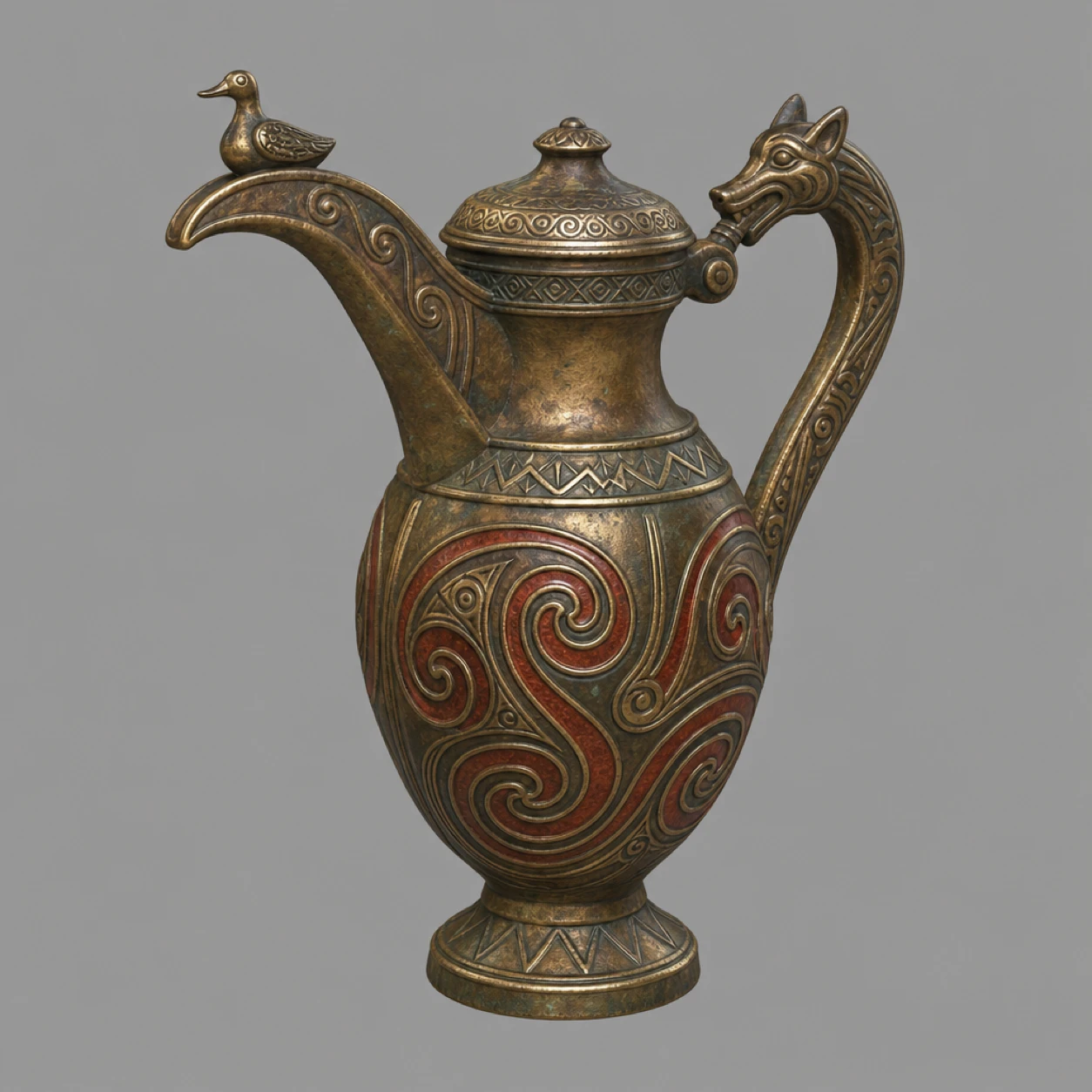
Set a matched pair of flagons on a low table beside a chieftain's couch, with cups and a mixing bowl implied but not piled as clutter. A single server figure mid-pour reads better than a banquet crowd. Link the feast to water offerings with a Battersea-style shield hung near a river shrine if you want ritual undertones. Our Celtic Ritual Relics pack includes a wine flagon model for hill-fort halls and druid grove gatherings.