The Corleck Head: Ireland's Three-Faced Stone Idol
A Celtic carved stone head is a free-standing sculpture of a human face, usually in limestone or sandstone, made in Ireland and Britain during the late Iron Age and Roman period. The finest Irish example is the Corleck Head, a three-faced idol from County Cavan with lentoid eyes, narrow mouths, and a hole in its base that once fitted a pedestal. Such heads were not portrait busts for tombs. Archaeologists treat them as ritual images, perhaps of gods, tied to hilltop shrines, harvest festivals, and a long tradition that treated the head as the seat of power and the soul.
Three faces carved from one limestone block
Corleck-type heads are carved in the round from a single stone block. The Corleck Head itself measures about 33 cm high and roughly 22.5 cm at its widest point, cut off just below the chin. Three similar faces look out from one skull, each with a flat wedge nose, slit mouth, and wide, closely set eyes. One mouth has a small circular hole at the centre, a detail shared with stone heads from Yorkshire and with other Irish finds. A hole in the base suggests the piece once sat on a tenon or pillar rather than lying loose in a field.
World History Encyclopedia's survey of ancient Celtic sculpture notes that early Celtic stone work often focuses on the human head with stylized features: lentoid eyes, a bulbous nose, and swept-back hair. Irish examples tend toward minimal relief and enigmatic expression rather than the naturalistic beards seen on some British heads. Triple faces are rarer than single heads but appear in both Ireland and northern England, hinting at a shared visual language across the Irish Sea.
From hilltop shrine to farm gatepost
The Corleck Head was found around 1855 in the townland of Drumeague, County Cavan, near Corleck Hill. Local farmer James Longmore was gathering stone for building when he uncovered the head alongside other carved figures, including the broken Corraghy Heads. For decades the Corleck piece served as a gatepost ornament. Folklorist Thomas J. Barron recognised its age in the 1930s and brought it to the attention of the National Museum of Ireland, which acquired it in 1998 after years on loan.
Corleck Hill itself was a major pre-Christian gathering place. A passage tomb, stone circle, and earthwork on the hill were dismantled between the 1830s and 1900 as farmland expanded, but memory of the site lingered in place names and festival custom. Until the late nineteenth century, Lughnasa harvest celebrations were held on the hill on the first Sunday of August. Britannica's article on Celtic religion places Lughnasadh among the great seasonal festivals of the Celtic year, linked to the god Lugh as patron of skill and kingship. Scholars have proposed, without consensus, that the three faces on the Corleck Head echo that triple rhythm of feast days or triple divine powers.
Heads at the shrine gate and in the harvest field
Celtic sculptors across Europe returned again and again to the human head. World History Encyclopedia states plainly that heads were considered containers of the soul and were especially important in Celtic religion and warfare, where they could be collected as trophies. Stone heads likely stood at sanctuaries as focal images, surrogates for living priests or deities who could "see" in several directions at once.
Irish tradition and modern archaeology both suggest that carved heads were periodically set up on hills during festivals, then stored or buried when Christianity made open idol worship dangerous. Some heads may have been deliberately broken before burial, a pattern seen with other Celtic sculptures broken and deposited in pits. The job of a stone head was not decoration for a chieftain's hall in the way a Roman bust might be. It was a presence at the boundary between human community, ancestral power, and the land that fed them.
How stone idols were lost, buried, and brought to museums
Surviving Irish stone heads cluster in Ulster and the northern midlands, with related examples in Britain from Greetland in Yorkshire to Anglesey. Many were found by accident during field clearance or building work in the nineteenth century, long after their original shrines had vanished. Without excavation records, dating rests on style comparisons with Romano-British and La Tène art, generally placing the Corleck Head in the 1st or 2nd century AD, though a few researchers have argued for later folk-carving revivals in early modern times.
Wooden idols beside stone heads have almost entirely rotted away. By the medieval period, the head motif lived on in metalwork and manuscript art even as free-standing stone gods disappeared from the Irish landscape.
The Corleck Head in Dublin today
Visitors can study the Corleck Head in the National Museum of Ireland, Archaeology, on Kildare Street in Dublin, where it is displayed among the museum's Iron Age treasures. Museum catalogue records give the accession number 1998:72 and a production date of roughly 0 to 200 AD. Standing before the piece, the three faces read as calm, remote, and nearly identical until you notice the subtle differences in brow and mouth.
The head's simplicity is part of its power: no torc, no antlers, no inscription naming the god. For anyone modeling a stone head prop, the Corleck example is the benchmark: compact, three-sided, and meant to be mounted high enough that a crowd below would look up into those slit eyes.
What survives in peat, and what scholars still dispute
Stone heads survive better than wood, but they are still rare. Each find is a fragment of a ritual world documented mainly by Roman commentators and by later Irish literature written centuries after pagan practice faded. Archaeologists disagree on whether triple faces represent a single all-seeing god, three related deities, or a symbolic link to past, present, and future. Some connect the Corleck group to Crom Dubh and harvest myth; others caution against reading medieval stories back onto Iron Age carvings.
Ian Armit and other scholars have noted that not every Irish stone head is prehistoric. Medieval and early modern carvings exist, so style alone cannot date every piece. What is secure for the Corleck Head is its Iron Age typology, its find context near a documented festival hill, and its place as the most refined three-faced idol known from Ireland. Everything else, including the name of the god it once embodied, remains interpretation built on silence.
In your scene
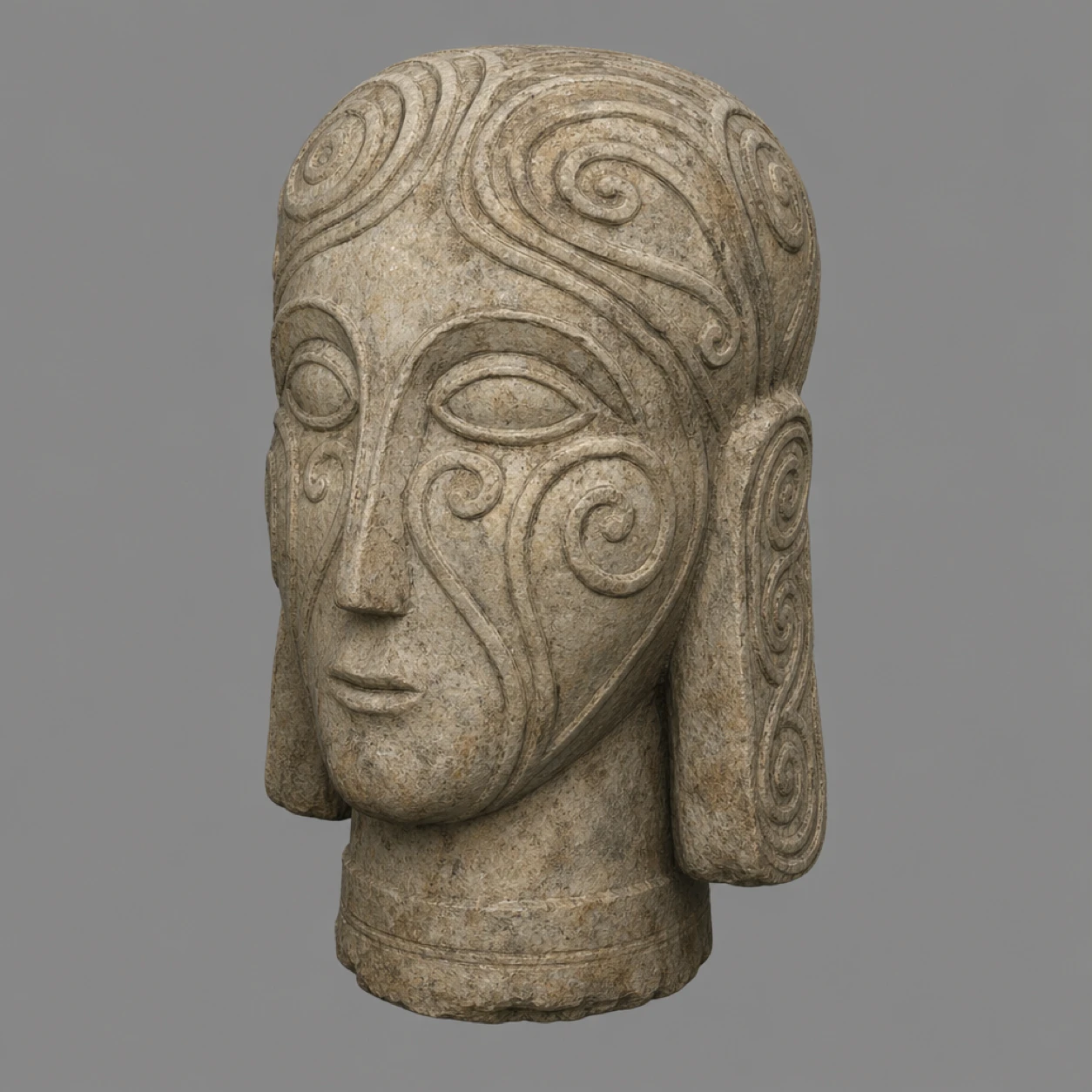
Set a carved stone head on a wooden pillar at a hilltop shrine or at the entrance to a ritual enclosure, not on a domestic shelf. Pair it with a great torc offering or a distant horned helmet processional prop to signal elite ceremony rather than everyday life. Our Celtic Ritual Relics pack includes a Corleck-style stone head for sacred groves and Iron Age ritual spaces.