Snettisham Great Torc: A Kilogram of Twisted Gold
A Celtic great torc is a large neck ring of gold or bronze, twisted or forged into a rigid collar with heavy terminals at each end. Torcs marked rank, protected portable wealth, and appear on gods and warriors across La Tène art. The most famous British example is the Snettisham Great Torc, discovered in 1950 when a plough turned up Iron Age gold at Ken Hill near the Norfolk village of Snettisham. Weighing just over a kilogram and built from sixty-four gold-alloy wires, it is one of the most complex pieces of metalwork surviving from ancient Europe.
Eight ropes of wire and hollow La Tène terminals
The body of a great torc is never a simple bar. On the Snettisham piece, sixty-four strands each about 1.9 mm wide were grouped into eight ropes of eight threads, then twisted together into the crescent collar. The terminals are hollow, decorated with embossed ridges and chased basket-work panels in typical late Iron Age British style. The British Museum collection record describes the ends as cast in moulds and welded to the rope collar, a process that demanded specialist goldsmiths and weeks of bench work.
Torcs could also be made from solid twisted bars, smooth tubes, or combinations of iron core and gold sheath. Spanish and Portuguese examples sometimes use thin bands with hourglass terminals. Continental hoards include torcs too heavy to wear, perhaps made for statues or votive display. The Snettisham Great Torc is wearable in theory, with an external diameter near 20 cm, but its weight alone would have announced that the wearer commanded resources ordinary farmers never touched.
Gods, warriors, and neck rings in Celtic Europe
Ancient authors and Celtic art agree that torcs mattered. Diodorus Siculus noted Gaulish love of gold necklaces. Polybius described Galatian warriors wearing gold torcs before Rome defeated them in 225 BCE and hung their standards in the Capitol. On the Gundestrup Cauldron, a cross-legged figure with antlers wears and holds a torc. World History Encyclopedia's article on Celtic torcs explains that gods and heroes across Celtic Europe wear torcs in sculpture and relief, while the precise spiritual meaning remains unknown.
Torcs likely combined display, ritual, and portable wealth. Warriors of high rank wore them in battle according to classical testimony, including Cassius Dio's description of Boudicca with a twisted gold necklace. Roman victors collected torcs as trophies. Generations later, Roman soldiers wore miniature torcs as awards on their armour, a fashion that grew into penannular brooches. In burial, torcs appear more often with women and girls in bronze form, while gold great torcs like Snettisham's tend to come from hoard pits rather than orderly graves.
Norfolk field pits and chained hoard deposits
The Snettisham Great Torc was the standout find from a landscape that kept yielding metal for decades. Farmer Tom Rout ploughed it up in 1950 at Ken Hill. Later seasons uncovered further hoards in the same field in 1948, 1990, and beyond, collectively producing more Iron Age torcs than any other site in Britain. The Great Torc was buried tied to a sheet-gold bracelet by another complete torc looped through its terminals. A gold coin later found caught in the ropes suggests burial around 75 to 50 BCE, consistent with stylistic dating of the torc itself to the 1st century BCE.
World History Encyclopedia notes that Snettisham produced at least twelve separate deposits, some with silver torcs layered above gold groups separated by soil. Whether each pit was a votive gift to gods, a community treasury, or a noble family's emergency cache is still debated. Threading torcs through one another before burial implies ritual intent beyond simple hiding. The scale of gold points toward royal or tribal authority, and many scholars link the site to the Iceni and neighbouring East Anglian power structures of the late Iron Age.
The Snettisham Great Torc at the British Museum
The torc has been in the British Museum since soon after discovery, registration number 1951,0402.2, part of hoard group Snettisham E. It is displayed among the Iron Age gold galleries alongside bracelets and lesser torcs from the same field. Museum curators describe it as one of the most elaborate golden objects from the ancient world, with workmanship compared to Greek, Roman, and Chinese gold traditions of the same era.
Close inspection rewards patience. The twist of the eight ropes is regular enough to look machine-made, yet each wire was laid by hand. Terminal decoration shifts between embossed fields and fine chased lines under magnification. Recent technical study has questioned older catalogues that called the terminals cast, proposing instead that they were raised from sheet gold alloy with solder and tooling marks from multiple workshops. That debate does not diminish the torc's public role as the anchor image of British Celtic goldwork. For a prop artist, the lesson is scale: a great torc is broad, stiff, and heavy, worn high on the neck as a collar of office rather than a loose pendant.
Gold alloy recipes, reworking, and open questions
Snettisham gold is not pure. Alloyed silver and copper gave strength and color variation detectable in laboratory analysis. Torcs were sometimes broken, shortened, or remounted across generations. Researchers studying other British torcs argue that mismatched terminals and solder lines can record repairs, gifts, or political marriages encoded in metal. The Great Torc's linked burial with bracelet and companion torc may mark a single event: a leader's death, a treaty, or a crisis that sent family wealth into the ground for safekeeping.
Counts of surviving great torcs remain uncertain because new hoards still appear. Dating by style overlaps with coin evidence and, where wooden cores survive, radiocarbon. None of that removes the central uncertainty: we know who wore torcs in art and in Roman prose, but we rarely know the name of the Snettisham donor who ordered this collar or the priest who accepted it in the earth. The object survives as proof of skill and power; the biography behind the burial is still largely silent.
In your scene
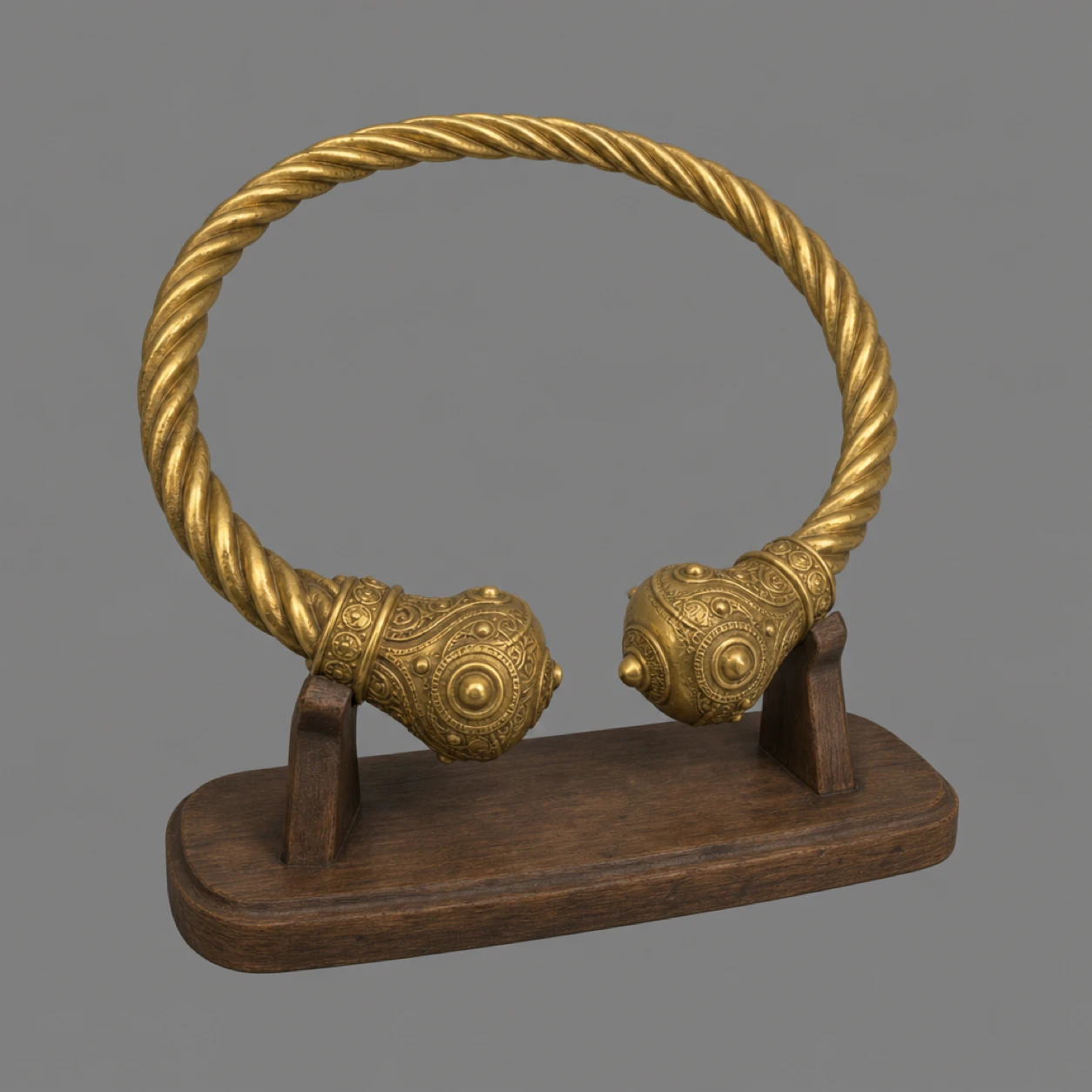
Hang a great torc on a wooden stand in a chieftain's hall or lay it with other gold in a ritual pit, never as lightweight costume jewelry on every extra. Pair it with a stone head on a hilltop shrine or a single horned helmet on a procession route to keep the scene ceremonial. Our Celtic Ritual Relics pack includes a Snettisham-style great torc for Iron Age elite interiors and hoard vignettes.