Waterloo Helmet: Europe's Only Iron Age Horned Helm
A Celtic horned helmet is a bronze headpiece with animal-style horns rising from the brow, cast and decorated in the La Tène art tradition of Iron Age Europe. Real examples are extraordinarily rare. Classical writers and carved monuments show warriors with horned or crested helms, yet archaeology has produced only one actual horned helmet from the Iron Age: the Waterloo Helmet, dredged from the River Thames in London in 1868 and now in the British Museum. It is a ceremonial piece with thin sheet bronze, red glass studs, and conical horns, impractical for a shield wall and probably made for ritual display or river offering.
Conical horns riveted to a La Tène bronze cap
The Waterloo Helmet is formed from hammered copper-alloy sheets riveted into a cap with a crescent-shaped neck guard. Two conical horns rise from the brow, each built from a sheet cone with a cast terminal knob. Decorative strips studded with rows of rivets run up from cheek fittings and across the crown between the horns. The cap once carried six cross-scored studs that held red glass "enamel" inlay, most now lost to corrosion. Small holes around the rim likely secured an inner lining of leather or textile.
World History Encyclopedia's catalogue entry for the piece gives approximate dimensions: about 24 cm high, 58.5 cm circumference, and roughly 568 g in weight, with about 42 cm between horn tips. The repoussé ornament on front and back matches the swirling style seen on other late Iron Age metalwork from Britain, including torcs from the Snettisham hoard. Curators class the helmet at roughly 150 to 50 BCE, the final centuries before Roman conquest reached southern Britain.
Horned warriors in art, almost none in graves
Ancient Mediterranean authors described Celtic fighters in vivid, sometimes contradictory dress. Diodorus Siculus, writing in the 1st century BCE, claimed some Gauls charged into battle naked while others wore elaborate horned or animal-crested helmets. The triumphal arch at Orange in southern Gaul shows horned helms in sculpted battle scenes. Small bronze figurines across Celtic Europe repeat the motif, including a warrior with horned helmet and torc in the Staatliche Museen, Berlin, discussed in World History Encyclopedia's survey of Celtic sculpture.
Graves tell a different story. Excavated Iron Age helmets from Britain and the Continent are generally hornless, with peaked or conical bowls suited to fighting. The Canterbury helmet, the Meyrick helmet, and most La Tène bronze caps lack horns entirely. Miranda Aldhouse-Green and other archaeologists have warned that because the Waterloo Helmet is unique, modern reconstructions tend to put horns on every Celtic warrior, turning a rare ceremonial type into a cliché. Horned helmets existed in Celtic art and perhaps in parade. They were not standard infantry kit.
River offerings, processions, and elite display
The Waterloo Helmet was found in the Thames near Waterloo Bridge during nineteenth-century river works. It may have been a votive deposit, like the Battersea Shield and many other high-status metal objects recovered from the same river system. Julia Farley's British Museum essay on Celtic identity pairs the helmet with classical descriptions of ostentatious dress and notes that such pieces dredged from the Thames help fill gaps left by literary stereotypes.
Thin bronze walls and delicate horn mounts would have dented quickly in combat. The helmet's weight under a kilogram and its glass inlay point toward ceremony: a procession, a feast where warriors displayed wealth, or a deliberate gift to river gods who guarded crossings. Ring fittings at the sides held a chin strap or cheek pieces, so it could be worn, but wear likely meant showing status rather than catching sword cuts. Torcs, shields, and carnyx war horns fulfilled overlapping roles in the same ritual economy of gold, bronze, and spectacle.
The Waterloo Helmet in the British Museum
The helmet is on display in the British Museum's Iron Age galleries (Room 50), registration number 1988,1004.1. It entered the collection after decades on loan from the Thames Conservancy and was donated by the Port of London Authority in 1988. Seen in the case, the horns project forward with an almost theatrical profile, while the low cap sits close to the skull unlike the tall crests of Hollywood fantasy.
The museum caption links the ornament to the same craft tradition as the Snettisham Great Torc, a useful reminder that helmets, neck rings, and shields were products of the same specialist metalworkers. One horn on the surviving piece is a replacement, evidence of ancient repair or modern restoration. Either way, the object is a working document of how La Tène smiths combined sheet bronze, cast fittings, and glass inlay into a single striking silhouette.
Rare archaeology, Viking opera, and modern fantasy
Two separate horn myths confuse popular culture. The first is Celtic: because one horned Iron Age helmet survives, illustrators horned every Iron Age warrior. The second is Norse: nineteenth-century opera and costume design put horns on Viking helmets even though Viking Age graves produced no horned helms at all. The Gjermundbu helmet from Norway has a spectacle visor and mail hooks, not horns. Conflating the traditions turns two distinct cultures into one generic "barbarian" look.
Archaeologists still debate who deposited the Waterloo Helmet and why. Was it a chieftain's treasure lost in conflict, a priest's regalia, or a structured votive gift at a sacred crossing? Thames finds rarely come with settlement context. What is secure is the object's date, its La Tène decoration, and its status as the only confirmed horned helmet from Iron Age Europe. For game scenes, that rarity is the point: one horned helm in a hall or on a shrine reads as ritual authority, not as standard issue kit for every fighter in the war band.
In your scene
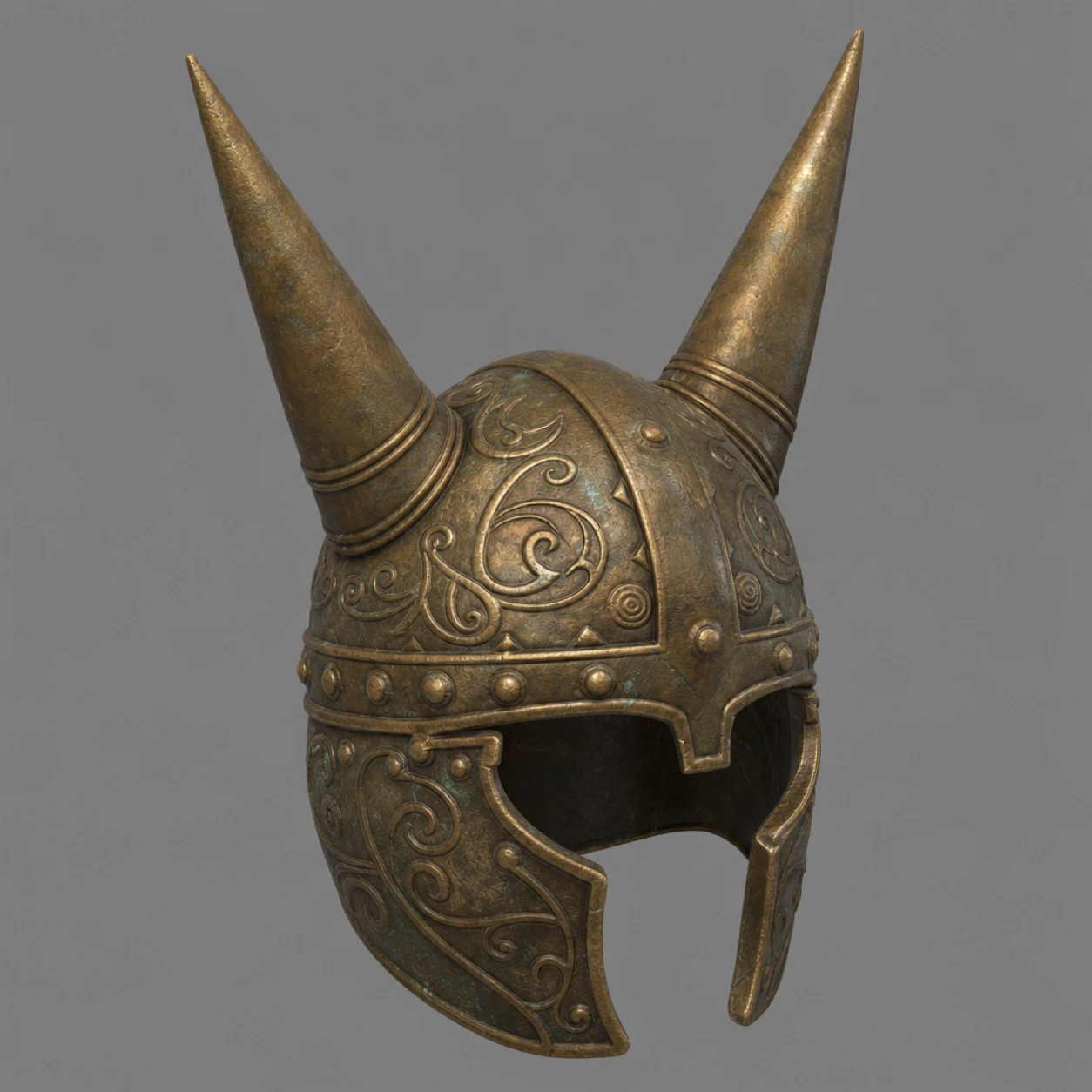
Reserve a horned helmet for a chieftain's feast, river shrine, or victory procession, not for rank-and-file soldiers in battle line. Place it near a great torc or carved stone head to signal ceremony rather than campaign gear. Our Celtic Ritual Relics pack includes a horned helmet model inspired by the Waterloo type for La Tène ritual interiors.