Marble Bust 12.233: Republican Verism at the Metropolitan Museum
A Roman bust is a sculpted portrait showing the head and upper chest of a real person, cut off below the shoulders and often set on a herm shaft or inserted into a statue body. Unlike the idealized gods of Greek temple pediments, Roman portrait busts were built to record a specific face: a senator's furrowed brow, an emperor's carefully styled hair, or a merchant's lined cheeks. They stood in house shrines beside wax ancestor masks, flanked cinerary urns in tomb niches, and lined imperial halls where visitors read power in bone structure and hairstyle. For modern viewers, the bust is the signature Roman sculptural format, and museums from Rome to New York hold thousands of examples spanning the Republic through late antiquity.
Head, shoulders, and the Roman habit of cutting portraits short
The Latin world did not use the modern word bust for these objects. Romans spoke of portrait heads, imagines, and statue bodies fitted with interchangeable heads. Sculptors routinely carved a likeness only as far as the chest, sometimes with a turned neck and drilled pupils, because that fragment was enough for display on a shelf, in a niche, or atop a draped torso. World History Encyclopedia's survey of Roman sculpture notes that by the Antonine period it became fashionable to show a complete upper torso rather than shoulders alone, a shift visible in military portraits dressed in the paludamentum cloak.
Marble was the prestige material for permanent display, but bronze, terracotta, and even painted wax served the same commemorative job at different social levels. A patrician house might combine a bronze ancestor bust in the lararium with marble copies for the garden. A freedperson's tomb might carry only a modest relief head on a stone stele. What unites the category is function: the bust is a portrait you can walk around, set on a table, or fix in a wall without needing a full standing figure.
Wax imagines, the lararium, and funeral display
Roman elite memory began in wax, not stone. The Metropolitan Museum's essay on Roman portrait sculpture describes wax portrait masks called imagines, worn in funeral processions of the upper classes to commemorate distinguished ancestry. These masks, portraits of ancestors who had held public office or received special honors, were proudly housed in the household lararium along with busts made of bronze, marble, or terracotta. In displaying these portraits so prominently, aristocratic families celebrated their history of public service while honoring deceased relatives.
That domestic context links the bust directly to the lararium, the household shrine where Lares, Genius, and ancestor images shared wall space. A wax mask might be carried once in a funeral parade, then retire to the shrine; a marble bust could stand beside it year round. Funerary sculpture extended the same logic into the tomb: portrait busts accompanied cinerary urns in columbarium niches, and relief portraits on altars named the dead with cursus inscriptions listing offices held. The bust was therefore both family furniture and public résumé, tying living faces to generations of office.
Republican verism, gravitas, and why wrinkles meant power
In the late Republic, portrait style turned harshly realistic. Scholars call this approach verism, from Latin verus (true). Wrinkles, sagging jowls, crooked noses, and thin lips were not accidents of poor carving but deliberate signals of age, duty, and authority. World History Encyclopedia explains that private portrait busts often move away from idealized beauty and present the subject as old, wrinkled, scarred, or flabby; in short, these portraits tell the truth. Prestige in Republican politics came from experience: the Senate was an assembly of mature men, and a face that looked battle-tested read as trustworthy.
Verism was not photographic accuracy. Artists exaggerated flaws to make a rhetorical point, much as a modern campaign portrait still chooses lighting and angle. The style likely grew from funeral masks and from competitive display among aristocratic clans who paraded ancestral images to prove long service to the state. When Augustus founded the principate, official imperial portraits shifted toward youthful, classicizing idealism that borrowed from Greek kingship. Republican grimness did not vanish, however; it returned as a deliberate revival whenever later patrons wanted to claim old-fashioned virtue.
From Augustan ideals to Antonine curls and military cloaks
Imperial portrait cycles followed political needs more than personal taste. Augustus and his successors circulated standardized types through temples, coins, and provincial workshops so that a citizen in Gaul or Syria could recognize the emperor's face. Private busts sometimes copied those official hairstyles, especially when a local elite wanted to show loyalty. Under Hadrian, beards spread from the emperor downward, emulating Greek philosophers. Antonine princes popularized busts cut below the chest and dressed in the paludamentum, the military cloak that marked a Caesar even before he held supreme power.
World History Encyclopedia notes that realism returned with the Antonines, with crow's-feet and flabbiness reappearing, and that sculptors sometimes polished skin surfaces while leaving hair deeply drilled for contrast. Youth portraits of Marcus Aurelius as Caesar, known in roughly twenty-five copies from about 139 CE, became models for private clients and even for later emperors such as Caracalla. The same period could produce both smooth imperial youths and stern Republican revivals, depending on whether the patron wanted dynastic glamour or ancestral austerity.
The Metropolitan Museum's marble bust of a man (12.233)
One of the clearest teaching pieces for Republican verism in a later imperial setting is the Marble bust of a man in the Metropolitan Museum of Art, object number 12.233, acquired in 1912. The museum dates it to the mid-1st century CE, Julio-Claudian period, and measures it at 14 3/8 inches (36.5 cm) high in marble. The curatorial text describes furrowed brows, piercing eyes, thin tightly sealed lips, heavy jowls etched with wrinkles, and rolls of flesh at the back of the neck, features that embody the austere values of the Roman Republic.
The label is explicit that this head was carved in the later Julio-Claudian period at a time when there was a revival of interest in Republican portraiture, not during the Republic itself. That distinction matters for historians: the bust is a nostalgic quotation, a mid-1st century CE sculptor imitating the grim middle-aged faces of two centuries earlier. Surface cleaning and recutting have altered some details, and a dark burial incrustation still clings in places, reminders that most surviving busts spent centuries underground before museum display. Standing in the Greek and Roman galleries, 12.233 lets viewers compare Republican rhetoric in stone with the smoother imperial portraits nearby.
Marble, bronze, and the uneven survival of Roman faces
Thousands of Roman portrait busts survive, yet the record is skewed. Marble endures in tombs and villa ruins; bronze was melted for reuse; wax vanished except where literary sources describe it. Names are lost for most private heads: a wrinkled man in a museum case is often "Roman patrician, 1st century BCE" because no inscription accompanied the find. Imperial busts fare better when tied to coin portraits, but even emperors suffer damnatio memoriae recutting, as the Met essay notes for condemned rulers whose faces were erased or reworked into private citizens.
Regional workshops adapted metropolitan models with local stone and varying skill. A bust from Delos in the 2nd century BCE shows early Republican realism far from Rome, while provincial copies of imperial types could be coarser but still politically useful. Scholars continue to debate how closely verism followed actual appearance, and dating without provenance remains uncertain. What is secure is the cultural weight Romans placed on displayed likeness: in the house, the tomb, the forum, and the legionary camp, a carved face was evidence of who you were, who you came from, and what you wanted others to believe.
In your scene
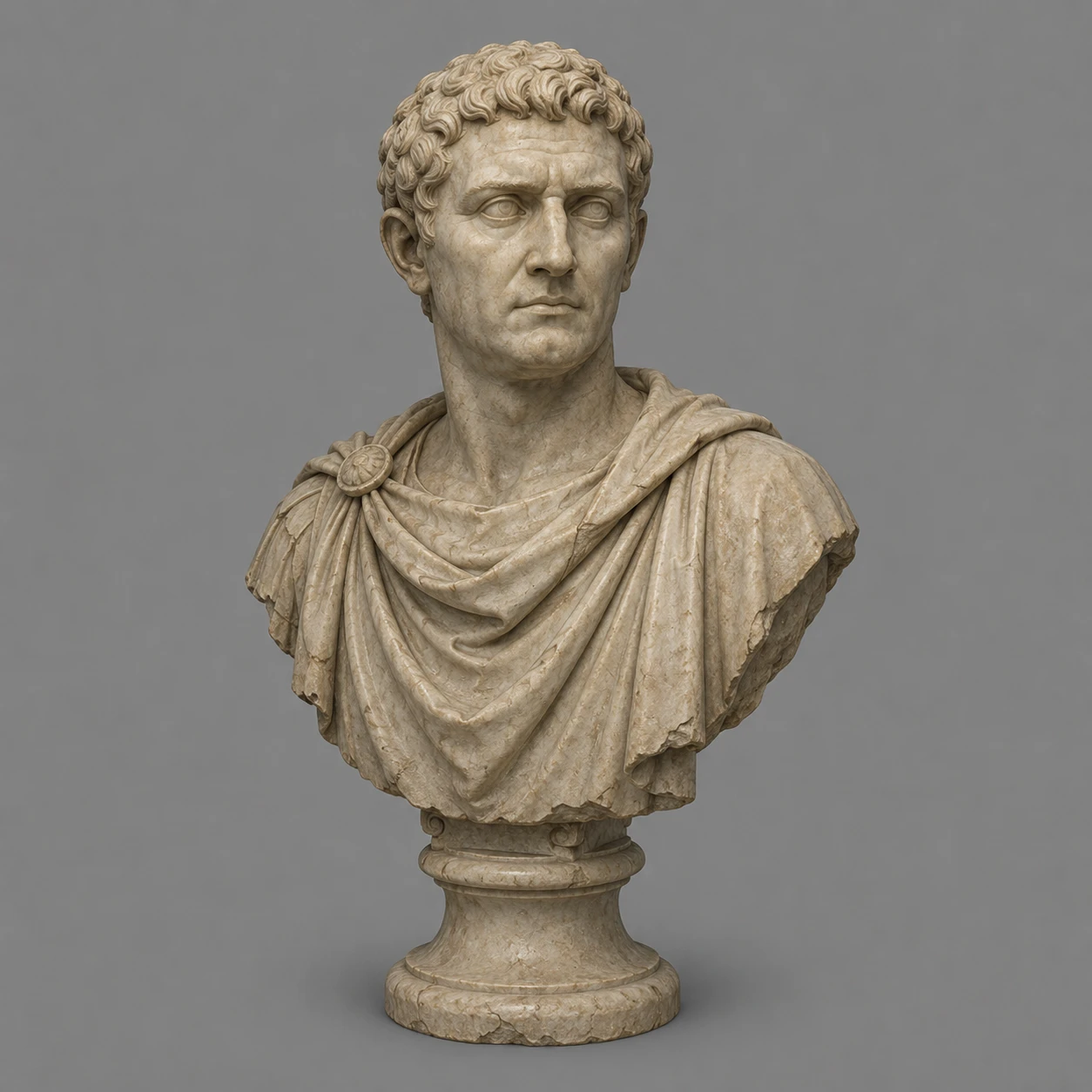
Place a Roman bust on a villa shelf, a commander’s study, or the side table of a lararium where ancestor portraits would gather. Pair a grim veristic head with a smoother imperial type to suggest generations of office, or set a military-cloaked bust near an aquila standard to mark a legionary officer’s quarters. Our Roman Empire Relics pack includes a stylised Roman bust suited to house shrines, temple antechambers, and fort interiors.