Vetutius Placidus' Thermopolium: Pompeii's Painted Lararium
A lararium is the household shrine where Roman families honored the Lares and related spirits who watched over hearth, home, and prosperity. The word comes from Lares, the guardian deities tied to family and property, and names both the sacred cupboard or niche and the altar area before which daily prayers and offerings were made. In Pompeii, where volcanic ash froze domestic interiors in 79 CE, lararia survive as some of the clearest evidence for religion practiced not in public temples but at kitchen walls, shop counters, and atrium corners.
Cupboard shrine, Lares Familiares, and the Genius
Roman writers grouped many spirits under one roof, but the lararium focused on those closest to daily life. World History Encyclopedia's survey of Roman household spirits describes a cupboard-shrine, the lararium, usually in the atrium, which housed statuettes of the Lares and worked to keep the family prosperous. These spirits were known as Lares Familiares (spirits of the family) or Lares Domestici (spirits of the home). They were closely linked to the Penates and Panes, protectors of the storeroom and pantry, and rituals to all three were often combined.
The Genius was a separate but related presence: the household spirit of manhood, tied to the procreative force of the paterfamilias and symbolized in art by a snake. On lararium paintings the Genius often appears as a toga-clad figure making sacrifice, while serpents below may represent fertility and the health of the household. Scholars still debate whether every snake in a lararium scene stands for the Genius alone or for broader chthonic protection, but the pairing of Genius, Lares, and serpent is one of the most recognizable formulas on Pompeian walls.
From Republican atria to Pompeii's hundreds of shrines
The lararium was not a single fixed design. George K. Boyce's catalogue of Pompeian examples, still the baseline for modern study, sorted surviving shrines by form as much as by location. Archaeologists commonly describe three types: a simple niche cut into a wall; a painted scene without built architecture; and an aedicula, a miniature temple front with columns, pediment, and sometimes stucco relief. The same house might hold more than one shrine, with a grand aedicula in the atrium and a simpler painted niche in the kitchen.
Modern surveys of Pompeii count more than three hundred domestic lararia across houses, gardens, and commercial spaces. That number grows when shops and workshops are included, because thermopolia and tabernae could display household cult images as openly as private homes. Most preserved examples date to the decades before the eruption, and many houses rebuilt after the earthquake of 62 CE received new or enlarged shrines, which is why Pompeii offers such a dense map of how lararia looked in ordinary Roman life.
Morning prayers, meal offerings, and quid pro quo
Roman domestic religion ran on reciprocity. As World History Encyclopedia notes, religion was understood as a contractual relationship: honor the spirits properly and they guarded health and prosperity; neglect them and fortune turned. The head of the household supervised domestic ritual much as elected officials handled public ceremonies. Daily prayers and small offerings to the Lares were expected throughout the year, with more elaborate rites on birthdays, weddings, departures, and returns from travel.
Meals were a common offering point. Statuettes of the Penates might be set on the table, a portion of food reserved, and that portion burned in the hearth fire afterward. The first fruits of harvest went to the pantry gods; garlands, incense, wine, and flowers appear in literary and archaeological evidence. When a family moved permanently, the Lares, Penates, and Panes moved with them, a detail that shows how tightly the lararium was bound to the people rather than to the stone walls alone.
After 62 CE, lararia move into courtyards and shop fronts
Before the mid-first century CE, many lararia sat in kitchens, close to the hearth. After the earthquake of 62 CE, Pompeian houses increasingly placed cult images in atria and peristyles, sometimes as built aediculae on podia that dominated the room. Painted Lares flanked by dancing figures, garlands, and sacrificial animals became more common in Fourth Style decoration. The shift did not replace kitchen shrines but added visible, architectural ones where guests and clients could see them.
Commercial lararia followed similar visual language. A bar or cook-shop might honor Mercury as patron of trade and Bacchus as god of wine alongside the Genius of the owner, because the same spirits that protected a domus also protected livelihood. That overlap matters when reading a thermopolium shrine: it uses household iconography in a public sales room, reminding customers that the proprietor's fortune and the shop's fortune were ritually linked.
The painted lararium at Vetutius Placidus' thermopolium
One of the best-preserved commercial lararia stands in the thermopolium of Vetutius Placidus at Pompeii (Regio I, insula VIII, on the Via dell'Abbondanza). World History Encyclopedia's image record describes the shop as a cook-bar that served hot food and drinks from an L-shaped masonry counter with large storage jars set into the stonework. Graffiti and stamped amphorae link the property to Vetutius Placidus and his partner Ascula, names repeated in election slogans on nearby walls.
On the rear wall of the bar, above the service counter, a painted lararium survives in vivid color. The caption identifies the central scene as the Genius of the household performing sacrifice over a small altar, flanked by Mercury on the left and Bacchus on the right. Scholarly descriptions of closely related compositions add dancing Lares with rhyta and situlae, a tripod, and serpents approaching offerings below. Whether read as a strict household shrine or as a shopkeeper's appeal to commerce and wine, the painting shows how an aedicula frame, stucco pediment, and figural program could fit on a single wall in a working food stall.
The thermopolium was excavated in stages from the early twentieth century onward and became a standard illustration in textbooks on Roman daily life because the counter, jars, and fresco survived together. Unlike portable bronze Lares that could be looted or melted, this wall painting fixes the ritual image in the same sight-line as the jars of hot food, which is exactly where a proprietor would see it at the start of each working day.
Niches, aediculae, paintings, and what ash preserved
Not every lararium was painted. Some held bronze or terracotta statuettes of the Lares, a lamp, a bowl, and a small portable altar with ash from burnt offerings. Others were only a recessed niche with no figures at all. Wooden aediculae certainly existed and rotted away; Pompeii's record is biased toward masonry, plaster, and pigment that could survive burial.
Attribution is not always secure. A painting attributed to household cult might belong to a shop, and a grand peristyle shrine might honor Egyptian or imported gods as well as Lares. Boyce's typology helps archaeologists describe form, but function still depends on context: kitchen, atrium, garden, or taberna. Even with more than three hundred catalogued examples at Pompeii alone, the sample is one city frozen in a single disaster. Herculaneum, Ostia, and Rome surely had lararia too, but Pompeii supplies the densest visual library for modelers and historians alike.
In your scene
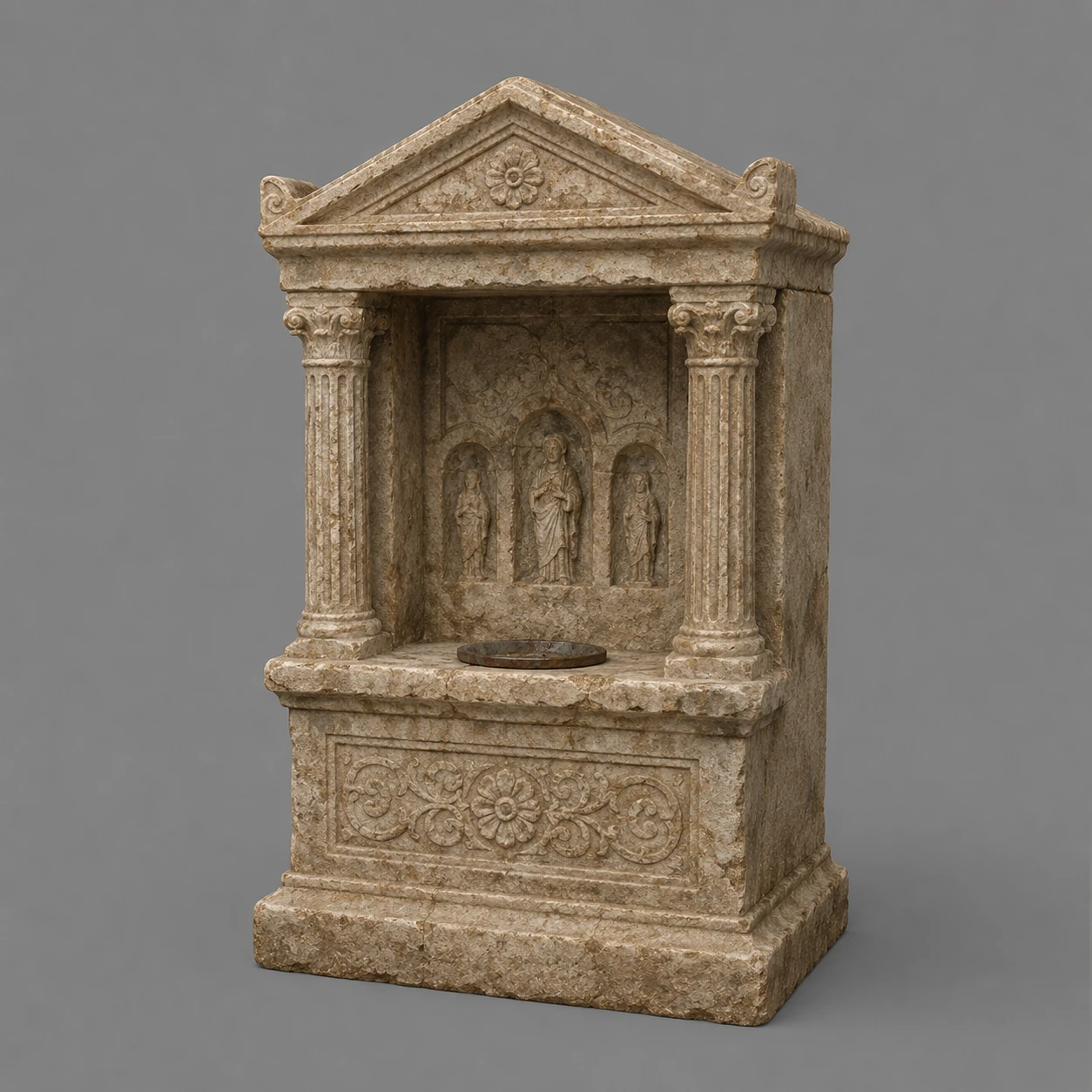
Place a lararium in a Roman villa atrium, a legion barracks shrine nook, or the back wall of a thermopolium where the proprietor would face it while serving food. A low altar with Lares statuettes, a painted Genius scene, or a small aedicula with columns reads instantly as domestic cult rather than state temple. Our Roman Empire Relics pack includes a lararium altar model suited to fort interiors, house shrines, and Roman street-front bars.