What Is an Aquila? Rome's Legion Eagle Standard
In 9 CE three Roman eagles vanished in the Teutoburg Forest with the destroyed legions of Publius Quinctilius Varus. Germanicus marched back into Germania around 16 CE and recovered two of them. The bird on the staff was the aquila, the legion's only standard after Marius. No battlefield original has survived to put in a case.
Aquila, signum, and the eagle on the staff
Latin writers used signum or signa for the infantry standard in general. The legionary form most readers picture is the aquila, a three-dimensional eagle fixed above the pole. World History Encyclopedia's survey of Roman standards notes that cavalry units carried a serpent standard called the draco, while infantry legions were identified by totemic animals, the eagle being the most famous among boar, wolf, horse, and minotaur emblems on earlier formations.
Republican standards sometimes bore the letters SPQR, shorthand for the Senate and People of Rome, so the staff represented the citizen army as well as the unit that carried it. The aquila itself was the bird of Jupiter, a fitting emblem for an army that presented its victories as divine favour. Art and modern reconstructions often show the eagle with wings spread or slightly lifted, claws gripping the crossbar, with a pointed finial below for socketing into the shaft.
From five animal standards to Marius's single eagle
Before Gaius Marius reorganized the legions in the late second century BCE, each legion marched with five separate standards: eagle, horse, bull, wolf, and bear. Marius replaced that set with one common standard for the whole legion, the silver eagle, later gilded in gold. World History Encyclopedia's account of legion emblems ties this change to the Marian Reforms, when property requirements for service dropped away and the legion became a professional, cohort-based force.
Uniform equipment meant legionaries needed another way to tell units apart on campaign. Each legion kept its own emblem on shields, a birth sign tied to the month of its founding, and its unique aquila. Capricorn appears often because many legions were organized in winter camp, though Aries, Taurus, Gemini, and Cancer show up in the record as well. The single eagle therefore did double duty: it unified the legion under one sacred object and sharpened rivalry between legions that might otherwise look identical in line.
The aquilifer and the first cohort's highest rank
Carrying the aquila was the job of the aquilifer, one of several specialist standard bearers in the imperial legion. The same article lists the vexillarius with the cavalry vexillum, the signifer with the infantry signum, and the imaginifer who bore the emperor's portrait, but ranks the aquilifer first because the golden eagle was the legion's paramount symbol. The post sat in the first cohort, among the most honoured positions a common soldier could reach.
An aquilifer had to stay visible in chaos. Relief sculpture and campaign accounts show bearers lifting the staff high so wavering ranks could find their place. Pay and prestige followed the burden: standard bearers earned more than ordinary legionaries because they combined parade duty, record keeping, and extreme personal risk. Drop the eagle or flee without it and a man's reputation, and his unit's, could be ruined for years.
Rally point, trumpet calls, and battlefield signals
The standard was practical as well as sacred. World History Encyclopedia describes trumpet blasts drawing the troops' eyes to the signa, after which the bearer lowered, raised, or waved the staff to signal the next movement, formation change, or retreat. In noise and dust, visual command through the standards could matter as much as shouted orders.
That is why Roman commanders fought to recover lost eagles. Standards were not interchangeable props. Each belonged to a numbered legion with its own history, and capturing one was a trophy that advertised the captor's victory as loudly as a broken line. Soldiers swore annual oaths to the emperor with the standards present, so the aquila also embodied the legal bond between the army and Rome. The staff linked the men in the ranks to the state they claimed to serve.
Teutoburg Forest and Rome's wars to recover lost eagles
The disaster in the Teutoburg Forest in 9 CE fixed the aquila in modern memory. Three legions under Publius Quinctilius Varus were ambushed in Germania and annihilated; all three standards fell into enemy hands. Augustus had already lost those legion numbers from Rome's roster after the battle, yet the eagle standards remained symbols worth a major campaign.
Germanicus led a punitive expedition into Germania around 16 CE to recover them. World History Encyclopedia records that he retrieved two of the three eagles lost with Varus, trading slaughter along the frontier for trophies that proved loyalty to Tiberius and to the fallen. Later literary tradition, and films such as The Eagle, stretched similar stories across Britain and the so-called lost Ninth Legion, though the historical disappearance of Legio IX Hispana is dated differently in the sources and may have involved disbandment rather than a single catastrophic defeat.
Vexillum, imago, and standards beside the legion eagle
The aquila did not march alone. Legion standards could combine several elements on one pole except for the rectangular cavalry vexillum, which marked unit type and legion number with its cloth panel. The manus, an open hand at the top, symbolized soldiers' loyalty to their commanders. The imago displayed the reigning emperor's image and stood for imperial will in the ranks. Cavalry carried the serpent draco, a windsock-like standard that hissed when moved.
These objects divided labour on the parade ground and in battle. The aquilifer held the eagle; other bearers managed their own devices. Together they let a legion display Rome, the emperor, and its own identity at once. Modern museum labels often flatten the distinction and call any Roman bird an aquila, which blurs how carefully Romans separated eagle, portrait, and unit flag.
Legion at the British Museum: standards through a soldier's career
The 2024 exhibition Legion: life in the Roman army at the British Museum placed standards inside a soldier's life rather than on a pedestal alone. Curators followed Claudius Terentianus, whose papyrus letters survive from Egypt, from failed enlistment through transfer into the legions and eventual retirement. Alongside those texts, the show displayed kit from fort and battlefield, including segmental armour from Kalkriese linked to the Teutoburg defeat.
The museum's introduction to the exhibition explains that the coveted role of standard bearer went only to literate, numerate soldiers who kept accounts, and that bearers earned double a legionary's base pay. A tombstone of an imaginifer's daughter, shown in the same project, reminds visitors that standard bearers were real families in forts from Britain to the Red Sea, not abstract icons. Teutoburg armour and Vindolanda tablets grounded the aquila's world in named sites and ordinary handwriting. The eagle itself remains absent from the cases because no legionary aquila has survived intact.
No surviving legion eagles, Silchester, and what remains
Archaeology has not produced a confirmed legionary aquila. Metal eagles turn up in Britain and the provinces, but scholars distinguish them from battlefield standards. The Silchester eagle, a bronze bird found at Calleva Atrebatum in 1866, was first read as a lost legionary eagle hidden during a last stand. Later study argues it belonged to a larger civilian statue, perhaps Jupiter or an emperor, with talons once clasped around a globe. Its fame grew through Rosemary Sutcliff's novel The Eagle of the Ninth, which treats the bird as a military standard even though the object itself was almost certainly not one.
What we do have are carved reliefs, tombstones of bearers, coins showing oath ceremonies, and descriptions in historians such as Tacitus. Reconstructions in museums and on film fill the gap with gilded eagles on tall poles, but those are educated guesses about weight, height, and mounting hardware. When you place an aquila in a historical scene, you are staging a symbol known from literature and secondary standards, not copying a surviving original. The emotional truth, that the eagle was worth dying for and worth sending armies to retrieve, is better documented than any single artefact's shape.
In your scene
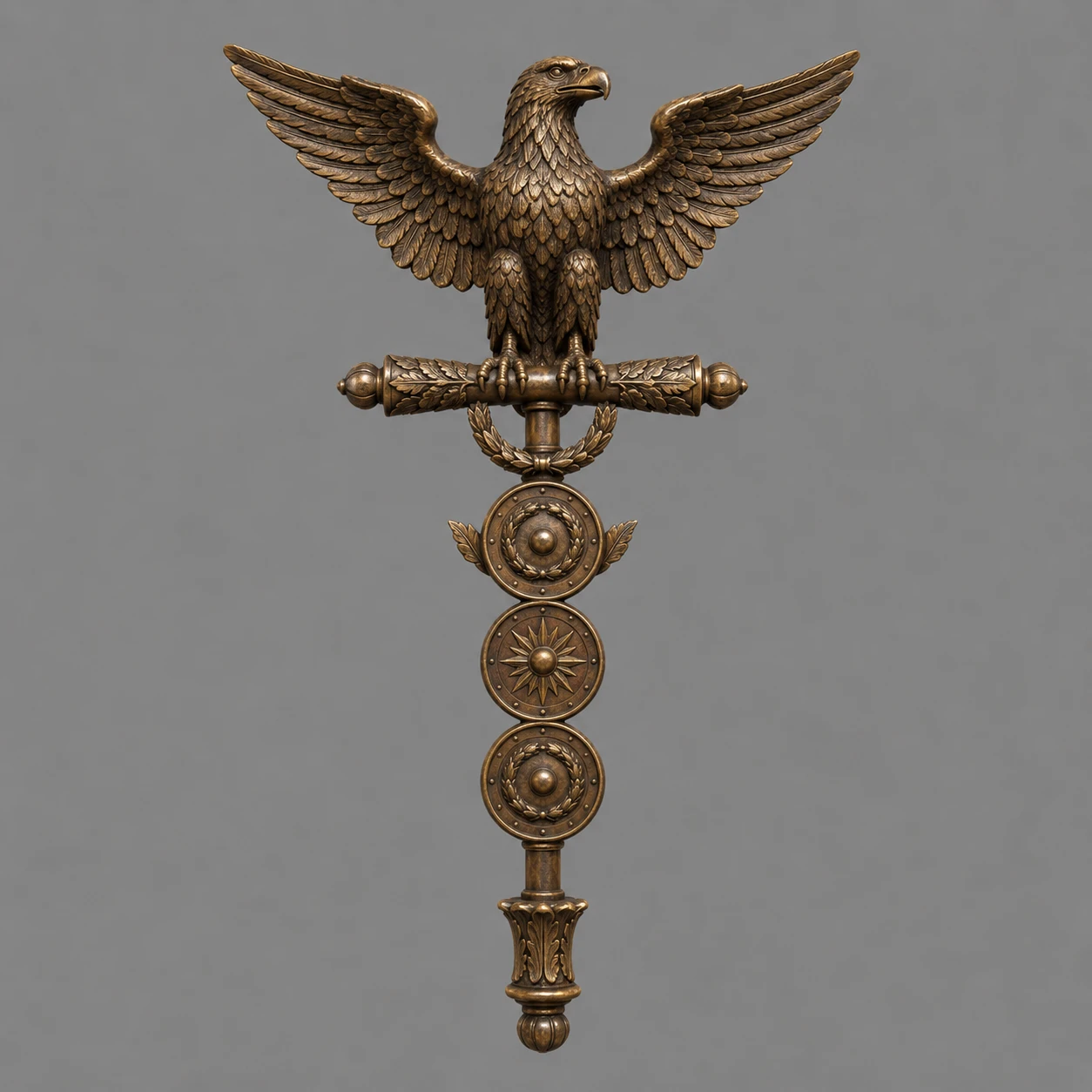
Stand the aquila upright in a principia or beside a centurion's tent, eagle high enough to read as the legion's focal point rather than a handheld trophy. Pair it with grounded shields or a parade line if you want a formal assembly, and keep other standards lower so the eagle stays dominant. Our Roman Empire Relics pack includes an aquila standard model sized for fort interiors and legion camp vignettes.