The British Museum Ram in the Thicket: Woolley's Goat from Ur's Death Pit
Leonard Woolley lifted a tangle of gold and shell from the floor of a mass grave at Ur, and the pieces still argue about what they were for. The statuette everyone calls the Ram in the Thicket is actually a goat on its hind legs, reaching into a flowering tree of hammered gold. By the end of this story you will know why a biblical nickname stuck to a Sumerian furnishing, and why the goat in London is partly a reconstruction. The British Museum lists it as museum number 122200, registration 1929,1017.1, from Sir Leonard Woolley's 1928-1929 season in the Royal Cemetery.
Gold fleece, lapis horns, and a shoulder tube
The figure is a composite animal sculpture, not a single cast. A wooden core once shaped the body. Gold leaf covers the goat's face and legs. Its ears are copper alloy, now green with corrosion. Twisted horns, eye pupils, and the fleece on the shoulders are lapis lazuli. The body fleece is white shell, set in bitumen. The flowering shrub behind the goat is gold leaf with gold flowers. The animal stands on a small rectangular base with a mosaic of shell, red limestone, and lapis lazuli.
A hollow tube rises from the goat's shoulders. The British Museum reads that as evidence the piece supported something above it, most likely a bowl or tray. The pose is naturalistic: a goat rearing to browse high branches, a posture herders still recognize. Museums file the object as statuette and stand together because the tree and base are part of the same furnishing, not a separate plinth for a freestanding sculpture.
From Ur's royal graves to Woolley's Genesis nickname
The statuette belongs to Early Dynastic III Mesopotamia, about 2600 BC in the British Museum catalogue. Ur, in what is now southern Iraq, was a wealthy Sumerian city whose royal cemetery yielded some of the most famous third-millennium finds. Woolley excavated in Ur's Royal Cemetery during his work there.
Woolley nicknamed the pair "the ram caught in a thicket" after Genesis 22:13, where Abraham finds a ram caught by its horns. World History Encyclopedia, reproducing the British Museum caption, states plainly that Woolley chose the name for its biblical allusion. That Genesis label is modern curator's poetry, not a Sumerian title from the grave. The animals are goats, not rams, and the scene is a goat feeding at a tree, not a sacrifice narrative frozen in metal.
The Great Death Pit in the Royal Cemetery
Woolley found this goat and its near twin lying close together in the Great Death Pit, one of the graves in the Royal Cemetery at Ur. World History Encyclopedia, reproducing the British Museum caption, names the findspot that way. The burial context matters for how you read the object. It was not street market stock. It was grave furniture from one of the richest excavated tombs of Early Dynastic Sumer.
How a flattened goat was pressed back into shape
The figure did not survive burial intact. Woolley recorded that soil weight crushed the statuette flat and rotted the wooden core. Excavators used wax to hold fragments during lifting, then gently pressed the piece back toward its original form. Shell inlays, gold leaf, and bitumen adhesive had to be reconciled to a shape the wood no longer guaranteed.
That recovery work is part of the object today. Museum labels describe an original wooden mount and a restored silhouette. When you look at the Ram in the Thicket, you are looking at third-millennium materials plus early twentieth-century reconstruction choices made under Woolley's direction.
The British Museum goat registered as 122200
The London half of the pair is catalogued online as statuette and stand, museum number 122200, registration 1929,1017.1. The British Museum title field reads The Ram in the Thicket. The record gives a height of 45.7 centimetres and a width of 30.48 centimetres, with excavation number U.12357. Materials listed match the gold, lapis, shell, wood, silver, and red limestone described above. Woolley is named as excavator; the findspot is the Royal Cemetery at Ur.
The British Museum collection entry on the live catalogue page states the object is not on display. Room 56 often appears in guidebooks because other Ur pieces and Mesopotamian highlights fill the gallery, but you should not plan a visit around seeing this goat on open view without checking current museum listings. The near-identical partner from the same pit is held by the University of Pennsylvania Museum in Philadelphia, a counterpart named on the World History Encyclopedia caption sourced from the Trustees of the British Museum.
What wood, ritual purpose, and the Standard of Ur still argue
Not every detail of the original join survives. Conservation notes on the British Museum record mention treatment. Some scholars read the shoulder tube as part of an offering stand for a daily ritual; others stress how little written ritual from the mid-third millennium names a matching ceremony. World History Encyclopedia's Standard of Ur scene shows a rearing goat at a small tree in shell inlay, with an overall depiction very similar to the Great Death Pit statuettes, which suggests the motif mattered in elite art without proving one shared meaning.
Debate also lingers over how literally to read the Genesis nickname. Woolley's phrase helped the public remember the find, but it can cast a Sumerian grave good as illustration of a later Hebrew text. The secure core is a pair of inlaid goat-and-tree supports from the Great Death Pit, rebuilt after excavation, split between London and Philadelphia, registered 122200 in the British Museum.
In your scene
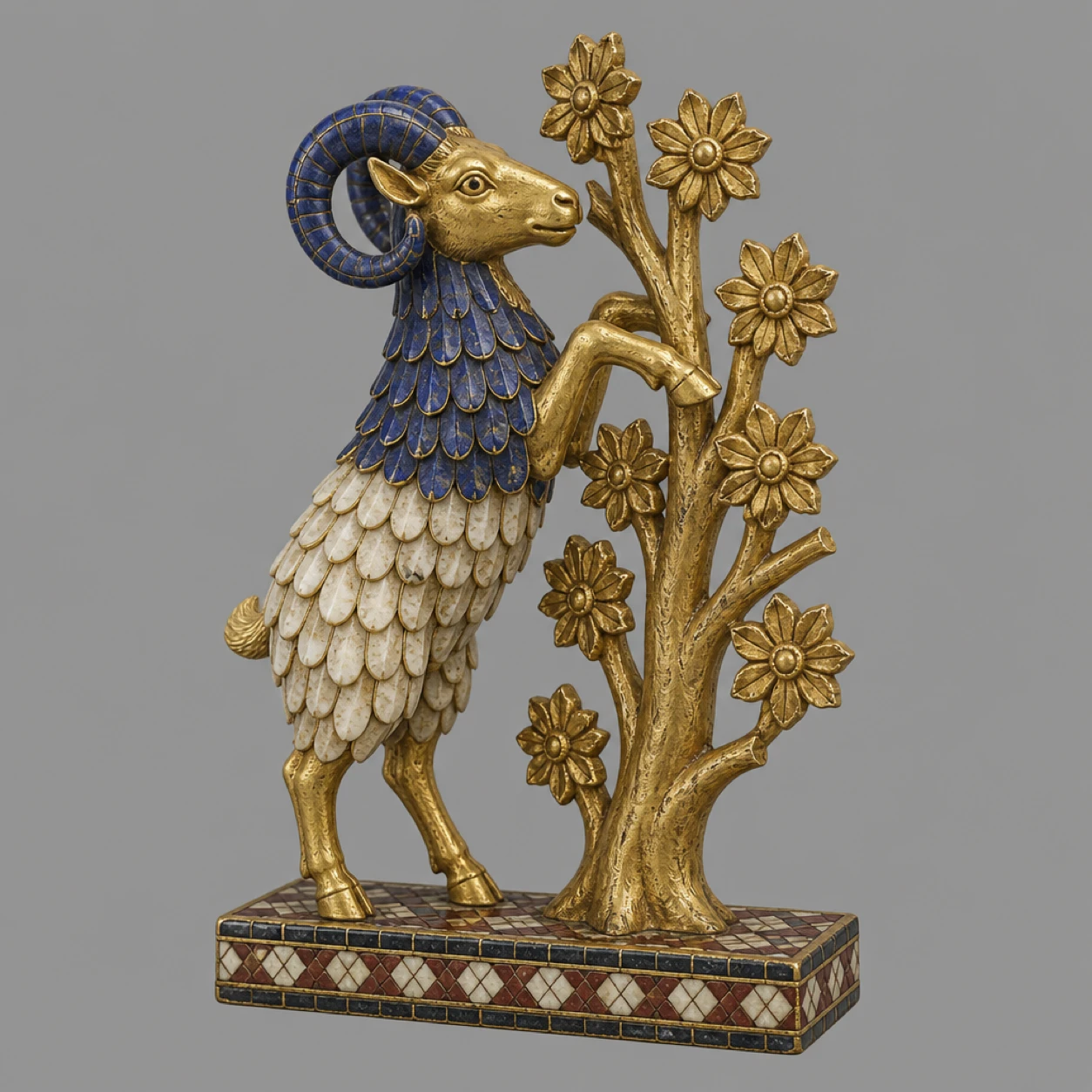
The Ram in the Thicket reads as temple or tomb furnishing, not a pasture prop dropped at random. Place it on a low platform with room above the shoulder tube for a bowl or tray, and keep gold, lapis, and shell surfaces consistent with Early Dynastic luxury. For other Ur-period pieces in the same register, see the Mesopotamian Temple Relics pack.