Palace Plaques: Brass Court Scenes on Benin's Pillars
A Benin palace plaque is a rectangular brass relief cast for the royal court of the Edo kingdom of Benin in present-day southern Nigeria. Guild casters fixed these panels to wooden pillars in the oba's palace so that visitors walking a courtyard gallery saw court rank, ritual, war memory, and trade power in metal. Museums group them with the wider corpus nicknamed the Benin Bronzes, though the metal is usually brass rather than true bronze. Edo speakers call such reliefs ama. They are not free-standing paintings or altar busts; they are architectural cladding that made palace timber read as a public archive of kingship.
Ama in brass: nails, relief, and who stands largest
A typical plaque is a tall rectangle, often near 45 to 50 cm high, cast by the lost-wax process. Figures rise in high relief from a patterned background. Many panels show punched nail holes from the mounts that once pinned them to palace posts. Two common formats appear in collections: some have turned-back vertical edges with an incised guilloché border, while narrower examples end more abruptly, as if cut to fit a thinner post. Depth of relief varies across the corpus, from shallow processions to figures that project strongly from the field.
The Igun Eronmwon (also written Ìgùn Ẹ́rọ̀nwwọ̀n) brass-casting guild made these works for the court. Portuguese coastal trade from the late fifteenth century supplied copper-alloy manillas and other metal that fed the foundries, but casting itself is an older Edo craft tradition. Hierarchy is drawn by scale: the oba or a high chief fills the centre and stands taller than attendants. Coral-bead caps, high collars (odigba), leopard teeth, ceremonial swords, shields, fans, and trumpets mark office. Portuguese figures sometimes appear in European dress and weapons, recording contact without handing authorship of the brass to outsiders.
From warrior kings to panels left in storage
Most scholars place the great plaque series in the sixteenth and early seventeenth centuries, the era of the warrior kings when Benin expanded and deepened Atlantic trade. The British Museum dates many relief plaques roughly from 1500 to the mid-1600s. World History Encyclopedia notes rectangular panels about 45 cm high attached to palace pillars. Kathryn Wysocki Gunsch's survey of nearly 850 plaques argues for a tighter production window under oba Esigie (early to mid-sixteenth century) and his son Orhogbua, when the audience-hall pillars may have carried a coordinated imperial program. Older catalogues sometimes stretch manufacture across about 150 years; newer work often compresses it. Treat printed date brackets as informed ranges, not stamps on each casting.
By the time British forces entered the palace in 1897, the plaques were no longer on the pillars. They were found stacked in a storage room within the compound. A seventeenth-century Dutch account still describes wooden pillars covered with brass scenes of court officials; a later visitor around 1702 does not mention them. The usual reading is that the panels came down sometime in the seventeenth century and were kept as court property rather than discarded. Exact motives for removal remain debated.
Pillars that taught rank and history
Palace compounds were built around atrium courtyards. In the larger rooms, galleries with wooden pillars held the roof, and brass plaques sheathed those posts from top to bottom. Matching pairs and processional sets likely wrapped all four faces of a pillar so that an ambassador, trader, or subject walking the veranda saw a continuous metal narrative. Subjects include mounted kings, warrior chiefs with attendants, ritual scenes, and European traders. Some commemorate campaigns; others freeze daily court protocol: who cools a chief with a fan, who announces him with a trumpet, who presents kola to the oba.
The plaques worked as political architecture, not gallery art. They told viewers that divine kingship rested on guild skill, coral wealth, and military order. They also sat beside other court brass such as commemorative heads made for ancestral altars. Heads belong to shrine platforms; plaques belong to the public face of the hall. Both glorify the oba, but they do different jobs in different spaces.
How palace cladding left Benin City
In February 1897 a British punitive expedition stormed Benin City, burned parts of the palace, and seized thousands of court works. More than 900 brass relief plaques left with that loot, along with altar heads, ivories, and other guild pieces. Many entered the British Museum and other European and American collections through official spoils sales and private dealing. Encyclopaedia Britannica's survey of the Benin Bronzes treats palace plaques as a core class within that diaspora. Restitution debates today still turn on these panels because they are numerous, visually famous, and clearly tied to a specific architectural setting that no longer holds them.
Guild casting continued in Benin City after 1897, and oba Eweka II later rebuilt palace craft structures. The sixteenth-century pillar program itself cannot be walked as it once stood. What survives is a scattered corpus whose original sequence on the posts is only partly reconstructed from style groups, matching edges, and scholarly installation studies.
The Met's equestrian Oba you can still see
One clear museum example is the Metropolitan Museum of Art's Plaque with equestrian ọ́bà (king) and attendants, object 1978.412.309, on view in Gallery 342. The Met attributes it to Ìgùn Ẹ́rọ̀nwwọ̀n artists and dates it about 1540–70. It measures 49.5 cm high, 41.9 cm wide, and 11.4 cm deep, cast in brass. The king mounts a horse at the centre; attendants appear at smaller scale. Coral-bead regalia and the privilege of shields held above his head mark him as oba. The piece entered the Met through the Michael C. Rockefeller Memorial Collection, gift of Nelson A. Rockefeller in 1965 (accessioned 1978).
Smarthistory and older labels sometimes print a wider date of 1550–1680 for the same object. The Met's tighter mid-sixteenth-century bracket fits the Esigie and Orhogbua production argument, while the wider bracket reflects older stylistic dating habits. Either way, the plaque is a court relief meant for a palace post, not a free-hanging picture. Hierarchical scale, equestrian display, and coral costume are the visual grammar that made rank legible at a glance in the audience hall.
Counts, dates, and what labels still leave open
Survival numbers are estimates that shift as databases grow. The British Museum speaks of more than 900 plaques taken from storage in 1897; Gunsch works from a corpus of nearly 850 tracked examples. Both figures describe a large but incomplete set. Materials labels vary between bronze and brass; technical studies usually point to leaded brass of mixed compositions. We do not know the full original order on every pillar, which scenes faced which courtyard, or exactly why the panels were taken down before colonial seizure.
Scholars also debate how tightly Portuguese trade metal caused the plaque boom versus how far older casting practice already stood ready. Facial naturalism, background patterns, and figure depth help group hands and workshops, but they do not yield birth years. Where catalogues disagree by decades, say so. The secure core remains: these ama were guild-made brass architecture for an Edo royal palace, cast to fix court history and hierarchy onto the pillars that held up the oba's halls.
In your scene
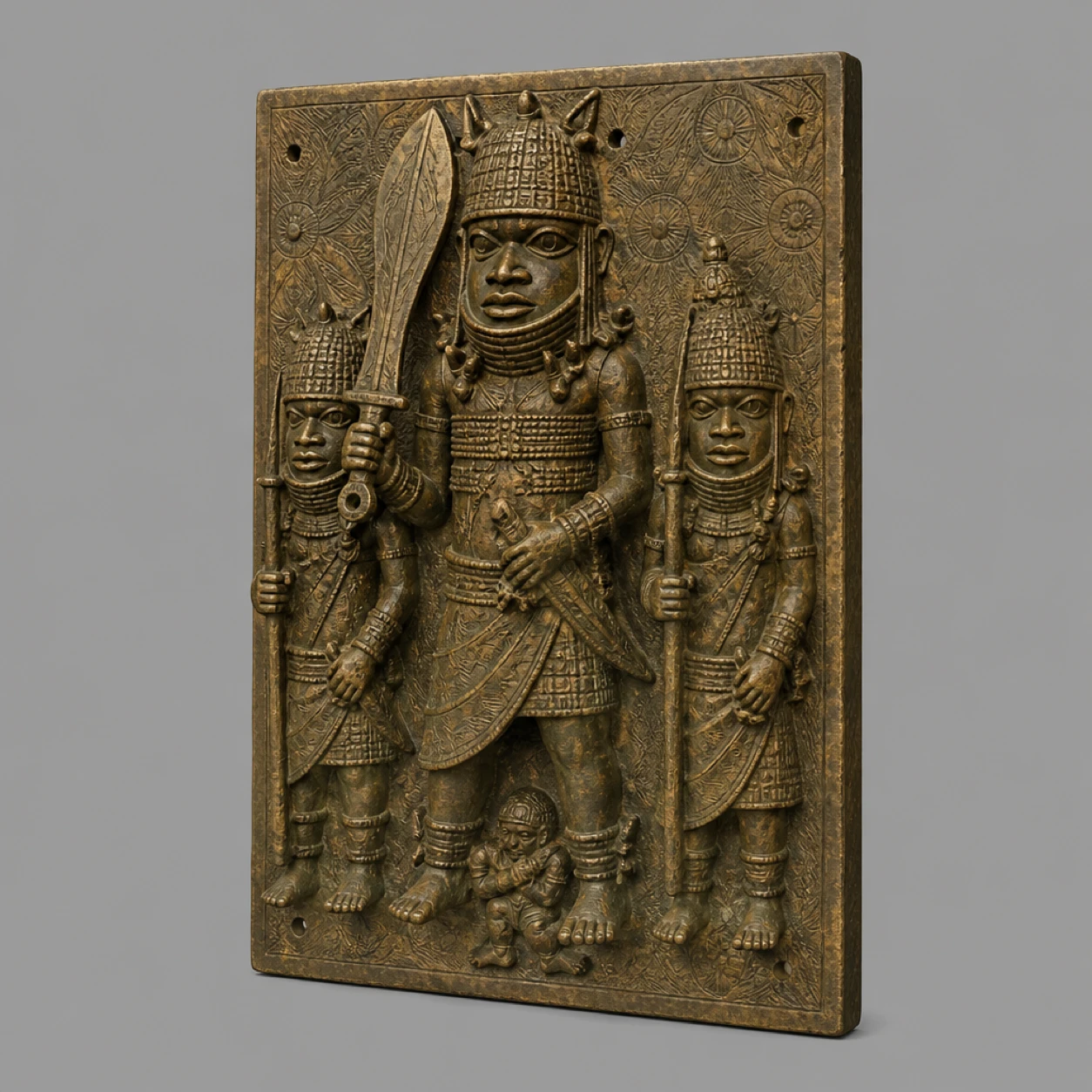
A Benin palace plaque reads as architectural court metal, not a loose wall trophy. Mount it as cladding on a wooden pillar or courtyard post, keep hierarchical scale in the figures, and leave room for nail-hole mounts if you show age. For a full court set, see the African Kingdom Relics pack.