Mushussu: Furious Snake-Dragon of the Ishtar Gate
In the early 6th century BCE, processions for the Babylonian New Year passed through a gate faced with deep blue glazed brick. Between rows of striding lions and powerful bulls, a long-bodied creature reared on the gate wall. Visitors called the gate after Ishtar, but the dragon on the bricks belonged to Marduk, Babylon's chief god. Modern guides often call it a dragon. That word hides what makes the beast strange: it is a composite snake, not a winged fire-breather from medieval Europe.
A furious snake with a horn and bird's talons
The creature is the mushhushshu, also written mušḫuššu or mushhushshu. Akkadian sources gloss the name as a "furious snake." In encyclopedic descriptions it appears as a slender dog with a scaly body and tail, bird's talons, a long neck, a forked tongue, and a protruding horn. There are no wings in the classic Babylonian type.
Gate reliefs and popular summaries sometimes add other predator parts: a horned viper head and scales, lion forepaws, or a scorpion sting on the tail. Those details show up in modern museum labels and reconstructions, but they are not the anatomy listed in the pantheon sources used here. The mushhushshu is less a zoological species than a visual formula for a protective spirit tied to the highest god of Babylon.
From Tiamat's monsters to Marduk's emblem
Long before Nebuchadnezzar lined his gate with glazed dragons, the mushhushshu sat in myth as one of the creatures born from the chaos goddess Tiamat. In the Babylonian creation epic Enuma Elish, Marduk defeats Tiamat and her army of monsters, then orders images of those beasts preserved as reminders of cosmic order restored. The mushhushshu appears among that defeated host.
Over centuries the same form moved from chaos enemy to royal protector. Scholars note that whichever god controlled the mushhushshu was treated as supreme, so early rulers linked themselves to the creature before it settled on Marduk. His son Nabu, god of writing, is often shown standing on or riding a mushhushshu in later Babylonian art. By the Neo-Babylonian period the snake-dragon is Marduk's animal the way the bull can stand for the storm god Adad. On the city gate the image does theology in brick: Babylon's patron stands guard at the entrance.
Dragons, bulls, and lions on the blue gate
King Nebuchadnezzar II built the Ishtar Gate around 575 BCE as the main ceremonial entrance into Babylon. It was the eighth gate of the inner city and led to the Processional Way used during the New Year's festival, when statues of the gods were carried toward Marduk's temple. Nebuchadnezzar's own inscription says he rebuilt the gate with bricks of blue stone and set "wild bulls and ferocious dragons" in the gateways so people would gaze on them in wonder.
The surviving reliefs show alternating rows of dragons and bulls on a field of blue glazed tile, with yellow and brown details on the animals. Young bulls, sometimes called aurochs, could represent Adad. Striding lions, associated with Ishtar, lined the Processional Way beside the gate. The mushhushshu dragons on the gate itself marked Marduk. Together the animals turned architecture into a wall of divine symbols meant to repel evil and bless the city.
Glazed brick scattered from Babylon to Berlin
Southern Mesopotamia has little stone, so Neo-Babylonian builders relied on molded, glazed brick. The surviving Ishtar Gate reliefs show dragons and bulls on deep blue fields, with yellow and brown details on the animals. Relief programs across the city used multiple colours: the Metropolitan Museum's striding lion from the Babylon Processional Way notes white, black, blue, red, and yellow figures decorating the city's gates and buildings. The gate stood more than 38 feet (about 11.5 m) high, with an antechamber and cedar doors sheathed in bronze in the original building.
German excavations led by Robert Koldewey between 1902 and 1914 uncovered the foundations and thousands of glazed fragments. A major reconstruction using those finds opened in 1930 at the Pergamon Museum in Berlin. That display is the image most people know, but it is not the complete double gate Nebuchadnezzar built. The Berlin version uses the smaller frontal section; the second wing and the wooden roof are absent. Portions of the gate also went to other museums, including the Metropolitan Museum of Art in New York, which holds lion panels and other glazed brick from Nebuchadnezzar's Babylon program.
A Met lion from Nebuchadnezzar's Babylon
One accessible piece from the same building campaign is the Metropolitan Museum of Art's Panel with striding lion, Neo-Babylonian glazed brick from Babylon's Processional Way, dated to the reign of Nebuchadnezzar II (604–562 BCE). It is on view in Gallery 176. The procession route north of the Ishtar Gate was lined with lions; the gate itself carried glazed bricks with bulls and dragons as symbols of Adad and Marduk. This is not a mushhushshu panel, but it shows the same molded, coloured brick medium and the animal pageant that framed the gate dragons.
Compared with a European dragon, the contrast is plain even on a lion tile. There is no pair of bat wings, no hoard, no maiden in distress. The power is apotropaic and civic: divine emblems on a threshold. Smaller versions carried the same idea into private life. A terracotta mushhushshu plaque from southern Mesopotamia, dated roughly 800–500 BCE and now in the British Museum, was meant to protect a household from enemies. Scale changes; the creature's job as a warding sign does not.
What Babylonians meant by "dragon"
Modern English calls the mushhushshu a dragon because it is a composite reptilian monster. That label is useful for search, but it misleads game artists and readers trained on winged Western types. Babylonian "dragons" on the gate are snake-bodied guardians tied to named gods, not generic fantasy predators.
Uncertainty remains in the details. Some 19th- and 20th-century writers used the name sirrush for the Ishtar Gate beast, and popular articles still mix the terms. Museum catalogues prefer mushhushshu or mushhushshu. Physical reconstructions also vary: encyclopedia summaries describe a slender doglike body with a horn and forked tongue, while gate-focused accounts sometimes stress viper scales, lion paws, or a scorpion tail. Even the blue glaze was once thought to imitate lapis lazuli; specialists now debate how literal that identification is.
The secure core is simpler. The mushhushshu is a Babylonian protective image linked to Marduk and famous from Nebuchadnezzar's Ishtar Gate. It guarded a real city on real brick. Treat it as a furious snake at the threshold, and the gate reads as Babylon meant it.
In your scene
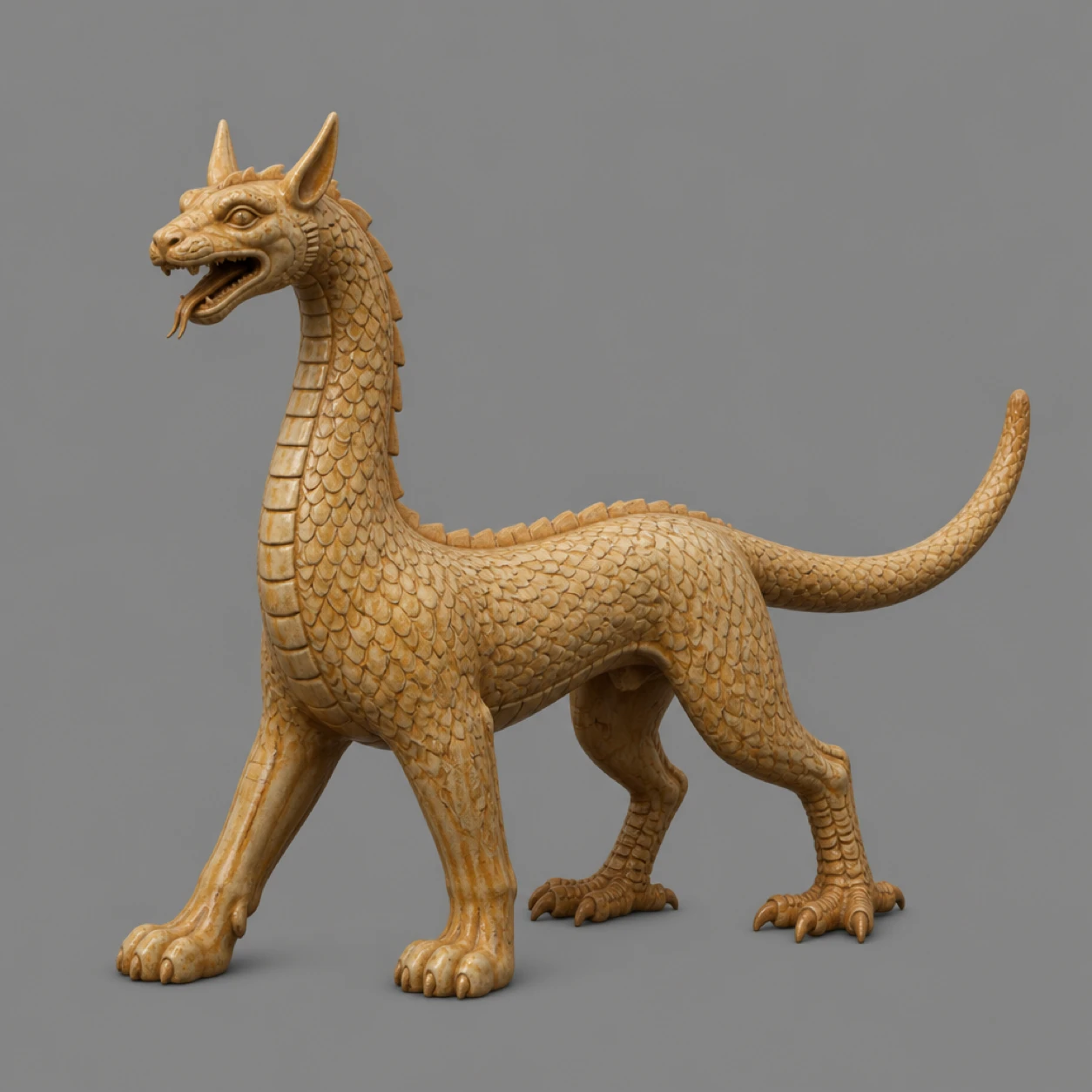
Place a mushhushshu on glazed brick architecture, not on a medieval battlement. Pair it with striding lions and bulls if you want the Ishtar Gate program, and keep the body low and serpentine with bird talons and a protruding horn rather than wings. Gate art and game refs often add lion forepaws or a scorpion tail; that is a stylistic choice, not a single fixed fossil. For a full Mesopotamian temple set, see the Mesopotamian Temple Relics pack.