Aspis: Round Shield, Argive Grip, and Hoplite Blazons
The hoplite shield is the large round board that defined Greek heavy infantry from the Archaic period through the classical age. Greeks called it an aspis, and modern writers often repeat the older term hoplon, though that word really meant "gear" in a wider sense. The form is also called an Argive shield, after the grip system associated with Argos. Paired with the crested Corinthian helmet, spear, and greaves, it turned a citizen soldier into a wall of bronze and wood that could push as hard as it parried.
Aspis, hoplon, and the Argive bowl
The aspis was circular, deeply concave, and large enough to cover the torso from knee to chin when a man stood in line. World History Encyclopedia gives a typical diameter of about 80 cm (roughly 30 inches) and a weight up to about 8 kg. The Metropolitan Museum of Art describes a similar scale, about 30 inches across, and treats the shield as the most important piece in the hoplite panoply because it was the soldier's main defense.
The outer face was not flat. The bowl shape let a man rest the rim on his shoulder on the march and gave room inside for the arm. A flat bronze band often ran around the edge, reinforcing the rim where blows landed hardest. Some shields carried a thin bronze facing over the whole exterior; others left painted wood exposed except at the rim. Both patterns appear in art and in surviving metal fragments.
Porpax and antilabe: how the grip worked
What made the Argive shield distinctive was the double grip. A bronze forearm cuff called the porpax sat near the centre of the inner bowl. The hoplite slid his left forearm through it up to the elbow. His hand then reached a cord or handle at the rim, the antilabe. World History Encyclopedia notes that the left arm passed through the central band while the hand gripped the strap at the shield edge.
That pairing mattered in combat. Weight sat close to the forearm rather than dangling from a single hand strap, so the board could be held steady for long clashes. The rim grip also let a soldier angle the face quickly to catch a spear point or sword cut. In a phalanx, each man's shield overlapped the neighbour to his left, so stability at the grip was what kept the line from opening. The Metropolitan Museum describes the shield as secured on the left arm and hand by a metal band on the inner rim, the same basic idea in museum terms.
From late Geometric rounds to the classical phalanx
Round body shields appear in Greek art from the late eighth century BCE onward, alongside the rise of organised hoplite fighting. By the seventh and sixth centuries, the deep bowl with offset rim was standard equipment for men wealthy enough to buy their own arms. City-states expected citizens to serve when called; Athens trained young men, while Sparta kept a standing warrior class whose entire identity rested on the phalanx.
The shield did not stand still. Early panoplies were heavy bronze throughout. Over the fifth century, lighter linen corselets and more mobile tactics crept in, yet the aspis stayed large. Even as skirmishers and peltasts gained ground, commanders still built battle plans around blocks of hoplites advancing shoulder to shoulder. World History Encyclopedia's overview of Greek warfare links the phalanx push directly to the overlapping round shield, the formation that made Marathon, Plataea, and countless polis battles intelligible to Greek audiences.
Blazons, chevrons, and the face of the phalanx
Painted devices on the shield face are often called blazons. Pottery shows hoplites carrying snakes, lions, wasps, and geometric signs, each chosen to read clearly at a distance. World History Encyclopedia singles out the gorgon head as a popular emblem, tied to myth and to the idea of freezing an enemy with a stare. Vase painters treated the shield as a canvas: a stamnos in the Metropolitan Museum praises its artist for being "particularly inventive with the shield devices" on a scene of contemporary foot soldiers.
Spartan shields carried some of the most famous blazons. World History Encyclopedia's article on Sparta describes professional hoplites with red cloaks and shields marked by the letter lambda, for Lacedaemonians, and also mentions the inverted V-shape that readers often picture on Spartan boards. Cities used these marks to spot units on a crowded field and to broadcast civic pride. A bronze boar plaque in the Metropolitan Museum, catalogued as a possible shield ornament from the fifth or fourth century BCE, shows how metal appliqués could supplement paint.
Wood cores, bronze facings, and the rim band
Most aspides were built from wooden planks, sometimes with a leather lining on the inside for comfort and grip. The centre was thinnest, which is why the porpax included a bronze plate to stiffen the core. The rim received a bronze band to resist splintering. A full bronze facing turned the shield into costly display metal as well as armor, and captured examples were prime dedications at sanctuaries after victory.
Weight varied with fittings. An all-bronze facing added mass, but the bowl shape and shoulder rest spread the load. Artists on black-figure vases often ring the shield with concentric circles to show that curved bulk, as on a chous attributed to the Amasis Painter in the Metropolitan Museum. Archaeology rarely preserves the wooden core intact. What survives is usually the bronze skin, rim strips, or small ornaments that once nailed to the face.
A Spartan shield facing from Pylos in the Agora Museum
The most tangible hoplite shield you can still see in Athens is not a complete board but a battered bronze facing in the Ancient Agora Museum. It comes from the Peloponnesian War campaign at Pylos in 425 BCE, when Athenian forces trapped Spartiates on the island of Sphacteria and forced a surrender that shocked the Greek world. Athenians treated captured Spartan gear as trophies and set shields up in public spaces, much as they displayed older victory dedications.
This piece is a thin hammered bronze facing that once clad a wooden aspis. The wood rotted away long ago, leaving the metal skin warped by combat and storage. On the back, an inscription states that the Athenians took it from the Lacedaemonians at Pylos, turning a private piece of kit into a civic boast. You can study the curve of the bowl, imagine the missing porpax fittings, and read the dedication as propaganda as much as archaeology. Scholars debate how many captured shields were hung in the Painted Stoa versus other sites on the Acropolis, but this facing is one of the few that survived burial and later excavation in the Agora.
Complete aspides are rare elsewhere for the same reason: timber and leather decay in Greek soils. Research depends on vase paintings, terracotta figurines, and bronze fragments like rim bands or ornaments. The Pylos facing shows diameter and metalwork, but it cannot recover every paint colour or unit emblem. Calling the shield a hoplon is convenient but imprecise; aspis is the clearer Greek noun for the object itself. What is secure is the social fact: owning this shield marked a man as a hoplite citizen, and losing it in flight was a disgrace poets and historians remembered long after the wood had vanished.
In your scene
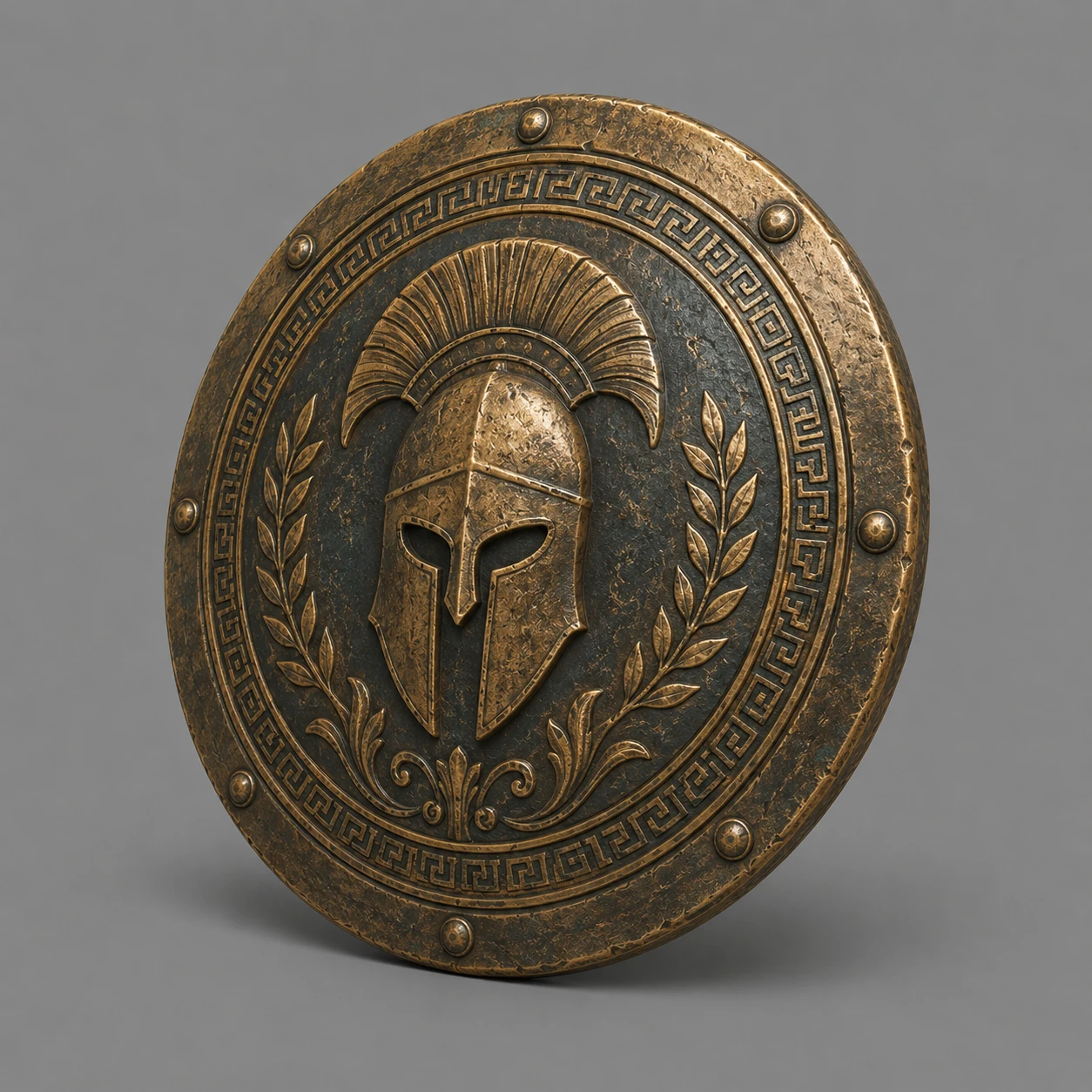
Place the aspis as a vertical prop against a temple wall, a treasury shelf, or a training ground rack, bowl facing out so a painted blazon reads clearly. Offset the grip hardware on the back if you show the interior, and pair it with a crested helmet and spear to complete the hoplite silhouette. Our Greek Temple Relics pack includes a hoplite shield model sized for classical sanctuary and military vignettes.