Hnefatafl: The King's Table in Norse Feast Halls
Hnefatafl is a Viking Age board game played on a square grid with two unequal sides. One player defends a king and a small force in the centre; the other attacks from the edges with a larger army. The king must reach safety at the board rim or in a corner. The attackers win by surrounding and capturing him. Medieval Scandinavians called the wider family of such games tafl, from a word for board or table.
Board, king, and the tafl family
The name hnefatafl combines Old Norse hnefi (king) and tafl (board). Related names appear across northern Europe: tablut in Sápmi, tawlbwrdd in Wales, brandubh in Ireland. All are asymmetric strategy games on a checkered or drilled board, not races or dice contests, though saga references once raised the possibility that dice were used in some versions.
Pieces move like chess rooks along open ranks and files. Capture happens when an enemy piece is caught between two opposing pieces on a row or column, or between a piece and a marked square at the centre or corners. The exact counts, board sizes, and escape rules varied by region. Archaeology and literature point to boards of 7, 9, 11, or 13 squares per side. No complete medieval rulebook survives, so modern players rely on reconstructions, chiefly from an 18th-century account of the related Sámi game tablut recorded by the naturalist Linnaeus.
From early tafl to Viking Age halls
Board gaming has a long history in northern Europe. A drilled gaming board from Wimose in Denmark, dated before about 400 CE, belongs to the tafl line. Hnefatafl itself peaks between the 8th and 11th centuries, the same centuries when Norse traders and raiders carried material culture from Dublin to the east.
World History Encyclopedia notes that Scandinavians played board games alongside dice and, later, chess itself. The habit fits a culture that valued strategy, boasting, and long evenings indoors. A carved board with counters was portable prestige gear, easier to show off than a ship and cheaper than a sword.
Between ale rounds in the chieftain's hall
A hnefatafl board belonged in the same social world as the drinking horn passed at a sumbl. Both were hall furniture for people with leisure time. Sagas mention tafl games at royal courts and tense matches where tempers flare. The board was not a children's toy in elite contexts. It was a contest of judgment, patience, and nerve.
Unlike chess, hnefatafl gives the defender fewer pieces but a special king whose escape is the whole point. That imbalance suits a storytelling culture fascinated by sieges, last stands, and a leader breaking through a closing ring. Whether every farmer owned a set is unclear. Grave goods and town excavations suggest gaming was common among the wealthy and the warlike.
Chess spreads north, tafl rules fade
Chess reached Scandinavia through trade and conquest in the 10th and 11th centuries. Britannica's history of chess records that Vikings carried the game to Iceland and England and that the Lewis chessmen, found in Scotland in 1831, remain the most famous surviving northern European set, dated to the 11th or 12th century.
As chess grew in status among nobles, hnefatafl rules were forgotten in most regions by the later Middle Ages. Saga evidence even describes double-sided boards where one face served hnefatafl and the other chess, a practical sign of the transition. Irish and Welsh variants lingered in place names and folk memory longer than in Norway, but the Viking Age heyday of hnefatafl belongs to the centuries before chess dominated the high table.
The Birka warrior's gaming set
One of the clearest archaeological links between hnefatafl and a high-status Viking life comes from grave Bj581 at Birka in Sweden. In an interview on World History Encyclopedia, author Nancy Marie Brown describes the chamber grave excavated in 1878: a seated figure with horses, weapons, and a full set of gaming pieces for hnefatafl on the lap.
The grave stood on a promontory beside Birka's fortress, aligned with the Warriors' Hall, and was marked by a large stone. For a century scholars treated it as the burial of a war leader who protected the town. DNA analysis published in 2017 showed the bones belonged to a woman, reopening debate about who played, who commanded, and who owned such sets.
The gaming pieces are not isolated trivia. They sit beside a sword, spears, shields, and riding gear in a furnished underground chamber, the kind of burial that advertises power. A coin in the grave helps date the burial to the 10th century, possibly near 965 when the Warriors' Hall burned. Whether the board itself survived is less certain than the pieces; many tafl boards were simple wood with drilled holes or inlaid lines, materials that rot unless conditions are exceptional.
Wood, bone, and rules we cannot fully recover
Excavations across Scandinavia, Ireland, and the British Isles yield board fragments and counters in bone, antler, glass, and wood. Dublin digs produced flat boards with cancelled squares alongside domed pieces. Luxury sets could be as fine as any tableware in the hall.
The gap in our knowledge is rules, not presence. Scholars agree hnefatafl was widely played; they disagree on details such as whether the king must reach a corner or any edge, whether the central square is hostile to defenders, and whether a shield-wall capture along the rim was original or a modern fix. If you place a board in a scene, a plain wooden grid with contrasting pieces reads honestly. An ornate carved board signals wealth. Either fits the evidence better than pretending we have a single Viking rulebook.
In your scene
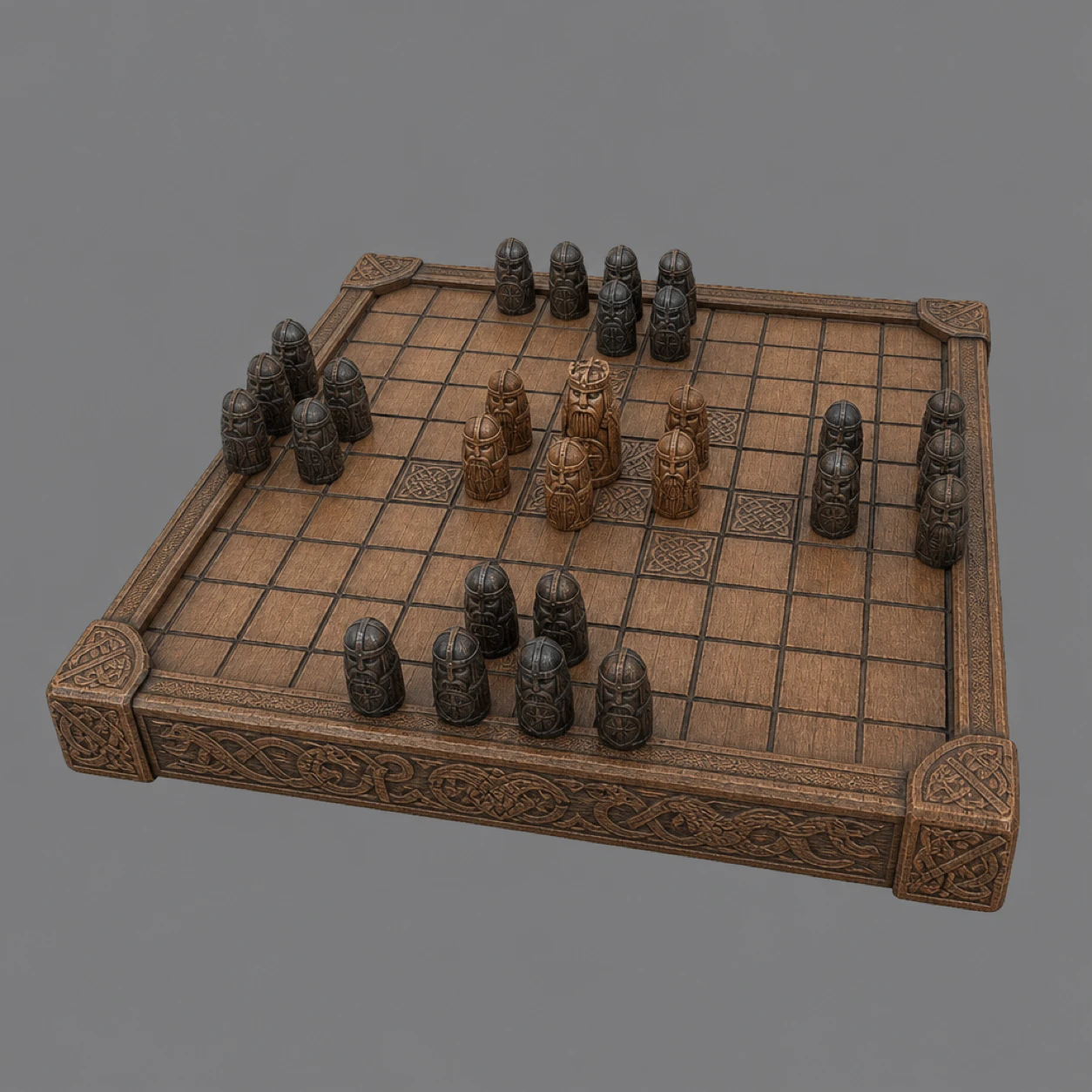
Lay a hnefatafl board on a bench between two guests, or half pushed aside after a long match while ale still stands in horns nearby. Keep the king piece distinct and cluster defenders in the centre. Our Viking Hall Relics Vol. 2 pack includes a board model sized for longhouse interiors and feast halls.