Drinking Horns at the Sumbl: Vessels for Feast and Oath
A drinking horn is exactly what the name suggests: the hollow horn of cattle or wild ox, fitted with a mouth rim and often a terminal cap, used to drink ale, mead, or wine. In Viking Age Scandinavia and across the Germanic world, horns were prestige vessels for formal feasts, funeral drinking, and the ritual toasts that bound oaths.
Horn, rim, and terminal cap
The basic vessel is organic. Cow horn was common and held less than half a litre in typical examples. Aurochs horn, from the larger wild ox, made showpiece cups that could reach two litres or more. Because horn rots in the ground, archaeology usually recovers the metal parts: gilded silver rims, triangular pendants below the mouth, and finials shaped like beast or bird heads at the tip.
Horns were not everyday tableware. They were passed hand to hand at gatherings, sometimes in pairs, and often decorated to match the status of the host. Sagas and poetry describe horns at royal banquets; the Bayeux Tapestry shows feasters raising horn-shaped cups at a high-status meal.
A long feasting tradition before the Vikings
Drinking horns predate the Viking Age by centuries. Germanic and Celtic peoples used them in the early Middle Ages, and luxury versions were cast in glass or silver on the Continent. The habit peaks in Viking Scandinavia as chieftains compete to host the best drink in the best hall.
Most complete horns in museums are later medieval survivals or modern reconstructions on ancient fittings. The Viking Age itself left few whole horns intact, which can make the object feel rarer in archaeology than it was in life.
Sumbl, toast, and the horn that must be drained
The formal drinking party in Old Norse culture is the sumbl, held in a chieftain's hall. World History Encyclopedia describes how the lady of the house opened the feast by serving the host, then the ranking guests, keeping the ritual order of the evening. The first rounds went to the gods, Odin first among them.
Drinking from a shared horn was not casual. Oaths sworn over a special cup, the bragarfull, were binding because drink came from the gods; what was said drunk was taken as truth. Thor's drinking contest in the Prose Edda, where he fails to empty a horn whose base rests in the sea, shows how myth turned the vessel into a test of strength.
Modern Asatru groups use horns again for blót and sumbel, but the medieval Christian church eventually pushed horn feasting aside in much of Scandinavia until the custom revived in the 14th century on surviving medieval examples.
From grave fittings to reconstructed pairs
Because horn decays, our clearest Viking Age glimpses come from burials where only mounts survived. Metal detector finds and grave excavations across Norway and the British Isles yield mouth fittings and terminals that prove horns were widespread even when the keratin is gone.
The richest published example is not Scandinavian but Anglo-Saxon, and it sets the visual standard for elite horns in the early 600s CE.
The Sutton Hoo pair in the British Museum
The ship burial at Sutton Hoo in Suffolk, excavated in 1939, held a feasting set among its grave goods. The British Museum's Sutton Hoo gallery describes the burial as the grave of an East Anglian ruler, packed with Byzantine silver, gold jewellery, and banquet gear.
Among the finds were fittings for drinking horns, registration numbers 1939,1010.120 and 1939,1010.121. The horn itself rotted in the mound. Conservators rebuilt the vessels around the original gilded silver mounts, which carry interlaced animals, human masks, and bird-head terminals. Museum guides give each reconstructed horn a rim diameter of about 9.5 cm, an overall length near 61 cm, and a capacity of roughly two litres, probably ale or mead passed around the hall.
The aurochs was extinct in Britain by then, so the horns were likely imported, matching saga emphasis on rare materials for the highest ranks. The pair sits in Room 41 beside the Sutton Hoo helmet as evidence that communal drinking was central to royal display long before the Viking Age proper.
What archaeology undercounts
Decorative terminals and rim mounts turn up in Viking graves from Ireland to Norway, far more numerous than preserved horn walls. That imbalance misleads if we judge popularity by whole vessels alone. Horns were also not the only cups: wooden stave vessels, glass beakers, and imported silver bowls shared the high table.
Still, the horn kept its symbolic weight: hospitality, alliance, funeral ale, and the moment a warrior drained the cup before speaking a boast. For scene building, a horn reads more loudly than a plain cup because everyone in the saga audience knows what passing it means.
In your scene
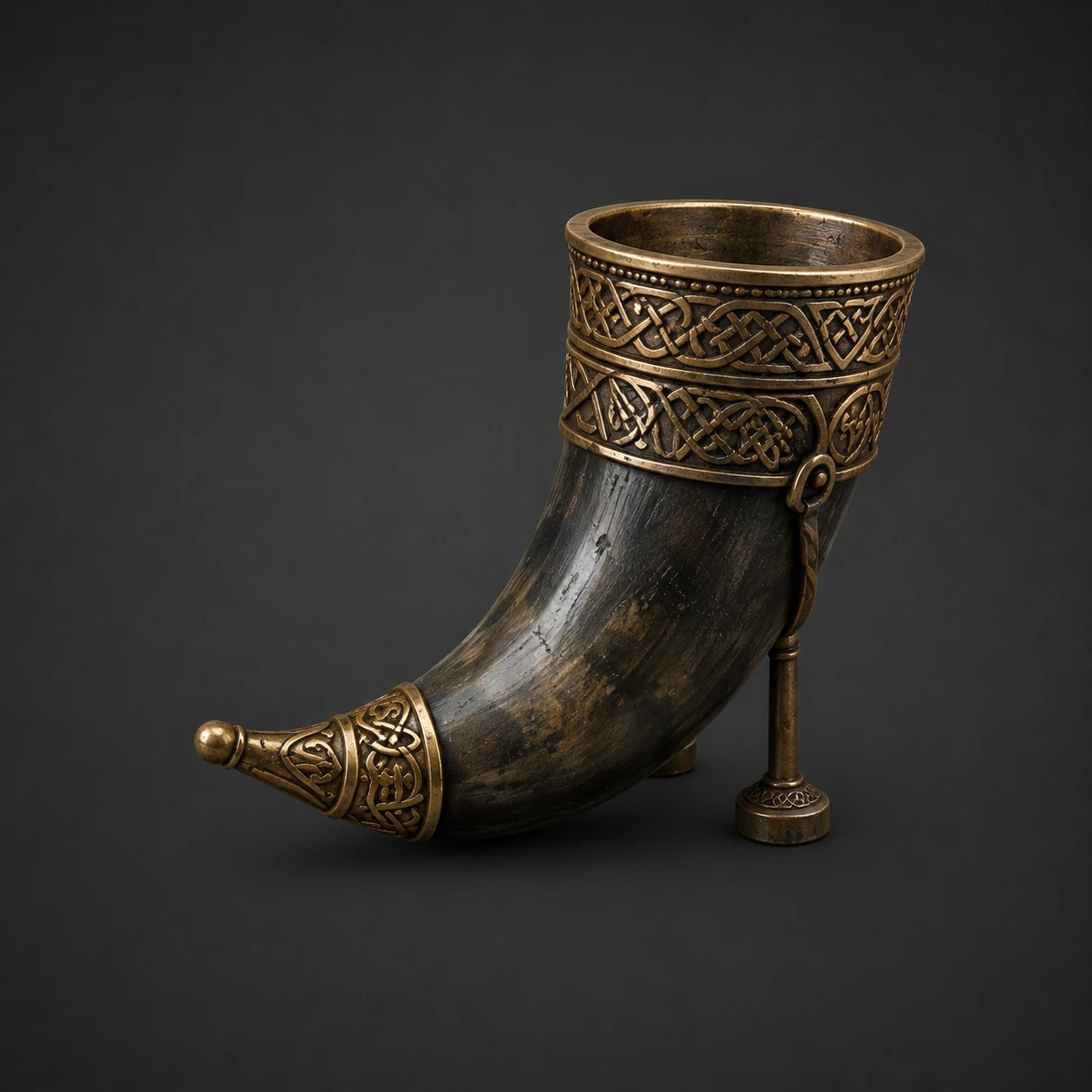
Set a drinking horn on the high seat table, in a chieftain's hand, or beside a funeral ale vat. Pair it with silver fittings if the character is wealthy, and scale aurochs-sized horns for royal hosts. Our Viking Ritual Relics pack includes a drinking horn model for longhouse feasts and blót clearings.