Hanging Cauldron: Iron Pots Over the Longhouse Hearth
A hanging cauldron is a large cooking pot, usually hammered from iron plates, suspended by chain or hook above an open hearth so the cook could raise or lower the heat. In Norse longhouses and other Germanic feast halls, it sat at the centre of daily meals, funeral feasts, and the ale brewing that kept a chieftain's household fed.
Riveted iron, ring handles, and the hanging chain
The typical Viking Age cauldron was built from sheet iron cut into panels, riveted edge to edge around a round base, with the bottom often left thicker so heat spread evenly. A reinforced rim band held the mouth open, and paired lugs or loop handles let an iron chain or hook take the weight. Smaller pots might sit on stones or a trivet; the showpiece versions were meant to hang.
The hanging gear mattered as much as the pot. Iron chains with swivels kept links from twisting as the cook adjusted height. Re-enactors and smiths sometimes call the adjustable link a trammel, though medieval inventories rarely use one fixed term. What survives in museums is often a corroded chain fragment beside a collapsed pot, enough to prove the whole assembly existed even when the vessel itself is crushed.
From Iron Age kettles to Viking Age halls
Riveted iron cooking pots appear across northern Europe long before the Viking Age. Graves and settlement dumps from Norway, Sweden, and Denmark yield fragments from the Merovingian period through the 11th century, with sizes ranging from a household stew pot to cauldrons that could feed a hall full of retainers.
Longhouses were built around a central hearth with smoke venting through the roof. Without chimneys, the fire stayed open and the cauldron hung where everyone could reach the shared meal. Britannica's account of the Oseberg ship places that famous 9th-century burial in 834 CE and lists farm and kitchen tools among the grave goods, a reminder that elite households treated cookware as worth taking to the afterlife.
Boiling stew and brewing ale before the sumbl
Most Viking Age meat was boiled rather than roasted, because a cauldron meal could feed many people while other work continued at the hearth. World History Encyclopedia's survey of Norse diet describes meat cut up and dropped into a pot over the fire, often with vegetables, then served with bread. The same source notes that ale, mead, and wine followed a similar rhythm: water heated in a cauldron, then honey, malt, or fruit added depending on the drink.
That kitchen labour tied directly to the sumbl, the formal drinking feast in a chieftain's hall. World History Encyclopedia on Norse alcohol stresses that the lady of the house opened the sumbl by serving the host, then the ranking guests, while keeping the evening's order. Boiled food and brewed drink were two sides of the same hospitality. A host who could not fill both pot and drinking horn lost standing fast.
When iron replaced soapstone at the high table
Soapstone vessels were common in Scandinavia and easier to carve than iron was to forge, so many farms cooked daily meals in stone pots set on the hearth. Iron cauldrons cost more in labour and fuel and turn up less often in ordinary graves, which makes each surviving example look more status-heavy than it may have been in life.
By the late Iron Age, scholars who study Norwegian commensal spaces argue that cooking itself became a tool of leadership: large shared meals differentiated ranks within the household. A hanging iron cauldron visible above the fire advertised that the owner could afford metalwork, grain, and livestock at scale. It was practical equipment, but also a prop for the kind of feast Beowulf and the sagas describe.
The Sutton Hoo cauldron chain in the British Museum
The clearest archaeological picture of a hall cauldron in use comes not from Norway but from the early 7th-century ship burial at Sutton Hoo in Suffolk, excavated in 1939 and now in the British Museum. The museum's Sutton Hoo overview notes domestic gear at the east end of the burial chamber, including wooden tubs, two smaller cauldrons, and one very large cauldron with an intricate iron chain meant to suspend it over a fire.
The Room 41 guide gives numbers for that set. The chain, registration 1939,1010.167, originally ran about 3.5 metres through 22 interlinking pieces and included a swivel against twisting. A copper alloy fragment from the largest cauldron, 1939,1010.113.2, held iron handles and could hang from the chain above a fire. Museum staff estimate its capacity at around 100 litres, enough to serve a hall full of guests from one boil. A modern replica in the gallery shows the cauldron suspended from a roof beam roughly four or five metres above the floor, which matches the chain length and the scale of timber halls in Old English poetry.
Sutton Hoo predates the Viking Age proper, but the technology is the same Germanic feasting kit later Norse chieftains would recognise: central hearth, hanging pot, and metalwork fine enough to bury beside a ruler.
Rust, fragments, and what graves still tell us
Complete iron cauldrons are rare because iron corrodes in acidic soil. Archaeologists more often find rim shards, rivet lines, or a chain link still twisted from use. Grave finds across Scandinavia and the British Isles prove cauldrons travelled with the dead, yet the counts underrepresent how many hung in living halls.
Oseberg and Sutton Hoo both skew elite. Village cooks surely relied on pottery, soapstone, and smaller iron pots that never entered a ship burial. When sources disagree on exact capacities or dates for individual vessels, the safer claim is typological: riveted iron, hanging chain, central hearth, shared boil. The uncertainty is worth stating because re-enactment markets sell uniform round pots that look nothing like the lopsided, hand-riveted originals in museum cases.
In your scene
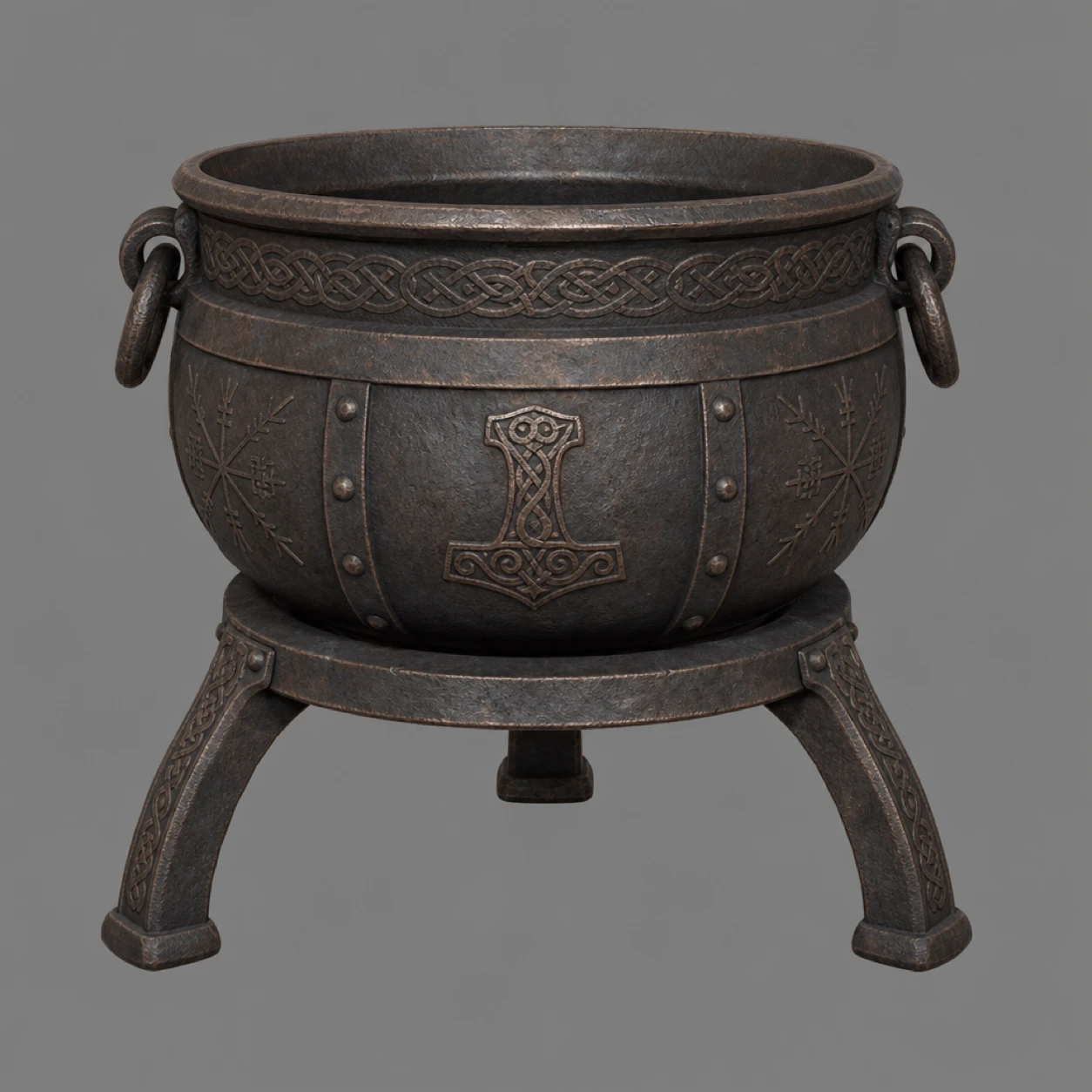
Place the cauldron above a central hearth, chain rising to a roof beam, with benches along the walls and steam catching the firelight. Scale up for a chieftain's hall, pair with a mead barrel or high seat, and keep the chain visible. Our Viking Hall Relics Vol. 2 pack includes a hanging cauldron model for longhouse feast scenes.