Met Gudea (59.2): Long Life to the Temple Builder
In the decades after Akkad's empire splintered, a prince at Lagash spent his reign rebuilding temples and setting his own image inside them. The seated figures he left behind are among the most recognizable faces of early Mesopotamia: a ruler in a wrapped royal cap, bare right shoulder, hands folded in prayer, carved from dark diorite hard enough to outlast empires. These are Gudea statues, votive portraits of Gudea, ruler of Lagash (ca. 2150–2125 BCE), not the law-code king Hammurabi of Babylon centuries later.
Clasped hands, royal cap, and diorite weight
A typical seated Gudea statue shows the prince on a low stool or block throne, torso wrapped in a draped robe that leaves the right shoulder bare, and a close-fitting royal cap. The hands meet at the chest in a gesture of greeting, prayer, and attentive service before a god. Many examples are carved from diorite or related hard stones such as gabbro, imported at great cost and polished to a smooth, reflective finish that made the ruler look permanent inside the temple.
The pose reads as pious availability, not military command. Neo-Sumerian Gudea images favor calm proportion, wide eyes, and a slight smile. Inscriptions on the lap or base name Gudea, list temples he built or restored, and dedicate the statue to a specific deity. The sculpture is both portrait and contract: the king presents himself eternally ready to serve the god who owns the house.
Lagash when the Akkadian empire broke apart
Gudea ruled the city-state of Lagash in southern Mesopotamia during the Neo-Sumerian period, after the Akkadian Empire collapsed and local dynasts competed across Sumer. His capital district at Girsu (modern Telloh in Iraq) was a major cult center for Ningirsu, the warrior god of the city. Literary and building inscriptions credit Gudea with restoring the Eninnu, Ningirsu's great temple, along with shrines for Nanshe, Ningishzida, and other Lagash deities.
Chronology is approximate. The Metropolitan Museum of Art dates Gudea's reign to ca. 2150–2125 BCE; other references place him around 2144–2124 BCE. What sources agree on is the character of his program: temple renewal, irrigation works, and hard-stone sculpture installed inside rebuilt sanctuaries.
Temple pledges carved in stone
Gudea's statues functioned as votive gifts. A ruler commissioned an image of himself, inscribed it with his titles and pious deeds, and installed it in the god's house so his presence and obligation continued after the ceremony ended. The long Sumerian texts mention canal digging, courtyard paving, and the raising of temple platforms. They also ask future visitors not to envy the patron's god and to speak the temple's name with respect.
The same king is known from two large clay cylinders with cuneiform accounts of temple construction, now in the Louvre. Those texts and the hard-stone statues reinforce each other: one tells the story at length, the other compresses it into a seated body facing the altar.
From standing lords to seated orants
Archaeologists have recovered more than 30 recorded statues of Gudea, most seated and many dedicated to Ningishzida or Ningirsu. Excavations at Telloh (ancient Girsu) from the late nineteenth century onward produced the core of the corpus, often in fragments matched across seasons. Standing examples with libation vases or builder's tools exist, but the seated orant with clasped hands became the signature image.
The Met's seated Gudea (59.2), not on view today
One well-documented example is the Metropolitan Museum of Art's Statue of Gudea, named "Gudea, the man who built the temple, may his life be long," accession 59.2. The museum dates it to ca. 2090 BCE, assigns it to the Neo-Sumerian period, and says it probably comes from Girsu (modern Tello). It is carved from diorite and measures 44 by 21.5 by 29.5 cm (about 17 5/16 by 8 7/16 by 11 5/8 inches). The Harris Brisbane Dick Fund purchased it in 1959. The Met's collection record lists the object as not on view at the time of writing; when it has been displayed, it has appeared in the Ancient Near East galleries.
The statue shows Gudea seated with folded hands in the traditional gesture of greeting and prayer. The robe inscription, translated in the museum record from Dietz Otto Edzard's royal-inscriptions volume, describes temple building for Ningirsu, Ningishzida, and Nanshe, then states that Gudea fashioned a statue of himself and named it so that "the life of Gudea, who built the house, be long," bringing the image into the god's house. That closing name formula is the hook of the title: the king asks durability not for his body alone, but for the patron who rebuilt divine architecture.
The Met notes the piece likely left Telloh before modern regulation, appeared on the art market in the 1930s, and was acquired in 1959 from the dealer Elias S. David.
What Telloh digs recovered, and what dates still shift
Many Gudea statues were found broken or headless. The Louvre's Petit Gudea assis (AO 3293 and AO 4108) joined a head from 1895–1903 with a body from 1900, and remains on display in the Richelieu wing, Room 228. The Met calls 59.2 diorite; the Louvre lists gabbro for AO 3293 after analysis. Both are dense igneous stones chosen for polish and permanence.
Scholars still debate how literally to read Gudea's building boasts and how many statues stood in one shrine. Stylistic dates can shift when new inscriptions appear. The stable core is narrower: Gudea commissioned seated hard-stone temple votives; clasped hands, royal cap, and bare right shoulder identify the type; and Met 59.2 or Louvre AO 3293 anchor real objects in collection records even when a gallery case is empty.
In your scene
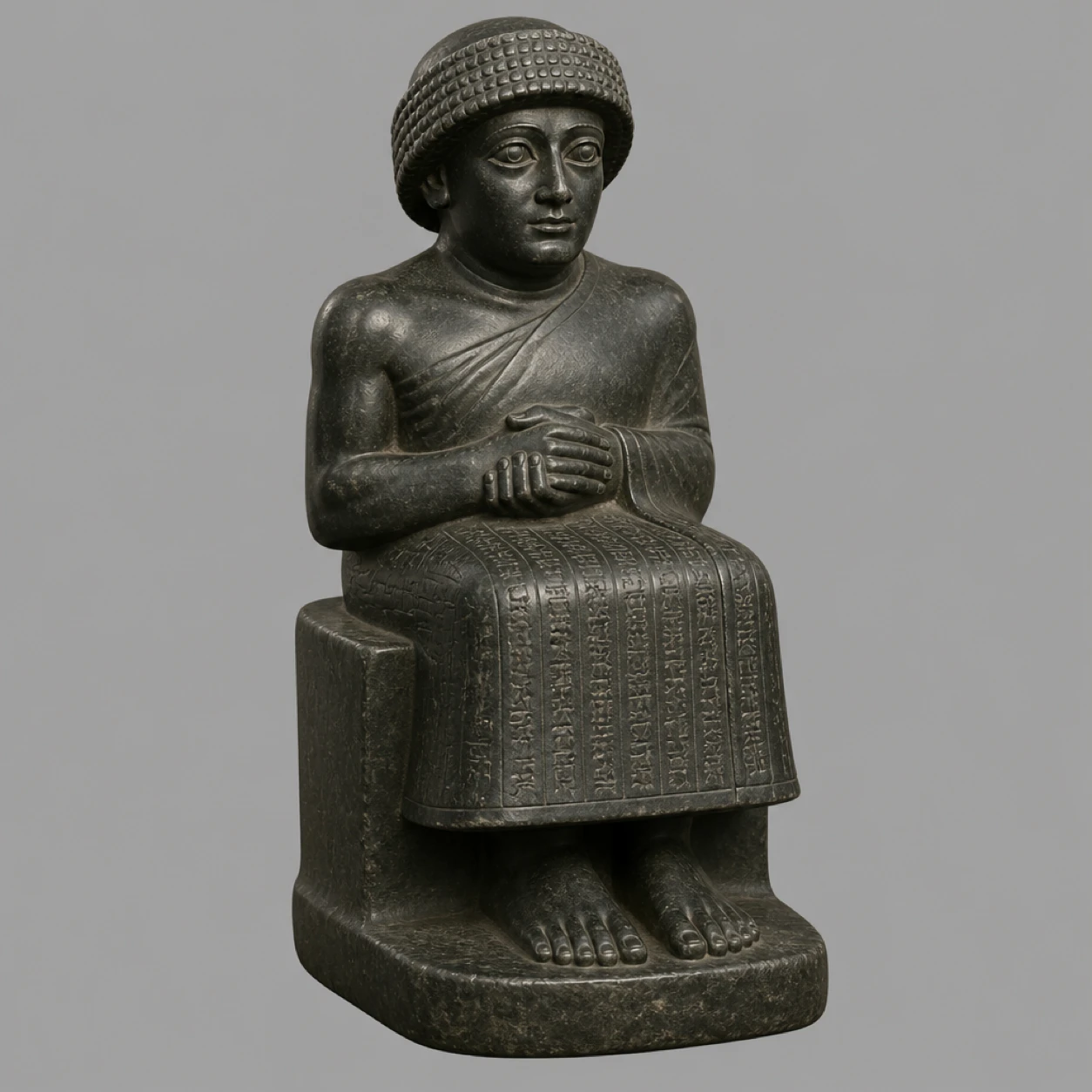
A Gudea statue belongs inside a Mesopotamian temple cella or anteroom, not on a battlefield plinth. Seat the figure low, hands joined at the chest, royal cap smooth, and give the god's statue or altar the focal height. For a full southern Mesopotamian set, see the Mesopotamian Temple Relics pack.
Sources
- The Metropolitan Museum of Art: Statue of Gudea (59.2)
- Musée du Louvre: Statue de Gudea dite "Petit Gudea assis" (AO 3293; AO 4108)
- Cleveland Museum of Art: Statue of Gudea (1963.154)
- World History Encyclopedia: Gudea of Lagash (image record)
- World History Encyclopedia: Gudea Cylinders (image record)
- Encyclopaedia Britannica: Gudea