Foundation Pegs in Ur III: Basket-Bearing Kings in Copper
Mudbrick rose at Ur while a copper figurine waited in a brick box below the floor. The man on the peg never finished his gesture: arms raised, a filled basket on his head, bare chest, and legs sheathed in a short skirt that tapered to a sharp point. Mesopotamian foundation pegs, also called foundation figures, were cast to be buried from the day they were made. They were not structural pins. They were royal witnesses pressed into temple foundations, often beside inscribed stone tablets that recorded the same building act.
Basket overhead, arms raised, legs ending in a peg
A classic Ur III foundation peg reads as half statue and half tool. The upper body is a standing king: clean-shaven head, bare torso, and a short skirt or loincloth engraved with cuneiform. Both arms lift to support a round basket heaped with earth. Below the waist the figure does not end in feet on a base. The skirt narrows into a peg, the same tapered point that would be driven or set into a foundation deposit.
Museum labels call the metal copper or copper alloy. World History Encyclopedia on Mesopotamian foundation figurines describes the Third Dynasty of Ur examples as peg-shaped copper alloy figurines of kings, each with a basket and inscription on the body. The Wildform prop follows that silhouette: waist-down peg, basket aloft, arms raised, without copying one excavated face.
Ur-Nammu, Shulgi, and the dynasty that built in brick
The type flourished under the Third Dynasty of Ur, the Ur III state that united southern Mesopotamia after centuries of city rivalry. World History Encyclopedia on Ur-Nammu credits him with founding the dynasty, commissioning major ziggurats, and issuing one of the oldest surviving law codes. World History Encyclopedia on his foundation figure dates his reign to circa 2112 to 2095 BCE. His son Shulgi of Ur ruled circa 2094 to 2047 BCE and continued temple building across the empire.
Foundation pegs name those kings and their successors. The British Museum holds a figurine of Ur-Nammu dedicated to Inanna of Uruk, from the Temple of Inanna at Warka. World History Encyclopedia notes that the figure was made for burial in a temple at Uruk and that its inscription records Ur-Nammu's restoration of Inanna's temple Eanna, the "house of heaven." A Shulgi peg in the same museum group came from the Temple of Dimtabba at Ur; a Shu-Sin peg came from Girsu. The three stand together in one display case, a compact family timeline in copper.
Foundation deposits and stone tablets
Foundation pegs belonged to a wider deposit custom. World History Encyclopedia on foundation figurines states that such figures were usually buried with foundation stone tablets that described the building process.
The peg had no load-bearing job in engineering terms. Its pointed end mimicked a building peg or the first brick, but the copper figure was symbolic ballast. Placed underground, it kept the king present in the act of serving the temple deity long after the ceremony ended and the courtyard above was paved.
When kings became basket-bearers in art
Before Ur III, Mesopotamian rulers advertised power through battle and hunt. Late third-millennium kings in the south added a quieter image: the monarch as temple builder carrying earth for bricks. World History Encyclopedia on Ur-Nammu's figure explains that caring for the gods and restoring their temples was a core royal duty, and that Ur-Nammu lifts a large basket of earth for making bricks while the copper peg acted as a record for posterity and a channel for divine blessing.
The pose also echoed ritual purity. Beardless, shaved heads and bare chests match the clean state expected for making the first brick, not a battlefield portrait. Shulgi, Amar-Sin, and Shu-Sin repeat the same body type because the image is an office, not a personal likeness. Gudea of Lagash later received his own foundation pegs in a related tradition, but the Ur III basket-bearer is the normative form scholars call the canephoros peg, the basket carrier fixed in metal under a god's house.
The Met's Shulgi foundation peg, 59.41.1
One clear museum example is the Metropolitan Museum of Art's Foundation figure of king Shulgi of Ur, carrying a basket, object 59.41.1. The Met dates it to circa 2094 to 2047 BCE, assigns it to the Ur III Neo-Sumerian period, and lists copper as the medium. It measures 12 1/4 by 3 7/16 by 2 3/16 inches (31.1 by 8.8 by 5.6 cm). Geography is recorded as Mesopotamia, Nippur; the Rogers Fund acquired it in 1959.
The Met also holds a closely related Foundation figure of Ur-Namma holding a basket, object 47.49, circa 2112 to 2095 BCE, copper alloy, 10 3/4 inches (27.3 cm) high, gift of Mrs. William H. Moore in 1947. The Met's online record for 47.49 describes the solid-cast type: a beardless figure with a shaved head holding a basket of earth above the head in the posture of ceremonial building work, such as the rite for the first brick attested in texts of the period. That example's inscription, per the museum summary, identifies a peg deposited in the foundation of a temple of Inanna restored or built by Ur-Namma.
What copper, clay, and closed boxes still leave open
Survival is uneven. Many pegs were found only when archaeologists opened foundation boxes at Nippur, Ur, Uruk, and Girsu; others, including several Ur-Nammu examples, entered collections without a recorded findspot. World History Encyclopedia lists three British Museum kings side by side, but thousands of Ur III foundations across Mesopotamia were never excavated or were destroyed by later building.
Scholars still debate how literally the basket scene mapped onto daily labor versus a one-day ritual, and how many pegs stood in a single temple. Date brackets for individual kings shift slightly between catalogues (Ur-Nammu circa 2112 to 2095 BCE at the Met and British Museum, versus broader "2100 to 2000 BCE" ranges on encyclopedia pages). The secure core is simpler: these pegs were royal foundation deposits for temples, meant to stay hidden while proclaiming, in metal and cuneiform, who restored the god's house.
In your scene
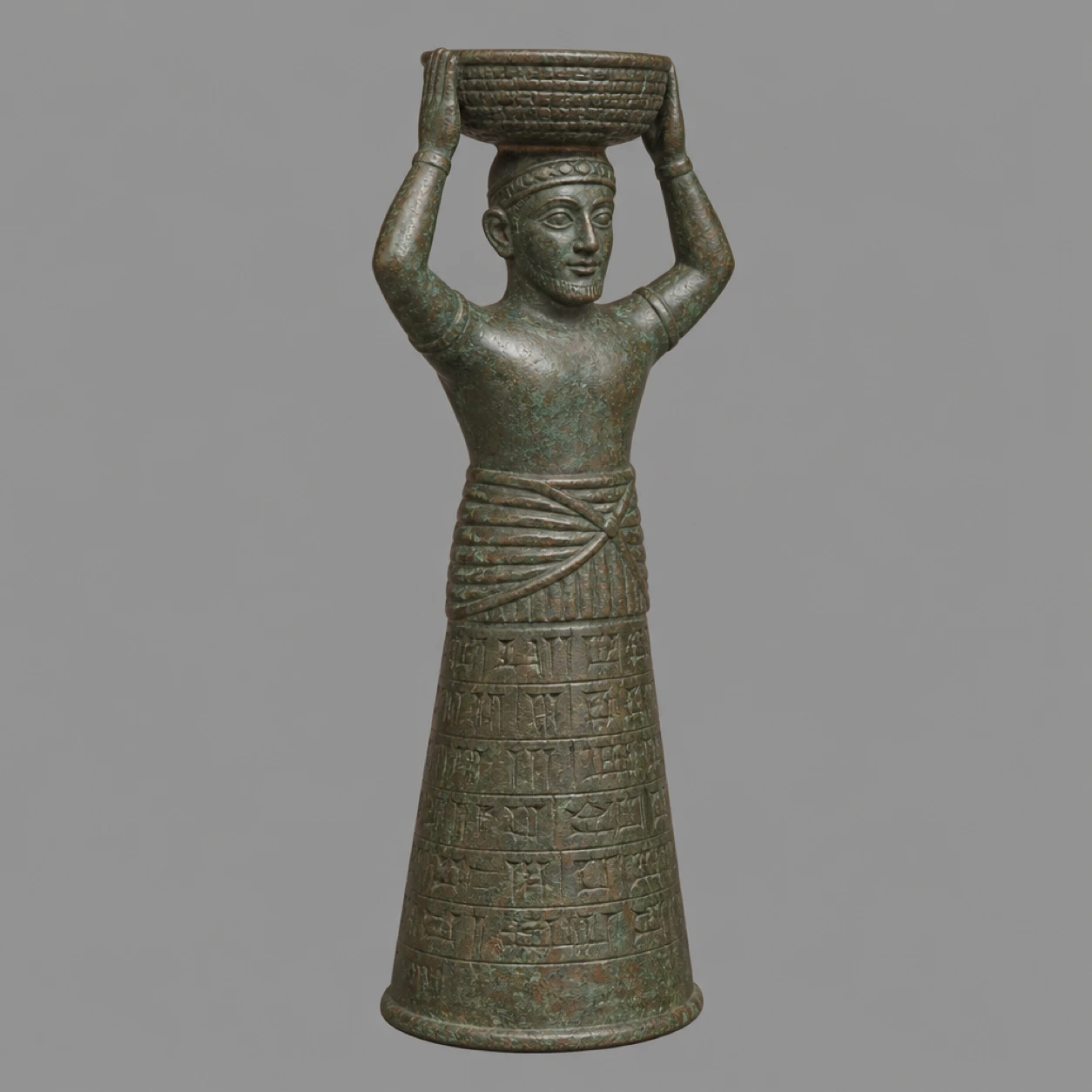
A foundation peg belongs under the floor, not on a shelf. Hide the pointed lower body as if the skirt continues into brick or packed earth, and keep the basket and raised arms visible in a cutaway foundation trench or a builder's deposit pit. For Ur III temple props in one pack, see Mesopotamian Temple Relics.
Sources
- The Metropolitan Museum of Art: Foundation figure of king Shulgi of Ur, carrying a basket, 59.41.1
- The Metropolitan Museum of Art: Foundation figure of Ur-Namma holding a basket, 47.49
- World History Encyclopedia: Mesopotamian Foundation Figurines
- World History Encyclopedia: Foundation figure of Ur-Nammu