Crook and Flail: Shepherd's Staff and Harvest Whip of the King
The crook and flail are paired royal sceptres from ancient Egypt. The crook is a long staff with a hooked upper end, like a shepherd's crook. The flail has a handle and a cluster of cords or beads that could strike grain or herd animals. Pharaohs held them crossed over the chest in statues and reliefs. Osiris, god of the dead and mythical first king, carried the same pair, so living rulers used the regalia to show that their authority continued his.
Heka and nekhakha: two names, two jobs
Egyptologists call the crook heka and the flail nekhakha (also written nkhakha). The crook evokes a shepherd guiding flocks, which Egyptians read as the king guiding his people. The flail recalls threshing and herding; it came to stand for the land's fertility and the ruler's power to command labour in field and storehouse.
In art the crook usually sits in the left hand and the flail in the right, arms crossed over the chest inside a broad collar. The pose is stiff and frontal, which is deliberate. It presents the body as an emblem of office rather than as a moving human figure. The same crossed arms appear on coffins, temple colossi, and tiny amulets tucked beside a mummy.
From marshland tools to Osiris's regalia
Both implements began as practical tools long before they were royal metalwork. World History Encyclopedia links the crook to shepherds and the flail to goat herding and to harvesting labdanum, a resin from shrubs. Because Osiris was first worshipped as a fertility god of the land, those agricultural associations stuck when he became lord of the underworld.
The myth matters for kingship. Set murdered Osiris; Isis restored him; Horus avenged his father and took the crook and flail as proof of legitimate rule. Pharaohs identified with Horus in life and with Osiris after death, so the sceptres bridged palace, temple, and tomb. World History Encyclopedia's article on Osiris notes that images of the god as a living king show him in royal dress with the atef crown and the crook and flail in his hands.
Predynastic art already treats the crook as a sign of rule. By the Second Dynasty the two symbols appear as a set on royal monuments. From then until the Roman period they rarely leave the iconography of power.
Crossed on the chest in temple and tomb
On a living king the pair meant guidance and provision for Egypt. On Osiris they meant the same duties extended into the afterlife. Statues of Ramesses II from Elephantine show the convention at monumental scale: the king grasps both sceptres while wearing the double crown of Upper and Lower Egypt.
Temple relief adds context. A Second Dynasty practice piece in the British Museum collection, described by World History Encyclopedia, shows a king in the red crown and festival robe holding crook and flail during a Sed festival, the ritual renewal of royal strength. The god called the Great White, shown as a seated baboon, faces the king to bless the ceremony. That pairing of regalia and ancestor god makes clear that the sceptres were not mere props. They marked a moment when kingship itself was renewed.
Only pharaohs and certain gods were shown with both implements. Priests might handle cult equipment in ritual, but the crossed pose belonged to divine kingship, not to officials.
Burial sets beside the mummy
Wealthy burials could include full-size wooden or metal sceptres laid near the body so the deceased entered the afterlife equipped like Osiris. Middle Kingdom tombs at Lisht north of Memphis have produced some of the best-preserved examples. They were not always reserved for royalty. Elite women such as Senebtisi received their own regalia sets when artists and priests expected them to join Osiris's court.
Materials varied with budget and period. Wood, painted and gessoed, was common. New Kingdom royal burials could use bronze cores inlaid with glass and gold. Tutankhamun's tomb is famous for such luxury pairs, among the few complete pharaonic sets known from excavation. Most figures in museums are stone or bronze sculptures of the implements, not the fragile wood originals from tombs.
A crook and flail from the tomb of Senebtisi
The Metropolitan Museum holds the crook scepter from the burial of Senebtisi (object 08.200.48), excavated at Lisht in 1906–07. It dates to about 1850–1775 BCE, late Dynasty 12 to early Dynasty 13. The staff is about 156 cm long, made of coniferous wood with stucco and paint. It lay in Pit 763 inside the tomb of Senwosret (758), alongside other ritual gear.
The matching flail scepter (07.227.15) from the same burial is shorter, about 45 cm along the handle, built from faience, wood, carnelian, and gold. Seeing both objects together shows how Egyptian artists mixed humble materials with precious inlay for a single funeral kit. Senebtisi was not a pharaoh, yet she received regalia normally associated with Osiris. That spread of royal symbolism into elite women's burials is one reason crook-and-flail sets appear in tomb scenes far below kingly rank.
Wood, bronze, and what survives in museums
Archaeology preserves sceptres unevenly. Painted wood cracks and warps; bronze and stone endure. Many tomb sets were looted or rotted, so our picture comes from a handful of sealed burials plus countless two-dimensional representations on stelae and coffins. Amulets in faience or gold could miniaturise the pair for mummy wrappings in the Late and Ptolemaic periods when Osiris cult remained strong under Greek and Roman rule.
Scholars still debate fine points, such as whether every flail bead count had symbolic meaning or whether some Middle Kingdom sets were purely funerary rather than copies of palace regalia used in life. Without an inscription tying a sceptre to a coronation text, dating relies on tomb context and style. A crook in a sculptor's workshop debris is equipment; a crook beside a named mummy is biography.
In your scene
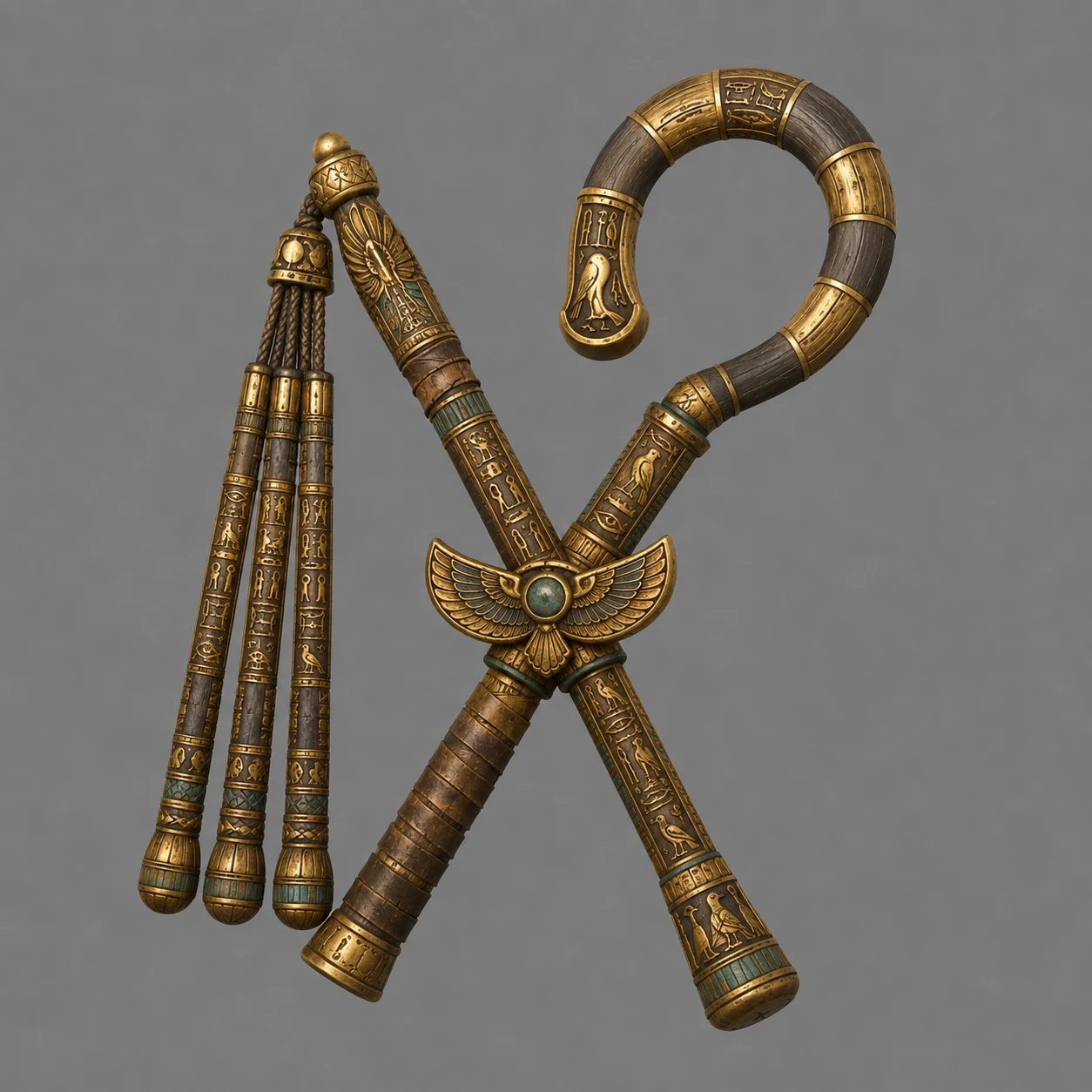
Crossed crook and flail on a statue niche or against a sarcophagus lid read as royal or Osirian authority faster than scattering sceptres on the floor. Side light catches gilded wood or painted stucco well. Our Egyptian Tomb Relics pack includes a crook and flail pair for throne daises and tomb chapels.