What Is a Carved Wooden Mask? Viking Faces in Wood and Ritual
A carved wooden mask in a Viking scene is usually a fiction built from scattered clues. Organic face masks almost never survive a thousand winters in Scandinavian soil. What archaeology does preserve are carved wooden heads, animal posts, and the occasional beam with a human face cut into structural timber. Together they show that early medieval Norse craftsmen shaped faces in wood for ritual display, burial, and hall decoration, even when we cannot name every mask that once hung on a longhouse wall.
Wood that rots, faces that vanish
Pine and oak masks dry out, warp, and feed fungi unless they land in waterlogged clay or airtight turf. That is why metal helmets, stone picture stones, and cast figurines dominate museum cases while wooden human masks from the Viking Age are nearly absent from excavations. Scholars therefore treat a carved wooden mask as a category inferred from art style, burial practice, and rare survivals rather than from shelves of identical finds.
When a face does survive, it is often part of something larger: a post shaft, a sleigh prow, or a hook beam in a rampart. The object may read as a mask to modern eyes while functioning as furniture, architecture, or procession gear in its own century.
Animal heads from the Oseberg chamber
The richest Viking Age group of carved wooden faces comes from the Oseberg ship burial near Tønsberg, Norway, sealed around 834 CE. Britannica lists five carved animal heads among the grave goods inside the oak vessel. None of the five match. Each was cut from a naturally curved hardwood trunk, worked by different hands, and two were studded with silver nails. Four lay in the burial chamber tied together with rope that passed through the mouth of one head like reins. A fifth sat on the forward deck.
Each head has a shaft roughly half a metre long at the neck base. Curators and archaeologists think the shafts let bearers carry the heads in procession, fix them beside a high seat, or hang them on wall posts. The animals are not labelled in any Old Norse text found with the grave, and their species is debated between serpent, lion, and composite beast. What is clear is the carving skill: deep grooves, biting jaws, and eyes meant to stare across a dim hall.
Blót halls, burial, and apotropaic carving
Norse religious gatherings called blót mixed feasting with offerings at outdoor sites and within chieftains' farms. We have texts and place names, but few wooden cult images survive. Small metal amulets such as Mjolnir pendants and seated Odin idols hint at personal devotion, while large wooden faces may have marked the ritual space itself.
Researchers have argued that the Oseberg heads, found with rattles and horse gear, could have played an apotropaic role, turning power away from the dead or guiding the burial rite. That reading is inference from context, not from a Viking Age instruction manual. Still, it fits a wider Germanic habit of carving grim faces on ships, carts, and posts to guard thresholds. A human mask on a pillar at a shrine entrance would belong to the same visual language even if no identical specimen has been dug up in Norway.
From processional posts to modern reconstructions
After the Oseberg find, woodcarvers and museums copied the animal heads for display mounts and festival props. Popular culture then merged those beasts with horned helmet clichés and face-covering masks from later folk drama. The result is a modern carved wooden mask that looks human and pagan at once, even though Viking Age artists more often carved animal snouts on staffs than symmetrical human cheeks on thin shells.
Re-enactors and game artists borrow the silhouette anyway because it signals otherworldly ritual at a glance. When you place a mask in a scene, you are citing a carving tradition documented on elite burial goods, not reproducing a mass-produced Viking product.
The Oseberg heads you can still see
Visitors to Oslo can study the ship and several animal heads at the Museum of the Viking Age, successor to the old Viking Ship Museum on Bygdøy. Britannica describes the vessel as about 21.5 metres long, built around 820 CE in western Norway, with a decorated prow and a burial chamber erected behind the mast. The heads share the same Oseberg art style as the ship's swirling serpent prow and the carved sleighs found beside them.
One head is too fragile for permanent display; conservators store its fragments while the Saving Oseberg project documents every wooden surface from the mound. Seeing even one head beside the hull makes the scale obvious: these are not pocket talismans but imposing faces meant to dominate a room or a grave.
What we cannot prove about human faces
No secure Viking Age wooden mask with eye holes and a hollow back has been published from a Scandinavian excavation on the scale of the Oseberg animals. Picture stones and metalwork show human profiles, and later folklore preserves mummers with animal skins, but the jump from those traces to a carved human mask is creative reconstruction. If your mask looks like a stern ancestor or a half beast, you are in the realm of plausible art direction, not copied museum inventory.
Dendrochronology, soil chemistry, and turf mounds occasionally surprise us, as when wetland timbers preserve faces in central Europe. Scandinavia may yet yield a human mask in a bog or ship grave. Until then, honesty about uncertainty is part of the history.
In your scene
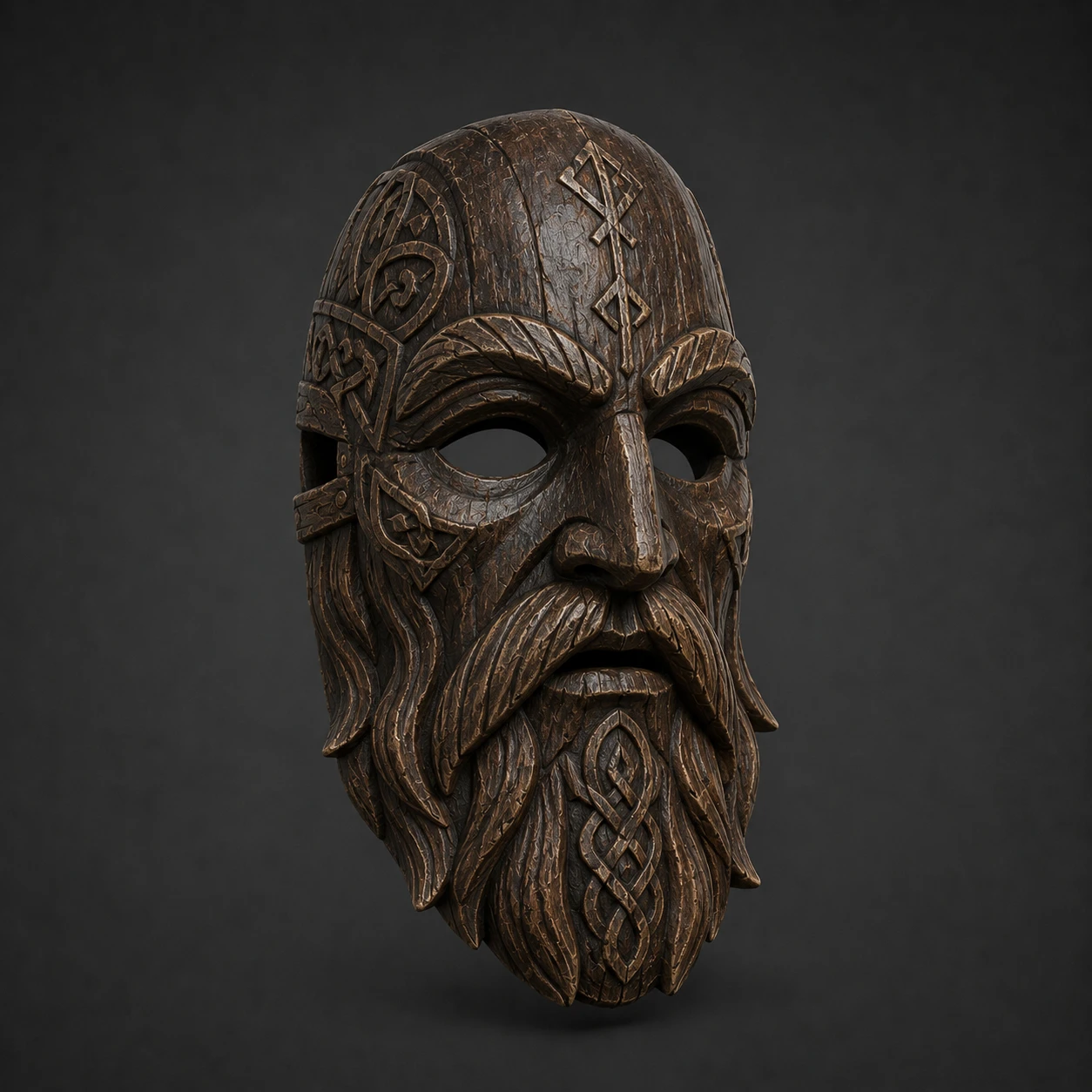
Hang a carved mask beside a raven totem post or above a blót altar where lamplight catches deep gouges in the wood. Treat it as ritual furniture, not casual clutter. Our Viking Ritual Relics pack includes a carved wooden mask sized for longhouse interiors and outdoor offering clearings.