Twenty-Square Board from the Royal Cemetery at Ur
When Leonard Woolley lifted the lid of a royal grave at Ur in the 1920s, the wood had already collapsed. What survived was a puzzle of shell and bitumen: twenty small squares pressed into the soil where a game board once lay face up. The Royal Game of Ur is that board tradition, also called the game of twenty squares. It is a two-player race on an inlaid wooden track, one of the oldest board games archaeologists can name from real pieces in the ground.
Twenty shell squares, rosettes, and the shoulder-board plan
The board is not a square chess grid. Britannica's survey of ancient board games describes a three-by-four block joined by a narrow bridge of two squares to a three-by-two block. That twenty-square path is the visual signature. Museum examples from Ur are low wooden boards with the playing face set in shell plaques. Some squares carry rosettes. Others show a ring of dots that curators read as an eye motif. The edges carry narrow strips of the same inlay work.
Players used separate pieces. Those counters rarely survive beside the board in the grave, so the wooden slab is what museums exhibit. The British Museum's catalogue describes the original board as wood with a drawer for pieces, a detail lost in the ground but preserved in the museum record. What you see in cases today is the inlaid track itself: a luxury object built to be handled, not a painted diagram on a wall.
From Early Dynastic graves to courts across Mesopotamia
Game boards of this type come from at least six royal graves at Ur, dated to the Early Dynastic III period, about 2600 to 2400 BCE. World History Encyclopedia's photograph caption notes boards of wood inlaid with shell, carnelian, and lapis lazuli, the last being among the most prized stones of the age. Woolley excavated them in the Royal Cemetery on behalf of the British Museum; the star pieces now live in London.
Britannica treats the Royal Game of Ur as one of the oldest known board games, originating in Mesopotamia around 2600 BCE and spreading through a city that was already a major urban centre. The name "royal" reflects the cemetery where the first famous boards appeared, not a rule that only kings could play. Elite graves held the inlaid sets.
Racing pieces in palace leisure time
Ancient Near Eastern board games mixed strategy and chance. Britannica's note on the game of twenty squares says the aim was to move your pieces along the path. World History Encyclopedia reproduces a British Museum cuneiform tablet with Akkadian text, a diagram of the twenty-square game, and squares tied to fortune telling. The colophon names Itti-Marduk-balatu and Seleucus IV; the tablet dates to about 177 BCE, in the late second century BCE, long after the Ur boards were buried, but it shows the game still had a name and a rule tradition in Mesopotamia.
In a palace or rich house, a board like this belonged to the same quiet hours as music and gossip. It was portable, social, and showy when inlaid with imported stone. Putting one in a royal tomb says something about the dead person's taste for crafted leisure, not only about cult.
How a shattered wood board survived the grave
Wood rots fast in Mesopotamian soil. Woolley's field notes, quoted on the British Museum object page, describe the face collapsing while edge strips stayed higher, trapping the shell inlay in the matrix left behind. Conservators rebuilt the profile you see in galleries. The back of the museum board still carries three rows of triangular red shell ornament set during modern reconstruction.
Replica boards and commercial sets followed once the Ur finds became famous. The British Museum catalogue itself mentions replica versions marketed from the late twentieth century onward. The ancient object and the modern game renaissance are different stories, but they share one hinge: a curator's later work on cuneiform instructions, discussed below.
BM 120834 on view in Room 56
The clearest single board to study is British Museum object ME 120834, registration 1928,1009.378, in the series titled The Royal Game of Ur. The museum dates it to 2600 to 2400 BCE, Early Dynastic III, and records excavation at the Royal Cemetery of Ur by Sir Leonard Woolley, field number U.9000. Materials are wood and shell, worked with inlay. Dimensions are 30.1 cm long, 11 cm wide at the broad end, 5.7 cm across the narrow bridge section, and 2.4 cm high.
The catalogue describes twenty square shell plaques on the face, some with rosettes, and edge strips with eye-like motifs. It is on display in Room 56 (Mesopotamia 6000 to 1500 BC), Display Case 16. If you visit, expect a low, shoulder-shaped track rather than a flat rectangle. Compare it with the photograph on World History Encyclopedia, which shows the same class of board exhibited in London: Early Dynastic III, about 2600 BCE, with the inlaid squares that make the game recognizable at a glance.
Reconstructed rules and what scholars still dispute
No rule sheet survived inside the royal graves. Play is known today because scholars matched boards to later cuneiform sources. The British Museum's One Hour at the Museum trail states that rules were lost until curator Irving Finkel decoded a tablet with instructions in the early 1980s. That is reconstruction from text, not a label on the wood. Modern players use several rule sets derived from those readings, and specialists still argue over details.
Do not treat any one reconstruction as the Sumerian original. The honest line for history writing is shorter: the board is Early Dynastic; the race layout is secure; the move list is inferred. Where sources disagree on board geometry or piece counts, say so. What remains solid is the object itself, a twenty-square inlaid track from a named grave at Ur, still on view under museum number 120834.
In your scene
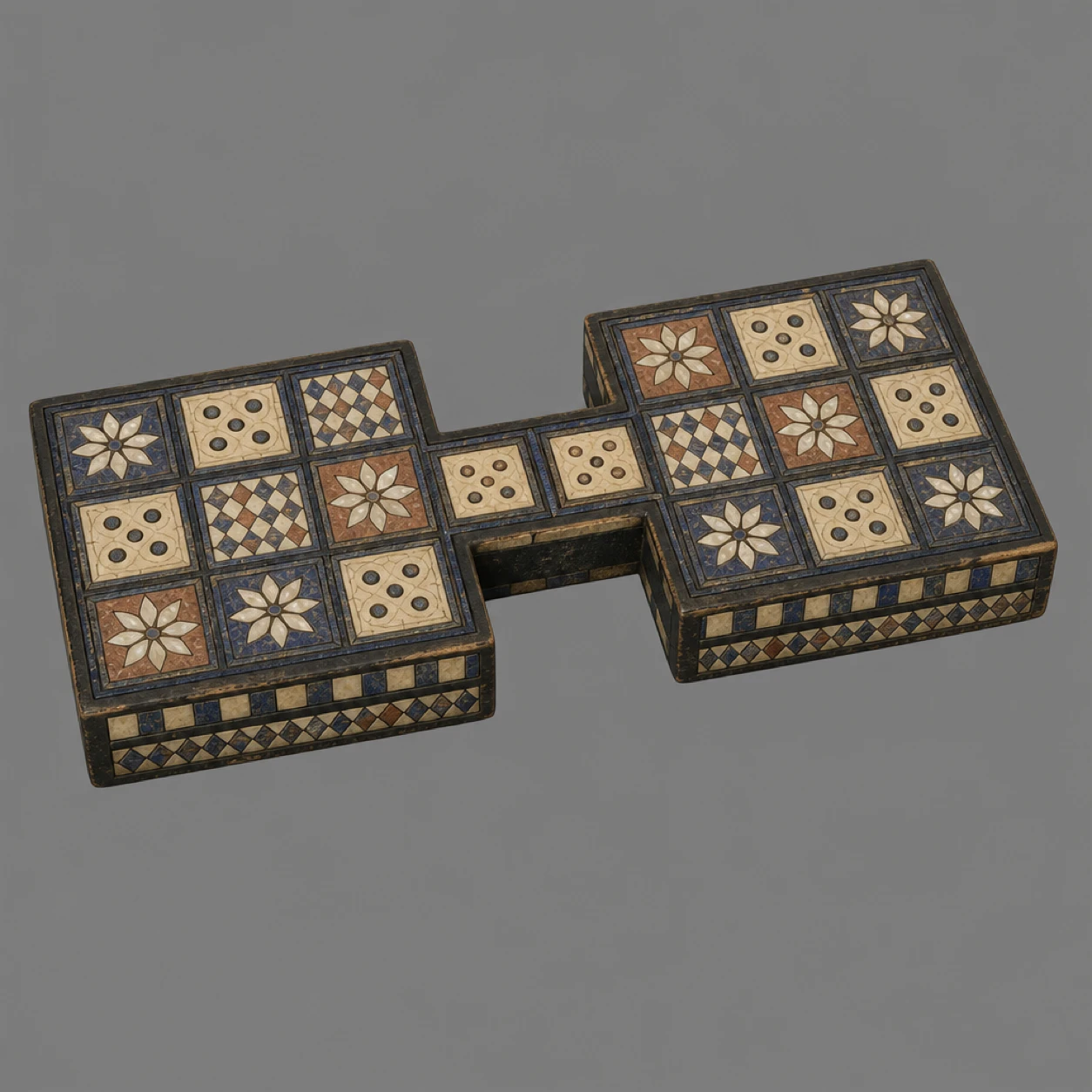
A Royal Game of Ur board reads as palace leisure, not battlefield gear. Place it low on a mat or stool between two seated players, with space for pieces off the board. Keep the shoulder-shaped plan and rosette squares visible. For matching Mesopotamian temple and palace props, see the Mesopotamian Temple Relics pack.
Sources
- British Museum: The Royal Game of Ur, ME 120834 (1928,1009.378)
- Encyclopaedia Britannica: Royal game of Ur
- World History Encyclopedia: The Royal Game of Ur (image)
- World History Encyclopedia: Rules for Playing the Royal Game of Ur (image)
- British Museum: One hour at the Museum (Royal Game of Ur, Room 56)